>
Gobiiformes (Gobies) >
Gobiidae (Gobies) > Gobiinae
Etymology: Benthophilus: Greek, benthos = depth of the sea + Greek, phyle, that loves (Ref. 45335).
More on author: Pallas.
Environment: milieu / climate zone / djupintervall / distribution range
Ekologi
; sötvatten bottenlevande; djupintervall 0 - 25 m (Ref. 59043). Temperate; 4°C - 20°C (Ref. 2059); 51°N - 38°N, 45°E - 57°E
Europe and Asia: Caspian Sea, along most coasts; Volga up to Astrakhan.
Size / Vikt / Age
Könsmognad: Lm ? range ? - ? cm
Max length : 11.6 cm TL hane/ej könsbestämd; (Ref. 2058)
Short description
Bestämningsnycklar | Morfologi | Morfometri
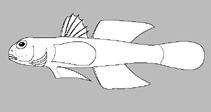
This species is distinguished from its congeners by the following characters: tubercles larger than granules, tubercles of equal size in dorsal row 24-26, ventral row 21-22, upper lateral row up to 20 but the lower one is usually absent; numerous granules, densely set and appearing as small spines covering head, back, flanks and caudal peduncle; a semicircular patch of granules along upper eye margin; chin barbel thick and conical; D1 III-IV; body plain grey (Ref. 59043).
Body shape (shape guide): elongated.
Inhabits shallow coastal waters and estuaries usually 0.5-10 m deep, over mud bottom; also in lower reaches or rivers. It is widely distributed but rare. During warm seasons, it prefers coastal waters; in northern Caspian Sea, it moves to deeper waters (20-25) in winter. This species lives for about a year. it forms schools during spawning season (April-July) over hard bottom with mollusc shells where females lay eggs in at least two portions. Feeds mostly on molluscs and fish (small gobies), also worms and crustaceans. (Ref.59043). Males are larger than females. Mature males become completely naked (Ref. 2058).
Life cycle and mating behavior
Könsmognad | Reproduktion | Lek | Ägg | Fecundity | Larver
Berg, L.S., 1965. Freshwater fishes of the U.S.S.R. and adjacent countries. volume 3, 4th edition. Israel Program for Scientific Translations Ltd, Jerusalem. (Russian version published 1949). (Ref. 2058)
IUCN Red List Status (Ref. 130435: Version 2025-1)
Threat to humans
Harmless
Human uses
Verktyg
Special reports
Download XML
Internet-källor
Estimates based on models
Phylogenetic diversity index (Ref.
82804): PD
50 = 0.5000 [Uniqueness, from 0.5 = low to 2.0 = high].
Bayesian length-weight: a=0.00724 (0.00339 - 0.01546), b=3.10 (2.92 - 3.28), in cm total length, based on LWR estimates for this (Sub)family-body shape (Ref.
93245).
Trofisk nivå (Ref.
69278): 3.3 ±0.4 se; based on size and trophs of closest relatives
Resiliens (Ref.
120179): Hög, lägsta populationsfördubblingstid mindre än 15 månader (Preliminary K or Fecundity.).
Fishing Vulnerability (Ref.
59153): Low vulnerability (10 of 100).
🛈