>
Carangaria/misc (Various families in series Carangaria) >
Latidae (Lates perches)
Etymology: Lates: Latin, lateo, latere = to be hidden.
More on author: Boulenger.
Environment: milieu / climate zone / εύρος βάθους / distribution range
Οικολογία
; Γλυκού νερού Πελαγικό(ά). Tropical; 24°C - 28°C (Ref. 2059); 3°S - 9°S
Africa: widely distributed in Lake Tanganyika (Ref. 36901) and present in the Malagarasi River delta (Ref. 54847).
Length at first maturity / Μέγεθος / Βάρος / Age
Γεννητική Ωρίμανση: Lm 51.0 range ? - ? cm
Max length : 93.0 cm TL αρσενικό/απροσδιόριστο; (Ref. 40637); μεγ. δημοσιευμένο βάρος: 8.3 kg (Ref. 4699)
Short description
Κλείδες προσδιορισμού | Μορφολογία | Μορφομετρία
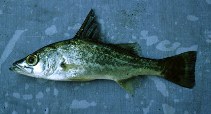
Caudal fin emarginate in juveniles.
Body shape (shape guide): fusiform / normal; Cross section: compressed.
Juveniles live in a specific inshore habitat until they reach 18 cm, thereafter it lives in the superficial pelagic zone; exclusively pelagic predator, feeding on clupeids and to a lesser extent on Luciolates; highly susceptible to intensive fishing (Ref. 2216). Oviparous (Ref. 205). Juveniles often found near river mouths, but not in the rivers (Ref. 36901). Also caught using handlines (Ref. 4967).
May breed in areas with plants (Ref. 205). Distinct pairing during breeding (Ref. 205). Oviparous (Ref. 205).
Coulter, G.W., 1976. The biology of Lates species in Lake Tanganyika, and the status of the pelagic fishery for Lates species and Luciolates stapersii. J. Fish Biol. 9(3):235-259. (Ref. 2216)
IUCN Red List Status (Ref. 130435: Version 2025-1)
Threat to humans
Harmless
Human uses
αλιεία: Εμπορικό(ά); αλιεία αναψυχής: ναί
Εργαλεία
Special reports
Download XML
Διαδικτυακές πηγές
Estimates based on models
Phylogenetic diversity index (Αναφ.
82804): PD
50 = 0.5005 [Uniqueness, from 0.5 = low to 2.0 = high].
Bayesian length-weight: a=0.00977 (0.00524 - 0.01822), b=3.01 (2.84 - 3.18), in cm total length, based on LWR estimates for this species & Genus-body shape (Ref.
93245).
Τροφικό Επίπεδο (Αναφ.
69278): 4.4 ±0.77 se; based on food items.
Generation time: 3.2 ( na - na) years. Estimated as median ln(3)/K based on 1
growth studies.
Ελαστικότητα (Αναφ.
120179): Μεσαίο(α), ελάχιστος χρόνος για διπλασιασμό πληθυσμού 1,4 - 4,4 έτη (tm=3-5).
Fishing Vulnerability (Ref.
59153): Moderate vulnerability (37 of 100).
🛈
Nutrients (Ref.
124155): Calcium = 145 [30, 322] mg/100g; Iron = 1.82 [0.81, 4.55] mg/100g; Protein = 19.9 [18.4, 21.6] %; Omega3 = 0.435 [0.169, 1.149] g/100g; Selenium = 141 [35, 444] μg/100g; VitaminA = 37.1 [8.2, 194.6] μg/100g; Zinc = 1.1 [0.5, 2.4] mg/100g (wet weight);