


上傳你的 相片 和 影像
照片 | Google 影像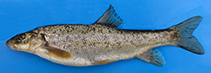 Barbus lacerta
拍攝者 Abbasi, K.
照片 | Google 影像
拍攝者 Abbasi, K.
分類 / 名稱 俗名 | 同種異名 | Catalog of Fishes(屬, 種) | ITIS | CoL | WoRMS | Cloffa
Teleostei > Cypriniformes (Carps) 鯉形目 (Carps) > Cyprinidae (Minnows or carps) 鯉科 (Minnows or carps) > Barbinae
Etymology: Barbus: Latin, barbus = barbel (Ref. 45335).
Eponymy: Sir Charles Alfred Payton (1843–1926) was a British adventurer, writer, fisherman and diplomat who was British Consul to Morocco, where this barb is found. [...] (Ref. 128868), visit book page.
More on author: Heckel.
Etymology: Barbus: Latin, barbus = barbel (Ref. 45335).
Eponymy: Sir Charles Alfred Payton (1843–1926) was a British adventurer, writer, fisherman and diplomat who was British Consul to Morocco, where this barb is found. [...] (Ref. 128868), visit book page.
More on author: Heckel.
環境: 環境 / 氣候帶 / 深度上下限 / 配送範圍 生態學
; 淡水 底中水層性. 溫帶
分布 領土 | FAO區域 | 生態系 | 發現紀錄 | 分布圖 | 簡介 | Faunafri
Asia: Euphrates and Tigris drainages.
歐洲與亞洲。
歐洲與亞洲。
大小 / 重量 / 年齡
簡短描述 檢索表 | 型態特徵 | 形態測量圖
Barbus lacerta is distinguished from other members of the Barbus lacerta group by having almost triangular gular region (vs. rectangular in other members of the B. lacerta group) and almost a longer anal fin; tip of the anal fin, when pressed to the body, reaches beyond the middle of the distance between the base of the last anal-fin ray and the lower caudal-fin origin, often to the caudal-fin base (vs. not reaching to middle of the distance); 0-3 (mode 2) scale rows between the tip of the anal fin and the base of the caudal fin (vs. 3-6, mode 5). It also differs from B. cyri by having a straight posterior anal-fin margin (vs. convex) and a narrow upper lip (its width 4-6 %HL vs. 7-9 % HL). Additional diagnostic characters include the following: long snout, its length 46-56% of body depth at dorsal-fin origin; eye diameter 2.5-3.1 times in snout length; 52-66+2-4 total scales along the lateral line; 35-48 (mode 39) predorsal scales; 25-32 (mode 28) circumpeduncular scales; length of caudal peduncle 1.7-2.0 times longer than depth; 60-70% of posterior margin of last unbranched dorsal-fin ray covered with denticles and median pad at lower lip small (Ref. 115584).
Body shape (shape guide): fusiform / normal.
Body shape (shape guide): fusiform / normal.
Inhabits rivers and lakes (Ref. 1441).
棲息於河川與湖泊。 (參考文獻 1441)
棲息於河川與湖泊。 (參考文獻 1441)
生命週期和交配行為 成熟度 | 繁殖 | 產卵場 | 卵 | 孕卵數 | 仔魚
歐洲與亞洲。
主要參考資料
上傳您的推薦信 | 參考文獻 | 合作者 | 合作者
Khaefi, R., H.R. Esmaeili, M.F. Geiger and S. Eagderi, 2017. Taxonomic review of the cryptic Barbus lacerta species group with description of a new species (Teleostei: Cyprinidae). FishTaxa 2(2):90-115. (Ref. 115584)
CITES
Not Evaluated
對人類具威脅
無害處的
人類使用
FAO - Publication: search | FishSource |
更多資訊
解剖學
鰓區
腦部
耳石
鰓區
腦部
耳石
生理學
身體成分
營養素
耗氧量
游泳類型
游泳速度
視覺色素
魚聲
疾病與寄生蟲
毒性 (LC50s)
身體成分
營養素
耗氧量
游泳類型
游泳速度
視覺色素
魚聲
疾病與寄生蟲
毒性 (LC50s)
遺傳學
基因組
遺傳學
異種性
遺傳率
遺傳多樣性
基因組
遺傳學
異種性
遺傳率
遺傳多樣性
工具
特別的報告
下載 XML
網路資源
AFORO (otoliths) | Aquatic Commons | BHL | Cloffa | Websites from users | 檢查 FishWatcher | CISTI | Catalog of Fishes: 屬, 種 | DiscoverLife | ECOTOX | FAO - Publication: search | Faunafri | Fishipedia | Fishtrace | GloBI | Google Books | Google Scholar | Google | IGFA World Record | 國家資料庫 | OneZoom | Open Tree of Life | Otolith Atlas of Taiwan Fishes | PubMed | Reef Life Survey | Socotra Atlas | TreeBase | 樹狀分類階層 | Wikipedia: 去, 搜尋 | World Records Freshwater Fishing | Zoobank | 動物學的記錄
基於模型的估計
系統發育多樣性指數 (參考文獻 82804): PD50 = 0.5000 [Uniqueness, from 0.5 = low to 2.0 = high].
Bayesian length-weight: a=0.00955 (0.00722 - 0.01264), b=2.98 (2.94 - 3.02), in cm total length, based on LWR estimates for this species (Ref. 93245).
營養階層 (參考文獻 69278): 3.1 ±0.4 se; based on size and trophs of closest relatives
Generation time: 11.7 ( na - na) years. Estimated as median ln(3)/K based on 2 growth studies.
回復力 (參考文獻 120179): 低的, 最小族群倍增時間4.5 - 14 年 (Preliminary K or Fecundity.).