>
Eupercaria/misc (Various families in series Eupercaria) >
Labridae (Wrasses) > Corinae
Etymology: Halichoeres: Greek, als, alis = salt + Greek, choiros = pig (Ref. 45335).
More on author: Bloch.
Environment: milieu / climate zone / rango de profundidad / distribution range
Ecología
marino asociado a arrecife; rango de profundidad 0 - 10 m (Ref. 9710). Tropical; 19°N - 12°S
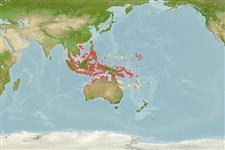
Western Central Pacific: Philippines to the Great Barrier Reef (Ref. 2334). Restricted to the Indo-Malayan region in the broad sense.
Tamaño / Peso / Age
Madurez: Lm ? range ? - ? cm
Max length : 19.0 cm SL macho / no sexado; (Ref. 9823)
Short description
Claves de identificación | Morfología | Morfometría
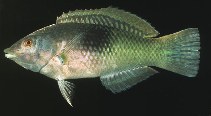
Espinas dorsales (total) : 9; Radios blandos dorsales (total) : 10 - 11; Espinas anales: 3; Radios blandos anales: 10 - 11; Vértebra: 25. Usually bright green in algae habitat, but pale or with longitudinal dark bands on plain rubble (Ref. 48636). Head of male with intricate reticulate pattern of bands that varies from one individual to another; small blackish spot on anus. Juveniles and females with dark dots dorsally and posteriorly; these are lost in males. Anterior lateral line scales with 1-3 pores; 8-13 suborbital pores. Anterior dorsal and anal soft rays longer than posterior rays; male pelvic fins not reaching the anus.
Body shape (shape guide): fusiform / normal; Cross section: compressed.
Inhabits shallow protected coral reefs and nearby silty sand and rubble bottoms (Ref. 2334). Feeds mainly on hard-shelled prey, including mollusks, crustaceans and sea urchins (Ref. 9823).
Life cycle and mating behavior
Madurez | Reproducción | Puesta | Huevos | Fecundidad | Larva
Distinct pairing during breeding (Ref. 205).
Randall, J.E., G.R. Allen and R.C. Steene, 1990. Fishes of the Great Barrier Reef and Coral Sea. University of Hawaii Press, Honolulu, Hawaii. 506 p. (Ref. 2334)
IUCN Red List Status (Ref. 130435: Version 2025-1)
Threat to humans
Harmless
Human uses
Pesquerías: escaso valor comercial; Acuario: Comercial
Herramientas
Special reports
Download XML
Fuentes de Internet
Estimates based on models
Preferred temperature (Referencia
123201): 28 - 29.3, mean 28.8 °C (based on 1830 cells).
Phylogenetic diversity index (Referencia
82804): PD
50 = 0.5000 [Uniqueness, from 0.5 = low to 2.0 = high].
Bayesian length-weight: a=0.00741 (0.00426 - 0.01291), b=3.02 (2.87 - 3.17), in cm total length, based on LWR estimates for this species & Genus-body shape (Ref.
93245).
Nivel trófico (Referencia
69278): 3.4 ±0.40 se; based on food items.
Resiliencia (Referencia
120179): Medio, población duplicada en un tiempo mínimo de 1.4-4.4 años (Preliminary K or Fecundity.).
Fishing Vulnerability (Ref.
59153): Low vulnerability (13 of 100).
🛈
Nutrients (Ref.
124155): Calcium = 77 [45, 131] mg/100g; Iron = 0.659 [0.374, 1.246] mg/100g; Protein = 18.5 [15.7, 20.7] %; Omega3 = 0.132 [0.082, 0.207] g/100g; Selenium = 18.9 [11.0, 35.0] μg/100g; VitaminA = 148 [44, 557] μg/100g; Zinc = 1.7 [1.2, 2.7] mg/100g (wet weight);