Elasmobranchii (haaien en roggen) (sharks and rays) >
Rajiformes (Skates and rays) >
Rajidae (Skates)
Etymology: Raja: Latin, raja, -ae = a sting ray (Raja sp.) (Ref. 45335).
More on author: Linnaeus.
Environment: milieu / Klimaatzone / Diepte / distribution range
Ecologie
marien; brak water demersaal; diepte 17 - 462 m (Ref. 56504), usually 50 - 150 m (Ref. 27121). Subtropical; 44°N - 35°S
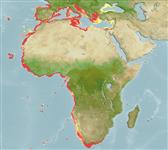
Northeast Atlantic: from Spain (Bay of Biscay) to Morocco and Madiera, including the Mediterranean Sea.
Lengte bij maturiteit / Grootte / Gewicht / Leeftijd
Maturiteit: Lm ?, range 44 - ? cm
Max length : 63.0 cm TL mannelijk / geslacht onbekend; (Ref. 39256); 59.7 cm TL (female); common length : 35.0 cm TL mannelijk / geslacht onbekend; (Ref. 2683)
Korte beschrijving
Determinatiesleutels | Morfologie | Morfometrie
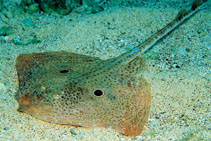
Dorsale stekels (totaal) : 0; Anale stekels: 0. Snout short and bluntly pointed; disc angular (Ref. 5578). Upper surface prickly only in young, nearly smooth in adults, underside smooth (Ref. 3167). Upper surface ochre to reddish-brown with scattered dark spots, underside white (Ref. 3167); two bright blue eyespots centered on the pectoral bases (Ref. 5578); may have a small dark spot on tip of snout (Ref. 2708).
Body shape (shape guide): other; Cross section: flattened.
Found over soft bottoms of the shelf and the uppermost slope (Ref. 5578). Depth range from 17-300 m, and up to depth of 462 m in the eastern Ionian Sea (Ref. 56504). Feed on all kinds of benthic animals, also on fish offal (Ref. 5578). Oviparous. Distinct pairing with embrace. Young may tend to follow large objects, such as their mother (Ref. 205). Eggs are oblong capsules with stiff pointed horns at the corners deposited in sandy or muddy flats (Ref. 205). Egg capsules are 4.2-4.6 cm long and 2.7-2.9 cm wide (Ref. 41250). About 40-72 eggs are lain by an individual in a year (Ref. 41250). Caught by ski-boat anglers (Ref. 5578).
Oviparous, paired eggs are laid. Embryos feed solely on yolk (Ref. 50449). With egg-cases laid from spring to summer (Ref. 3167). Distinct pairing with embrace. Young may tend to follow large objects, such as their mother (Ref. 205).
McEachran, J.D. and K.A. Dunn, 1998. Phylogenetic analysis of skates, a morphologically conservative clade of elasmobranchs (Chondrichthyes: Rajidae). Copeia 1998(2):271-290. (Ref. 27314)
Status op de Rode Lijst van het IUCN (Ref. 130435: Version 2025-1)
Gevaar voor de mens
Harmless
Gebruik door de mens
Visserij: commercieel; sportvis: ja
Tools
Speciale rapporten
Download XML
Internetbronnen
Estimates based on models
Preferred temperature (Ref.
123201): 13.1 - 25.6, mean 17.6 °C (based on 383 cells).
Fylogenetische diversiteitsindex (Ref.
82804): PD
50 = 0.5000 [Uniqueness, from 0.5 = low to 2.0 = high].
Bayesian length-weight: a=0.00182 (0.00152 - 0.00219), b=3.27 (3.24 - 3.30), in cm total length, based on LWR estimates for this species (Ref.
93245).
Trofisch niveau (Ref.
69278): 3.7 ±0.6 se; based on diet studies.
Generation time: 6.5 ( na - na) years. Estimated as median ln(3)/K based on 2
growth studies.
Weerstandsvermogen (Ref.
120179): laag, minimale populatieverdubbelingstijd 4,5-14 jaar (Fec assumed to be <100).
Fishing Vulnerability (Ref.
59153): Moderate to high vulnerability (51 of 100).
🛈
Nutrients (Ref.
124155): Calcium = 14.6 [1.8, 262.7] mg/100g; Iron = 0.723 [0.068, 8.569] mg/100g; Protein = 17.4 [14.6, 19.7] %; Omega3 = 0.651 [0.282, 1.514] g/100g; Selenium = 27.2 [5.1, 132.3] μg/100g; VitaminA = 5.9 [0.6, 60.8] μg/100g; Zinc = 0.601 [0.041, 6.724] mg/100g (wet weight);