


Polypterus senegalus Cuvier, 1829
Gray bichir
Uploaden van uw Foto's en video's
Afbeeldingen | Google afbeelding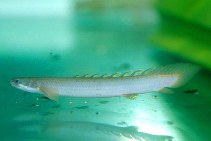 Polypterus senegalus
Afbeelding van JJPhoto
Afbeeldingen | Google afbeelding
Afbeelding van JJPhoto
Classificatie / Namen Lokale namen | Synoniemen | Catalog of Fishes(Genus, Soort(en)) | ITIS | CoL | WoRMS | Cloffa
> Polypteriformes (Bichirs) > Polypteridae (Bichirs)
Etymology: Polypterus: Greek, poly = a lot of + Greek, pteron = wing, fin (Ref. 45335).
More on author: Cuvier.
Etymology: Polypterus: Greek, poly = a lot of + Greek, pteron = wing, fin (Ref. 45335).
More on author: Cuvier.
Milieu: milieu / Klimaatzone / Diepte / verspreidingsgebied Ecologie
; zoet water demersaal; pH range: 6.0 - 8.0; dH range: 5 - 19; potamodroom (Ref. 51243). Tropical; 25°C - 28°C (Ref. 2060); 16°N - 2°S, 17°W - 37°E
Verspreiding Gebieden | FAO regio's | Ecosystemen | Voorkomen | Verspreidingskaart | Introducties | Faunafri
Africa: subspecies Polypterus senegalus senegalus known from West Africa, in Senegal, Gambia, Niger, Volta and Chad basins (Ref. 2835, 3188, 81263), up to Nile River basin (Ref. 2835, 3188) and lakes Turkana (Ref. 3188) and Albert (Ref. 41590, 48922, 48960). Subspecies Polypterus senegalus meridionalis known from middle and upper Congo River basin (Ref. 2835, 3188, 4910, 45434).
Lengte bij maturiteit / Grootte / Gewicht / Leeftijd
Maturiteit: Lm 19.0, range 15 - 23 cm
Max length : 70.0 cm SL mannelijk / geslacht onbekend; (Ref. 3188); max. gepubliceerd gewicht: 207.00 g (Ref. 3013)
Max length : 70.0 cm SL mannelijk / geslacht onbekend; (Ref. 3188); max. gepubliceerd gewicht: 207.00 g (Ref. 3013)
Korte beschrijving Determinatiesleutels | Morfologie | Morfometrie
Dorsale stekels (totaal) : 8 - 11; Anale stekels: 14 - 17; Wervels: 53 - 59. Diagnosis: Polypterus senegalus is characterized by jaws of equal length or an upper jaw slightly longer than lower jaw and a pectoral fin not reaching the first dorsal ray (Ref. 2756, 2835, 42908, 43035, 81263).
Body shape (shape guide): elongated; Cross section: circular.
Body shape (shape guide): elongated; Cross section: circular.
Facultative air-breathing (Ref. 126274); This species inhabits marginal swamps and freshwater lagoons (Ref. 3066) and it appears to favor sheltered inshore habitats (Ref. 3034); it inhabits the muddy regions at the sides of rivers and swampy waters, where it lies quiet or glides about with snake-like movements (Ref. 49805). During the hottest hours of the day, it comes to the surface just on the outer edge of the vegetation, and it goes back to the bottom when disturbed (Ref. 45962). It feeds on insects, crustaceans, mollusks, frogs and fishes (Ref. 4903, Ref. 28714). Polypterus senegalus senegalus is mainly insectivorous (Ref. 367). Longevity of Polypterus senegalus in captivity can be 34 years and more (Ref. 48954).
Larval fish 1.1-3.8 cm SL were found in papyrus root mat and juveniles up to 10 cm SL retaining external gills were found in fringing water hyacinth. Feeds mainly on fishes (Ref. 9695), insects, crustaceans, mollusks, frogs as well as on plant fragments and seeds.
Levenscyclus en paargedrag Maturiteit | Voortplanting | Paaien | Eieren | Fecunditeit | Larven
In Polypterus senegalus courtship starts with a series of leaps from the surface by usually only one of the pair at a time, followed by a slow descent through the water; after a while the male stays very close to the female and at times the female will remain motionless in the water and the male will come up to her from behind and nudge her with sidewise movements of his head; the enlarged and swollen anal fin of the male is folded in a cup-like fashion and is used to brush the female (Ref. 42791). No nest is constructed, but the eggs are laid a few at a time throughout the thick vegetation (Ref. 42791). The larvae, which move about with the male parent in a dense school, are provided with accessory gills and appear very salamander-like (Ref. 42791).
Hoofdreferentie
Upload uw referenties | Referenties | Coördinator | Medewerkers
Gosse, J.P. and J. Daget, 2003. Polypteridae. p. 101-112. In D. Paugy, C. Lévêque and G.G Teugels (eds.) The fresh and brackish water fishes of West Africa Volume 1. Coll. faune et flore tropicales 40. Institut de recherche de développement, Paris, France, Muséum national d'histoire naturelle, Paris, France and Musée royal de l'Afrique Central, Tervuren, Belgium, 457p. (Ref. 81263)
Status op de Rode Lijst van het IUCN (Ref. 130435: Version 2025-2 (Global))
Niet bedreigd (LC) ; Date assessed: 07 June 2019
CITES
Not Evaluated
Gevaar voor de mens
Harmless
Gebruik door de mens
Visserij: commercieel
FAO - Publication: search | FishSource |
Meer informatie
Trofische ecologie
Voedsel (prooien)
Dieetsamenstelling
Voedselconsumptie
Voedselrantsoenen
Predatoren
Voedsel (prooien)
Dieetsamenstelling
Voedselconsumptie
Voedselrantsoenen
Predatoren
Populatiedynamica
Groeiparameters
Max. leeftijden / maten
Lengte-gewicht rel.
Lengte-lengte rel.
Lengtefrequenties
Massaconversie
Rekrutering
Abundantie
Groeiparameters
Max. leeftijden / maten
Lengte-gewicht rel.
Lengte-lengte rel.
Lengtefrequenties
Massaconversie
Rekrutering
Abundantie
Levenscyclus
Voortplanting
Maturiteit
Rijpheid/kieuwen rel.
Fecunditeit
Paaien
Paaibestanden
Eieren
Ontwikkeling van de eieren
Larven
Larvale populatiedynamiek
Voortplanting
Maturiteit
Rijpheid/kieuwen rel.
Fecunditeit
Paaien
Paaibestanden
Eieren
Ontwikkeling van de eieren
Larven
Larvale populatiedynamiek
Anatomie
Kieuwoppervlak
Hersenen
Otoliet
Kieuwoppervlak
Hersenen
Otoliet
Fysiologie
Lichaamssamenstelling
Voedingsstoffen
Zuurstofverbruik
Type zwemmen
Zwemsnelheid
Visuele pigmenten
Vis geluid
Ziekten en parasieten
Toxiciteit (LC50)
Lichaamssamenstelling
Voedingsstoffen
Zuurstofverbruik
Type zwemmen
Zwemsnelheid
Visuele pigmenten
Vis geluid
Ziekten en parasieten
Toxiciteit (LC50)
Menselijk gerelateerd
Aquacultuursystemen
Aquacultuurprofielen
Kweeklijnen
Ciguatera gevallen
Postzegels, munten, diversen.
Aquacultuursystemen
Aquacultuurprofielen
Kweeklijnen
Ciguatera gevallen
Postzegels, munten, diversen.
Tools
Biologische quiz | E-boek | Veldgids | Determinatiesleutels | Lengtefrequentie Tool | Levenscyclus tool | Verspreidingskaart |
Vangst-MSY |
Speciale rapporten
Bekijk gegevens voor het houden in een aquarium | Bekijk Fact Sheets voor de soort | Bekijk Aquacultuur Fact Sheets
Download XML
Internetbronnen
AFORO (otoliths) | Aquatic Commons | BHL | Cloffa | Websites from users | Bekijk FishWatcher | CISTI | Catalog of Fishes: Genus, Soort(en) | DiscoverLife | ECOTOX | FAO - Publication: search | Faunafri | Fishipedia | Fishtrace | GloBI | Google Books | Google Scholar | Google | IGFA World Record | OneZoom | Open Tree of Life | Otolith Atlas of Taiwan Fishes | Publieke aquaria | PubMed | Reef Life Survey | Socotra Atlas | TreeBase | Tree of Life | Wikipedia: ga naar, zoek | World Records Freshwater Fishing | Zoobank | Zoological Record
Schattingen op basis van modellen
|
Fylogenetische diversiteitsindex (Ref. 82804) |
PD50 = 0.5003 [Uniqueness, from 0.5 = low to 2.0 = high]. |
| Bayesian length-weight | a=0.00457 (0.00320 - 0.00653), b=2.99 (2.90 - 3.08), in cm total length, based on LWR estimates for this species (Ref. 93245). |
|
Trofisch niveau (Ref. 69278) |
3.5 ±0.2 se; based on diet studies. |
|
Weerstandsvermogen (Ref. 120179) |
laag, minimale populatieverdubbelingstijd 4,5-14 jaar (tmax=34 in Aquarium; Fec < 1,000). |
|
Kwetsbaarheid van de visserij (Ref. 59153) |
Moderate vulnerability (40 of 100). 🛈 |
|
Prijsklasse (Ref. 80766) |
Unknown. |
|
Voedingsstoffen (Ref. 124155) |
Calcium = 124 [54, 216] mg/100g; Iron = 1.39 [0.84, 2.25] mg/100g; Protein = 18.1 [17.1, 19.2] %; Omega3 = 0.27 [0.11, 0.64] g/100g; Selenium = 76.3 [34.4, 176.1] μg/100g; VitaminA = 18.8 [7.8, 43.0] μg/100g; Zinc = 1.38 [0.99, 1.92] mg/100g (wet weight); |