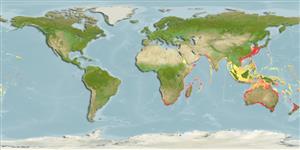
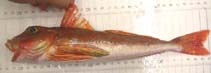
Environment: milieu / climate zone / intervalo de profundidade / distribution range
Ecologia
marinhas; estuarina demersal; intervalo de profundidade 1 - 200 m (Ref. 4316), usually 75 - 150 m (Ref. 33616). Subtropical; 34°N - 43°S, 15°E - 154°W
Indo-West Pacific: Delagoa Bay, Mozambique to the Cape, South Africa; common in Australia and New Zealand and reported from Japan and Korea. Also reported from Hong Kong (Ref. 12086).
Length at first maturity / Tamanho / Peso / Idade
Maturidade: Lm 21.2 range ? - ? cm
Max length : 60.0 cm TL macho/indeterminado; (Ref. 4316); common length : 40.0 cm TL macho/indeterminado; (Ref. 9258); peso máx. Publicado: 1.5 kg (Ref. 9988); Idade máx. registada: 15 anos (Ref. 9072)
Descrição breve
Chaves de identificação | Morfologia | Morfometria
Espinhos dorsais (total) : 9 - 10; Raios dorsais moles (total) : 15 - 16; Espinhos anais: 0; Raios anais moles: 14 - 16; Vértebras: 33 - 35. Olive or brownish in color, becomes red when stressed; lower half of the inner part of pectoral fin with large black blotch surrounded by numerous pale spots (Ref. 9771).
Body shape (shape guide): elongated.
Found from estuaries to edge of continental shelves over sand and sandy shell seabed (Ref. 9258). Reported to be often found in rivers (Ref. 4316). Juveniles may occur in bays (Ref. 33616). Benthic (Ref. 58302). Dorsal spine reported to be venomous (Ref. 9771). Neither anterolateral glandular grooves nor venom gland is present (Ref. 57406). Current information in the table (dangerous fish) do not match; needs verification. Excellent food fish (Ref. 9771). Utilized fresh and frozen; eaten pan-fried, broiled, microwaved and baked (Ref. 9988).
Heemstra, P.C., 1986. Triglidae. p. 486-488. In M.M. Smith and P.C. Heemstra (eds.) Smiths' sea fishes. Springer-Verlag, Berlin. (Ref. 4316)
Categoria na Lista Vermelha da IUCN (Ref. 130435: Version 2025-1)
Utilização humana
Pescarias: espécies comerciais
Ferramentas
Relatórios especiais
Descarregue XML
Fontes da internet
Estimates based on models
Preferred temperature (Ref.
123201): 13.3 - 25, mean 19.3 °C (based on 186 cells).
Phylogenetic diversity index (Ref.
82804): PD
50 = 0.5010 [Uniqueness, from 0.5 = low to 2.0 = high].
Bayesian length-weight: a=0.00776 (0.00407 - 0.01480), b=3.07 (2.90 - 3.24), in cm total length, based on LWR estimates for this species & (Sub)family-body (Ref.
93245).
Nível Trófico (Ref.
69278): 3.7 ±0.57 se; based on food items.
Generation time: 2.7 (1.9 - 3.0) years. Estimated as median ln(3)/K based on 10
growth studies.
Resiliência (Ref.
120179): Baixo, tempo mínimo de duplicação da população 4,5 - 14 anos (K=0.4-0.6; tm=2-3; tmax=15;).
Prior r = 0.36, 95% CL = 0.24 - 0.55, Based on 1 data-limited stock assessment.
Fishing Vulnerability (Ref.
59153): Low to moderate vulnerability (29 of 100).
🛈
Climate Vulnerability (Ref.
125649): Moderate to high vulnerability (45 of 100).
🛈
Nutrients (Ref.
124155): Calcium = 88.2 [46.4, 215.9] mg/100g; Iron = 1.09 [0.59, 2.04] mg/100g; Protein = 19.3 [18.0, 20.7] %; Omega3 = 0.381 [0.173, 1.076] g/100g; Selenium = 41.3 [20.5, 90.6] μg/100g; VitaminA = 7.38 [2.92, 18.85] μg/100g; Zinc = 0.753 [0.531, 1.080] mg/100g (wet weight); based on
nutrient studies.