


Borostomias elucens (Brauer, 1906)
把你的觀察加入 Fish Watcher
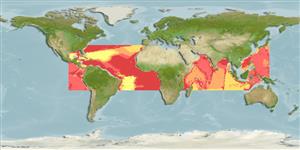
| Native range | All suitable habitat | Point map | Year 2050 |
|
| This map was computer-generated and has not yet been reviewed. |
| Borostomias elucens AquaMaps Data sources: GBIF OBIS |
分類 / 名稱 俗名 | 同種異名 | Catalog of Fishes(屬, 種) | ITIS | CoL | WoRMS | Cloffa
Teleostei > Stomiiformes (Lightfishes and dragonfishes) 巨口魚目 (Lightfishes and dragonfishes) > Stomiidae (Barbeled dragonfishes) 巨口魚科 (Barbeled dragonfishes) > Astronesthinae
Etymology: Borostomias: Greek, boros, -a, -on = gluttonous + Greek, stomías, -ou = a tough, hard -mouthed horse (Ref. 45335).
Etymology: Borostomias: Greek, boros, -a, -on = gluttonous + Greek, stomías, -ou = a tough, hard -mouthed horse (Ref. 45335).
環境: 環境 / 氣候帶 / 深度上下限 / 配送範圍 生態學
海洋 深海區的; 深度上下限 500 - 2500 m (Ref. 58018). 深水域; 36°N - 18°S, 98°W - 143°E
分布 領土 | FAO區域 | 生態系 | 發現紀錄 | 分布圖 | 簡介 | Faunafri
Eastern Atlantic: Madeira south to Angola. Western Atlantic: Gulf of Mexico and western Caribbean Sea. One specimen collected off the Guianas (Ref. 13608). Elsewhere, Indian and Pacific oceans.
東大西洋: 馬得拉群島南至安哥拉。 西大西洋: 墨西哥灣與加勒比海西部海洋。 一件標本收集了於圭亞那外。 (參考文獻 13608) 其他地方,印度洋與太平洋。
東大西洋: 馬得拉群島南至安哥拉。 西大西洋: 墨西哥灣與加勒比海西部海洋。 一件標本收集了於圭亞那外。 (參考文獻 13608) 其他地方,印度洋與太平洋。
大小 / 重量 / 年齡
簡短描述 檢索表 | 型態特徵 | 形態測量圖
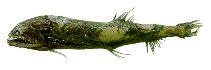
背棘 (總數) : 0; 背的軟條 (總數) : 15; 臀棘: 0; 臀鰭軟條: 16 - 17. Teeth on maxilla 7. POSTORB single. AC greatly arched behind the anal fin base. Stem of barbel black; the distal end forming a small, spherical white bulb lacking filaments (Ref. 559). Body moderately slender and elongate. Serial photophores not broken in small groups. Black in color (Ref. 37039).
Body shape (shape guide): elongated; Cross section: compressed.
牙齒在顎骨 7 。 POSTORB 單個。 AC 非常弓形在後臀鰭基底。 觸鬚黑色的莖; 末端形成一個小的, 圓球狀的白色球莖缺乏絲狀突起.(參考文獻 559) 身體一般細長與細長的。 不斷掉的形成小群魚群的序列發光器。 黑色的.(參考文獻 37039)
Body shape (shape guide): elongated; Cross section: compressed.
牙齒在顎骨 7 。 POSTORB 單個。 AC 非常弓形在後臀鰭基底。 觸鬚黑色的莖; 末端形成一個小的, 圓球狀的白色球莖缺乏絲狀突起.(參考文獻 559) 身體一般細長與細長的。 不斷掉的形成小群魚群的序列發光器。 黑色的.(參考文獻 37039)
Quite common in deep oceanic waters, usually living deeper than 500 m during the day. Smaller individuals migrate to near-surface or even surface waters at night. Feeds on midwater fishes and crustaceans (Ref. 2802).
相當常見於深的大洋性水域, 通常在白天期間的活深度超過 500 公尺。 較小的個體迴游到近表面的或平坦的水表面在晚上。 吃中層水域魚與甲殼動物。 (參考文獻 2802)
相當常見於深的大洋性水域, 通常在白天期間的活深度超過 500 公尺。 較小的個體迴游到近表面的或平坦的水表面在晚上。 吃中層水域魚與甲殼動物。 (參考文獻 2802)
生命週期和交配行為 成熟度 | 繁殖 | 產卵場 | 卵 | 孕卵數 | 仔魚
東大西洋: 馬得拉群島南至安哥拉。 西大西洋: 墨西哥灣與加勒比海西部海洋。 一件標本收集了於圭亞那外。 (參考文獻 13608) 其他地方,印度洋與太平洋。
主要參考資料
上傳您的推薦信 | 參考文獻 | 合作者 | 合作者
Gibbs, R.H. Jr., 1990. Astronesthidae. p. 300-307. In J.C. Quero, J.C. Hureau, C. Karrer, A. Post and L. Saldanha (eds.) Check-list of the fishes of the eastern tropical Atlantic (CLOFETA). JNICT, Lisbon; SEI, Paris and UNESCO, Paris. Vol. 1. (Ref. 4465)
CITES
Not Evaluated
對人類具威脅
無害處的
人類使用
FAO - Publication: search | FishSource |
更多資訊
解剖學
鰓區
腦部
耳石
鰓區
腦部
耳石
生理學
身體成分
營養素
耗氧量
游泳類型
游泳速度
視覺色素
魚聲
疾病與寄生蟲
毒性 (LC50s)
身體成分
營養素
耗氧量
游泳類型
游泳速度
視覺色素
魚聲
疾病與寄生蟲
毒性 (LC50s)
遺傳學
基因組
遺傳學
異種性
遺傳率
遺傳多樣性
基因組
遺傳學
異種性
遺傳率
遺傳多樣性
工具
特別的報告
下載 XML
網路資源
AFORO (otoliths) | Aquatic Commons | BHL | Cloffa | Websites from users | 檢查 FishWatcher | CISTI | Catalog of Fishes: 屬, 種 | DiscoverLife | ECOTOX | FAO - Publication: search | Faunafri | Fishipedia | Fishtrace | GloBI | Google Books | Google Scholar | Google | IGFA World Record | 國家資料庫 | OneZoom | Open Tree of Life | Otolith Atlas of Taiwan Fishes | PubMed | Reef Life Survey | Socotra Atlas | TreeBase | 樹狀分類階層 | Wikipedia: 去, 搜尋 | World Records Freshwater Fishing | 動物學的記錄
基於模型的估計
首選溫度 (參考文獻 123201): 3.7 - 8, mean 5.2 °C (based on 724 cells).
系統發育多樣性指數 (參考文獻 82804): PD50 = 0.5156 [Uniqueness, from 0.5 = low to 2.0 = high].
Bayesian length-weight: a=0.00407 (0.00167 - 0.00996), b=3.05 (2.83 - 3.27), in cm total length, based on LWR estimates for this (Sub)family-body shape (Ref. 93245).
營養階層 (參考文獻 69278): 4.0 ±0.67 se; based on food items.
回復力 (參考文獻 120179): 中等的, 族群倍增時間最少 1.4 - 4.4年 (Preliminary K or Fecundity.).