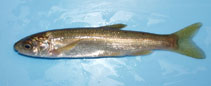
Classification / Names
Populärnamn | synonymer | Catalog of Fishes(Släkte, Arter) | ITIS | CoL | WoRMS | Cloffa
>
Cypriniformes (Carps) >
Leuciscidae (Minnows) > Leuciscinae
Etymology: Pseudochondrostoma: Name refers to its morphological similarity with the genus Chondrostoma as a consequence of homoplasy in multiple traits.
Environment: milieu / climate zone / djupintervall / distribution range
Ekologi
; sötvatten bentopelagisk. Temperate
Europe: Iberian Peninsula from Douro drainage to Galicia.
Size / Vikt / Age
Könsmognad: Lm ? range ? - ? cm
Max length : 40.0 cm SL hane/ej könsbestämd; (Ref. 59043)
Short description
Bestämningsnycklar | Morfologi | Morfometri
Diagnosed from its congeners by having the following characters: slightly arched lower jaw edge; 60-70 + 3-4 scales on lateral line; anal fin usually with 8½ branched rays; 18-24 gill rakers; 5-5 pharyngeal teeth; caudal peduncle depth 1.9-2.1 times in its length; and upper half of body with numerous small black dots for individuals from Portugal and Galicia (Ref. 59043).
Body shape (shape guide): elongated.
Found in the middle stretches of rivers, in areas with current. Feeds on vegetal matter, supplemented by small invertebrates and detritus. Occurs in groups, especially during prespawning migration. Spawns from April to June. (Ref. 59043).
Life cycle and mating behavior
Könsmognad | Reproduktion | Lek | Ägg | Fecundity | Larver
Kottelat, M. and J. Freyhof, 2007. Handbook of European freshwater fishes. Publications Kottelat, Cornol and Freyhof, Berlin. 646 pp. (Ref. 59043)
IUCN Red List Status (Ref. 130435: Version 2025-1)
Threat to humans
Harmless
Human uses
Verktyg
Special reports
Download XML
Internet-källor
Estimates based on models
Phylogenetic diversity index (Ref.
82804): PD
50 = 0.6250 [Uniqueness, from 0.5 = low to 2.0 = high].
Bayesian length-weight: a=0.00813 (0.00374 - 0.01767), b=3.10 (2.92 - 3.28), in cm total length, based on LWR estimates for this (Sub)family-body shape (Ref.
93245).
Trofisk nivå (Ref.
69278): 2.5 ±0.2 se; based on size and trophs of closest relatives
Resiliens (Ref.
120179): Låg, lägsta populationsfördubblingstid 4,5-14 år (Preliminary K or Fecundity.).
Fishing Vulnerability (Ref.
59153): Moderate vulnerability (39 of 100).
🛈