


Serranochromis jallae (Boulenger, 1896)
Nembwe
Tải lên của bạn hình ảnh Và Video
Các tranh (Ảnh) | Google image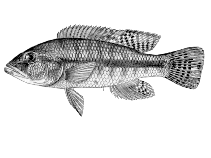 Serranochromis jallae
Hình ảnh của Mertens, P.
Các tranh (Ảnh) | Google image
Hình ảnh của Mertens, P.
Phân loại / Tên Tên thường gặp | Các synonym ( Các tên trùng) | Catalog of Fishes(Giống, Các loài) | ITIS | CoL | WoRMS | Cloffa
> Cichliformes (Cichlids, convict blennies) > Cichlidae (Cichlids) > Pseudocrenilabrinae
Etymology: Serranochromis: Latin, serra = saw + Greek, chromis = a fish, perhaps a perch (Ref. 45335).
Eponymy: Rev. Luigi (Louis) David Jalla (1860–1943) was an Italian protestant missionary for the Société des Missions Évangeliques, Paris. He was ordained (1886) and sent to Africa, being in Northern Rhodesia (Zambia) and Southern Rhodesia [...] (Ref. 128868), visit book page.
More on author: Boulenger.
Etymology: Serranochromis: Latin, serra = saw + Greek, chromis = a fish, perhaps a perch (Ref. 45335).
Eponymy: Rev. Luigi (Louis) David Jalla (1860–1943) was an Italian protestant missionary for the Société des Missions Évangeliques, Paris. He was ordained (1886) and sent to Africa, being in Northern Rhodesia (Zambia) and Southern Rhodesia [...] (Ref. 128868), visit book page.
More on author: Boulenger.
Môi trường: môi trường / vùng khí hậu / Mức độ sâu / phạm vi phân phối Sinh thái học
; nước ngọt gần đáy. Tropical
Sự phân bố Lãnh thổ | Các khu vực của FAO | Các hệ sinh thái | Những lần xuất hiện | Bản đồ điểm | Những chỉ dẫn | Faunafri
Africa: Okavango, upper Zambezi, Kafue, Kasai and Zambian Congo systems (Ref. 11970, 13332, 94654, 97233, 97235, 128638), including upper Lualaba in Democratic Republic of the Congo (Ref. 97233) and Mweru-Bangweulu area of Upper Congo River basin (Ref. 95585, 97233); also Cunene River (Ref. 13332, 120641). It has been introduced to Lake Kariba and elsewhere in Zimbabwe (Ref. 94654, 128638), including Sabi River catchment (Ref. 13721), and to Shashi Dam in Botswana (Ref. 6465) and South Africa (Ref. 6465).
Bộ gần gũi / Khối lượng (Trọng lượng) / Tuổi
Chín muồi sinh dục: Lm ? range ? - ? cm
Max length : 39.6 cm SL con đực/không giới tính; (Ref. 5693); Khối lượng cực đại được công bố: 4.0 kg (Ref. 128638)
Max length : 39.6 cm SL con đực/không giới tính; (Ref. 5693); Khối lượng cực đại được công bố: 4.0 kg (Ref. 128638)
Mô tả ngắn gọn Khóa để định loại | Hình thái học | Sinh trắc học
Các tia vây lưng cứng (tổng cộng) : 15 - 17; Các vây lưng mềm (tổng cộng) : 14 - 16; Tia cứng vây hậu môn: 3; Tia mềm vây hậu môn: 10 - 12. Diagnosis: The presence of four or five scale rows between the posterior margin of the orbit and the ascending arm of the preoperculum, the presence of widely set unicuspid teeth on the jaws, widely separated gill rakers, and anal fins with egg ocelli places this species in Serranochromis (Ref. 128638). Breeding males of S. jallae possess ocelli that are restricted to the posterior 4-5 membranes of the anal fin, which delimits them from all other Serranochromis species, which have ocelli throughout the anal fin in breeding males, with the exception of S. robustus (Ref. 128638). Serranochromis robustus generally has a longer lower jaw than S. jallae, 50.7-59.6% of head length vs. 49.2-52.7%; it is not as deep-bodied as S. jallae as evidenced by the distance between the posterior insertion of the dorsal fin and the posterior insertion of the anal fin, 13.4-15.1% of standard length in S. robustus vs. 14.9-18.4% in S. jallae; additionally, S. robustus has a narrower least caudal peduncle depth than S. jallae, 10.9-12.8% of standard length vs. 11.3-14.2%, the least caudal peduncle depth of all S. robustus was less than 12.8% of standard length while for S. jallae, except for the smallest specimen, the least caudal peduncle depth was greater than 13.2%; Serranochromis robustus has a smaller horizontal eye diameter than S. jallae, 17.7-27.4% of head length vs. 18.6-25.5%; in general, S. robustus has more teeth in the outer row of the left lower jaw than S. jallae, 14-23 vs. 13-14 (Ref. 128638). Adults in breeding colour of Serranochromis robustus are blue/green laterally with a narrow yellow marginal band on the dorsal fin and usually a small yellowish tip to the upper caudal-fin lobe; adults in breeding colour of S. jallae are yellow/green laterally with a bright orange marginal band on the dorsal and caudal fins in fish from the Okavango River system, but creamy yellow bands in fish from the upper Zambezi River system; the throat and belly of S. jallae becomes more intensely yellow-orange in breeding dress hence the local name 'yellow-belly'; rarely, specimens from the Okavango River in Namibia also have yellow rather than orange marginal bands (Ref. 128638).
Juveniles occur mostly on the floodplain and in lagoons and secondary channels, but larger adults appear to prefer mainstream habitats, like deep main channels and permanent lagoons,and are associated with in-stream structures such as woody debris, macrophyte beds, reeds, and eroded clay cliffs on outside bends of the rivers (Ref. 7248, 94654, 128638). Large specimens patrol open water of rivers and lakes, never very far from shore (Ref. 246) and live in well-vegetated quiet waters or near submerged trees or rocks in the lee of the river’s main current, lunging out to capture prey (Ref. 5614). Predator on fish but also feeds on aquatic and terrestrial insects, shrimps and small crabs (Ref. 13337). Adults often feed on squeakers (Ref. 7248, 13337, 94654). Mouthbrooder (Ref. 246, 13337, 13721) and multiple spawner (Ref. 13337). Constructs shallow nest on sandy or muddy substrate in shallow water (Ref. 13337). Reported to have adverse impact on native fish species in Zimbabwe (Ref. 94654).
Vòng đời và hành vi giao phối Chín muồi sinh dục | Sự tái sinh sản | Đẻ trứng | Các trứng | Sự sinh sản | Ấu trùng
Incubates eggs in the mouth. Constructs a shallow concave nest on a sandy or muddy substrate in fairly shallow water.
Tài liệu tham khảo chính
Tải lên tài liệu tham khảo của bạn | Các tài liệu tham khảo | Người điều phối : Kullander, Sven O. | Người cộng tác
Stauffer, J.R. Jr., R. Bills, P.H. Skelton and O.L.F. Weyl, 2020. Re-evaluation to species level and redescription of Serranochromis jallae and Serranochromis robustus (Teleostei: Cichlidae). Zootaxa 4858(1):126-134. (Ref. 128638)
Tình trạng Sách đỏ IUCN (Ref. 130435: Version 2025-2 (Global))
Least Concern (LC) ; Date assessed: 01 May 2009
CITES
Not Evaluated
Mối đe dọa đối với con người
Harmless
Sử dụng của con người
Các nghề cá: buôn bán nhỏ; Bể nuôi cá: Tính thương mại
FAO - Publication: search | FishSource |
Thêm thông tin
Sinh thái dinh dưỡng
Thức ăn (con mồi)
Thành phần thức ăn
Thành phần thức ăn
Khẩu phần ăn
Các động vật ăn mồi
Thức ăn (con mồi)
Thành phần thức ăn
Thành phần thức ăn
Khẩu phần ăn
Các động vật ăn mồi
Biến động dân số
Các thông số tăng trưởng
Độ tuổi / kích thước tối đa
Chiều dài-trọng lượng tương đối
Chiều dài-chiều dài tương đối.
Chiều dài-tần số
Chuyển đổi khối lượng
Bổ xung
Sự phong phú
Các thông số tăng trưởng
Độ tuổi / kích thước tối đa
Chiều dài-trọng lượng tương đối
Chiều dài-chiều dài tương đối.
Chiều dài-tần số
Chuyển đổi khối lượng
Bổ xung
Sự phong phú
Vòng đời
Sự tái sinh sản
Chín muồi sinh dục
Độ trưởng thành/Mang liên quan
Sự sinh sản
Đẻ trứng
Tập hợp sinh sản
Các trứng
Sự phát triển của trứng
Ấu trùng
Sự biến động ấu trùng
Sự tái sinh sản
Chín muồi sinh dục
Độ trưởng thành/Mang liên quan
Sự sinh sản
Đẻ trứng
Tập hợp sinh sản
Các trứng
Sự phát triển của trứng
Ấu trùng
Sự biến động ấu trùng
Sự phân bố
Lãnh thổ
Các khu vực của FAO
Các hệ sinh thái
Những lần xuất hiện
Những chỉ dẫn
BRUVS - Video
Lãnh thổ
Các khu vực của FAO
Các hệ sinh thái
Những lần xuất hiện
Những chỉ dẫn
BRUVS - Video
Giải phẫu
Vùng mang
Não
sỏi tai
Vùng mang
Não
sỏi tai
Sinh lý học
Thành phần cơ thể
Chất dinh dưỡng
Thành phần ô-xy
Kiểu bơi
Tốc độ bơi
Sắc tố thị giác
Tiếng cá
Bệnh tật & Ký sinh trùng
Độc tính (LC50)
Thành phần cơ thể
Chất dinh dưỡng
Thành phần ô-xy
Kiểu bơi
Tốc độ bơi
Sắc tố thị giác
Tiếng cá
Bệnh tật & Ký sinh trùng
Độc tính (LC50)
Liên quan đến con người
Hệ thống nuôi trồng thủy sản
Các tổng quan nuôi trồng thủy sản
Các giống
Các trường hợp ngộ độc Ciguatera
Tem, tiền xu, v.v.
Hệ thống nuôi trồng thủy sản
Các tổng quan nuôi trồng thủy sản
Các giống
Các trường hợp ngộ độc Ciguatera
Tem, tiền xu, v.v.
Các công cụ
Sách điện tử | Hướng dẫn hiện trường | Tần suất chiều dài Wizard | Công cụ của vòng đời | Bản đồ điểm |
Bắt-MSY |
Báo cáo đặc biệt
Kiểm tra bảo trì bể cá | Kiểm tra các tờ thông tin về loài | Kiểm tra các tờ thông tin về nuôi trồng thủy sản
Tải xuống XML
Các nguồn internet
AFORO (otoliths) | Alien/Invasive Species database | Aquatic Commons | BHL | Cloffa | Websites from users | Check FishWatcher | CISTI | Catalog of Fishes: Giống, Các loài | DiscoverLife | ECOTOX | FAO - Publication: search | Faunafri | Fishipedia | Fishtrace | GloBI | Google Books | Google Scholar | Google | IGFA World Record | OneZoom | Open Tree of Life | Otolith Atlas of Taiwan Fishes | PubMed | Reef Life Survey | Socotra Atlas | TreeBase | Cây Đời sống | Wikipedia: Go, tìm | World Records Freshwater Fishing | Tạp chí Zoological Record
Ước tính dựa trên mô hình
Chỉ số đa dạng phát sinh loài (Tài liệu tham khảo 82804): PD50 = 0.5000 [Uniqueness, from 0.5 = low to 2.0 = high].
Bayesian length-weight: a=0.01413 (0.00689 - 0.02895), b=3.01 (2.84 - 3.18), in cm total length, based on LWR estimates for this species & (Sub)family-body (Ref. 93245).
Mức dinh dưỡng (Tài liệu tham khảo 69278): 4.1 ±0.7 se; based on size and trophs of closest relatives
Thích nghi nhanh (Tài liệu tham khảo 120179): Trung bình, thời gian nhân đôi của chủng quần tối thiểu là 1.4 - 4.4 năm (Preliminary K or Fecundity.).