>
Eupercaria/misc (Various families in series Eupercaria) >
Sparidae (Porgies)
Etymology: Rhabdosargus: Greek, rhabdos = stick + Latin, sargus = sargus (1591) (Ref. 45335).
More on author: Forsskål.
Environment: milieu / climate zone / Tiefenbereich / distribution range
Ökologie
seewasser; brackwasser riff-verbunden; ozeanodrom (Ref. 51243); tiefenbereich 0 - 60 m (Ref. 30573). Tropical; 36°N - 38°S, 19°E - 155°E (Ref. 57004)
Indo-West Pacific: Red Sea and East Africa to Japan, China, and Australia.
Length at first maturity / Size / Gewicht / Alter
Geschlechtsreife: Lm 23.7 range ? - ? cm
Max length : 80.0 cm TL Männchen/unbestimmt; (Ref. 3678); common length : 45.0 cm TL Männchen/unbestimmt; (Ref. 1724); max. veröff. Gewicht: 12.0 kg (Ref. 1724)
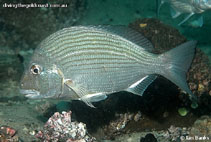
Rückenflossenstacheln (insgesamt) : 11; Rückenflossenweichstrahlen (insgesamt) : 12 - 13; Afterflossenstacheln: 3; Afterflossenweichstrahlen: 10 - 11. Bright yellow mark above the pelvic base.
Body shape (shape guide): short and / or deep.
Inhabit coastal waters (Ref. 30573, 44894), usually entering estuaries (Ref. 44894). Abundant in shallow water and often caught at the surf-line or in rock pools (Ref. 9987). Larger, solitary fish sometimes enter brackish mangrove areas (Ref. 9987). Juveniles in estuaries move into deeper water with growth (Ref. 4335). Often in schools (Ref. 9710). Feed on benthic invertebrates, mainly mollusks (Ref. 5213) and aquatic macrophytes (Ref. 26055). Popular angling species commonly captured with hook and line (Ref. 44894). Marketed fresh (Ref. 5284).
Normally sexes are separate but some individuals are protandrous due to geographical variation in sexual pattern (Ref. 103751). Gonochorism is confirmed in Australia, and protandry in Asia (Ref. 103751). Also Ref. 28504.
Bauchot, M.-L. and M.M. Smith, 1984. Sparidae. In W. Fischer and G. Bianchi (eds.) FAO species identification sheets for fishery purposes. Western Indian Ocean (Fishing Area 51). volume 4. [var. pag.] FAO, Rome. (Ref. 3507)
IUCN Rote Liste Status (Ref. 130435: Version 2025-1)
Bedrohung für Menschen
Harmless
Nutzung durch Menschen
Fischereien: kommerziell; Aquakultur: kommerziell; Sportfisch: ja
Tools
Zusatzinformationen
Download XML
Internet Quellen
Estimates based on models
Preferred temperature (Ref.
123201): 21.9 - 29, mean 28 °C (based on 1662 cells).
Phylogenetic diversity index (Ref.
82804): PD
50 = 0.5156 [Uniqueness, from 0.5 = low to 2.0 = high].
Bayesian length-weight: a=0.01995 (0.01666 - 0.02389), b=2.96 (2.91 - 3.01), in cm total length, based on LWR estimates for this species (Ref.
93245).
Trophic level (Ref.
69278): 3.3 ±0.47 se; based on food items.
Generation time: 3.3 ( na - na) years. Estimated as median ln(3)/K based on 1
growth studies.
Widerstandsfähigkeit (Ref.
120179): mittel, Verdopplung der Population dauert 1,4 - 4,4 Jahre. (Assuming tm=2-4).
Fishing Vulnerability (Ref.
59153): Moderate vulnerability (36 of 100).
🛈
Climate Vulnerability (Ref.
125649): Very high vulnerability (88 of 100).
🛈
Nutrients (Ref.
124155): Calcium = 34 [15, 69] mg/100g; Iron = 0.537 [0.280, 1.105] mg/100g; Protein = 19.7 [18.4, 21.1] %; Omega3 = 0.114 [0.068, 0.201] g/100g; Selenium = 39.8 [20.0, 80.7] μg/100g; VitaminA = 26.9 [6.4, 109.3] μg/100g; Zinc = 0.956 [0.602, 1.420] mg/100g (wet weight);