Environment: milieu / Klimaatzone / Diepte / distribution range
Ecologie
; zoet water demersaal. Tropical; 22°C - 24°C (Ref. 12468); 11°S - 21°S
Africa: Cunene, Okavango, Buzi, Pungwe (Ref. 52193), Zambezi (Ref. 3203, 52193, 95585), Save (Ref. 13337) and Cubango Rivers (Ref. 3203). Absent from the Kafue River (Ref. 7248, 52193, 95585). Also in Malagarasi River, Lake Rukwa (Ref. 27292), lakes Tanganyika and Malawi (Ref. 3203, 52193). In the Congo basin known from the Lindi-Tshopo (Ref. 106290), upper Kasai (middle Congo River basin)(Ref. 2970), Lualaba (Ref. 45434), upper Lualaba (Ref. 2970, 45434) and the Mweru-Luapula-Bangweulu area (Ref. 13337, 95585).
Lengte bij maturiteit / Grootte / Gewicht / Leeftijd
Maturiteit: Lm 11.0 range ? - ? cm
Max length : 31.0 cm SL mannelijk / geslacht onbekend; (Ref. 4967); max. gepubliceerd gewicht: 1.1 kg (Ref. 52193)
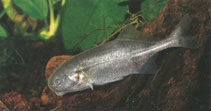
Dorsale stekels (totaal) : 0; Dorsale zachte stralen (totaal) : 28 - 37; Anale stekels: 0; Anale zachte stralen: 23 - 27; Wervels: 39 - 41. Diagnosis: Dorsal fin up to 1.5 times in length of anal fin; origin of dorsal fin in advance of anal fin (Ref. 52193). Snout rounded, in front of mouth; eye well above mouth; chin with fleshy bulge (Ref. 4967). For distinguishing between specimens of Cyphomyrus discorhynchus en C. cubangoensis, the most useful anatomical characters are: longer dorsal fin length, longer anal fin length, higher number of dorsal fin rays and anal fin rays, and a higher caudal peduncle depth and caudal peduncle length ratio in C. discorhynchus than in C. cubangoensis (Ref. 119538).
Body shape (shape guide): fusiform / normal; Cross section: oval.
Nocturnal shoaling species; favors large river channels with a soft bottom and fringing vegetation (Ref. 7248, 52193). Found mainly in sheltered bays, lagoons and swampy areas; occurs also in typical sandy or rocky rivers (Ref. 13337). Feeds on bottom-living invertebrates (Ref. 52193) and insect larvae at night (Ref. 5595). Known to migrate up tributary rivers of Lake Kariba during rainy season, though it is not yet clear whether this is a breeding migration (Ref. 13337). Breeds during summer rainy season; females carry up to 5,000 eggs (Ref. 7248).
Levenscyclus en paargedrag
Maturiteit | Voortplanting | Paaien | Eieren | Fecunditeit | Larven
Gosse, J.-P., 1984. Mormyridae. p. 63-122. In J. Daget, J.-P. Gosse and D.F.E. Thys van den Audenaerde (eds.) Check-list of the freshwater fishes of Africa (CLOFFA). ORSTOM, Paris and MRAC, Tervuren. Vol. 1. (Ref. 3203)
Status op de Rode Lijst van het IUCN (Ref. 130435: Version 2025-1)
Gevaar voor de mens
Harmless
Gebruik door de mens
Visserij: van minder commercieel belang; Aquarium: Commercieel
Tools
Speciale rapporten
Download XML
Internetbronnen
Estimates based on models
Fylogenetische diversiteitsindex (Ref.
82804): PD
50 = 0.5010 [Uniqueness, from 0.5 = low to 2.0 = high].
Bayesian length-weight: a=0.01445 (0.00841 - 0.02484), b=2.81 (2.66 - 2.96), in cm total length, based on LWR estimates for this species & (Sub)family-body (Ref.
93245).
Trofisch niveau (Ref.
69278): 3.2 ±0.40 se; based on food items.
Generation time: 7.0 ( na - na) years. Estimated as median ln(3)/K based on 1
growth studies.
Weerstandsvermogen (Ref.
120179): Gemiddeld, minimale populatieverdubbelingstijd 1,4-4,4 jaar (K=0.16).
Fishing Vulnerability (Ref.
59153): Moderate to high vulnerability (49 of 100).
🛈
Nutrients (Ref.
124155): Calcium = 150 [68, 369] mg/100g; Iron = 1.41 [0.64, 2.99] mg/100g; Protein = 17.5 [15.1, 19.8] %; Omega3 = 0.519 [0.199, 1.391] g/100g; Selenium = 66.3 [24.7, 158.1] μg/100g; VitaminA = 52 [18, 156] μg/100g; Zinc = 1.89 [1.22, 3.87] mg/100g (wet weight);