>
Cichliformes (Cichlids, convict blennies) >
Cichlidae (Cichlids) > Pseudocrenilabrinae
Etymology: Oreochromis: Latin, aurum = gold + Greek, chromis = a fish, perhaps a perch (Ref. 45335).
Environment: milieu / climate zone / rango de profundidad / distribution range
Ecología
; agua dulce bentopelágico. Tropical
Africa: known only from the catchment of Lake Natron in Tanzania (Ref. 32272, 118638).
Tamaño / Peso / Age
Madurez: Lm ? range ? - ? cm
Max length : 5.0 cm SL macho / no sexado; (Ref. 32272)
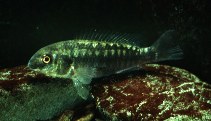
Espinas dorsales (total) : 13 - 14; Radios blandos dorsales (total) : 9 - 12; Espinas anales: 3 - 4; Radios blandos anales: 9 - 11. Diagnosis: A very small slender species with a narrow ventrally-placed mouth (Ref. 118638). Mature males have dark-edged dorsal and anal fins, iridescent blue-white spots on flanks, white lower lips, and a spotted caudal fin; male breeding dress shows geographic variation, with males of some populations having yellow throats and white bellies, while others are a fiery orange underneath (Ref. 118638). Females and non-territorial males are sandy-coloured, paler ventrally, sometimes with faint vertical bars (Ref. 118638).
Body shape (shape guide): elongated.
It inhabits the springs and some spring-fed creeks near the southern and south-eastern shores of Lake Natron (Ref. 32272). It co-occurs with Alcolapia alcalicus and Alcolapia latilabris (Ref. 32272). Observed to nibble at stones and gravel, probably taking mainly algae for food; omnivorous, taking insects from the water surface as well (Ref. 32272). A maternal mouthbrooder: males defend spawning territories among rocks in shallow water (Ref. 32272, 118638). Potential as an aquarium fish (Ref. 118638).
Life cycle and mating behavior
Madurez | Reproducción | Puesta | Huevos | Fecundidad | Larva
A maternal mouthbrooder: males defend spawning territories among rocks in shallow water (Ref. 32272, 118638). Females carry eggs and larvae in their mouths (Ref. 32272).
Seegers, L. and H. Tichy, 1999. The Oreochromis alcalicus flock (Teleostei: Cichlidae) from lakes Natron and Magadi, Tanzania and Kenya, with descriptions of two new species. Ichthyol. Explor. Freshwat. 10(2):97-146. (Ref. 32272)
IUCN Red List Status (Ref. 130435: Version 2025-1)
Threat to humans
Harmless
Human uses
Herramientas
Special reports
Download XML
Fuentes de Internet
Estimates based on models
Phylogenetic diversity index (Referencia
82804): PD
50 = 0.5000 [Uniqueness, from 0.5 = low to 2.0 = high].
Bayesian length-weight: a=0.00389 (0.00180 - 0.00842), b=3.12 (2.94 - 3.30), in cm total length, based on all LWR estimates for this body shape (Ref.
93245).
Nivel trófico (Referencia
69278): 3.2 ±0.40 se; based on food items.
Resiliencia (Referencia
120179): Alto, población duplicada en un tiempo mínimo inferior a 15 meses (Preliminary K or Fecundity.).
Fishing Vulnerability (Ref.
59153): Low vulnerability (10 of 100).
🛈