>
Acanthuriformes (Surgeonfishes) >
Chaetodontidae (Butterflyfishes)
Etymology: Chaetodon: Greek, chaite = hair + Greek, odous = teeth (Ref. 45335).
Eponymy: Jacob Theodor Klein (1685–1759) was a German jurist, historian, botanist, zoologist and mathematician. His publications on fishes include: Historiae Piscium Naturalis promovendae Missus primus Gedani (1744). (Ref. 128868), visit book page.
More on author: Bloch.
Environment: milieu / climate zone / rango de profundidad / distribution range
Ecología
marino asociado a arrecife; rango de profundidad 0 - 90 m (Ref. 128797), usually 10 - ? m (Ref. 1602). Tropical; 30°N - 32°S, 29°E - 130°W
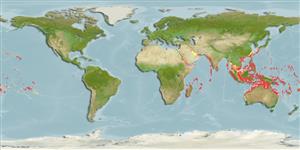
Indo-West Pacific: Red Sea and East Africa (south to Coffee Bay, South Africa, Ref. 5372) to the Hawaiian Islands and Samoa, north to southern Japan, south to New South Wales, Australia and New Caledonia. Eastern Pacific: Galapagos Islands (Ref. 5227).
Tamaño / Peso / Age
Madurez: Lm ? range ? - ? cm
Max length : 15.0 cm TL macho / no sexado; (Ref. 5372)
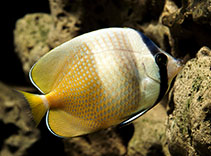
Espinas dorsales (total) : 13 - 14; Radios blandos dorsales (total) : 20 - 23; Espinas anales: 3; Radios blandos anales: 17 - 20; Vértebra: 24. Body is yellowish brown with two broad white vertical bars running across the body one from near the origin of the dorsal spine and the other from the middle of the back. A black bar runs vertically across the eye. There are numerous dotted horizontal stripes on the sides. The margin of caudal fin is transparent (Ref. 4855). Snout length 2.5-3.2 in HL. Body depth 1.5-1.8 in SL (Ref. 90102).
Body shape (shape guide): short and / or deep; Cross section: compressed.
Occur in deeper lagoons and channels, and seaward reefs (Ref. 1602). Benthopelagic (Ref. 58302). Depth 2-61 m, usually below 10 m (Ref. 90102). Occur singly or in pairs (Ref. 37816). Common, omnivorous individuals that feed mainly on soft coral polyps (mainly on Sarcophyton tracheliophorum and Litophyton viridis), algae and zooplankton. Oviparous (Ref. 205). Form pairs during breeding (Ref. 205).
Life cycle and mating behavior
Madurez | Reproducción | Puesta | Huevos | Fecundidad | Larva
Distinct pairing (Ref. 205). Monogamous mating is observed as both obligate and social (Ref. 52884).
Myers, R.F., 1991. Micronesian reef fishes. Second Ed. Coral Graphics, Barrigada, Guam. 298 p. (Ref. 1602)
IUCN Red List Status (Ref. 130435: Version 2025-1)
Threat to humans
Harmless
Human uses
Pesquerías: pesquerías de subsistencia; Acuario: Comercial
Herramientas
Special reports
Download XML
Fuentes de Internet
Estimates based on models
Preferred temperature (Referencia
123201): 24.7 - 29, mean 27.8 °C (based on 832 cells).
Phylogenetic diversity index (Referencia
82804): PD
50 = 0.5000 [Uniqueness, from 0.5 = low to 2.0 = high].
Bayesian length-weight: a=0.03090 (0.01890 - 0.05054), b=3.04 (2.90 - 3.18), in cm total length, based on LWR estimates for this species & Genus-body shape (Ref.
93245).
Nivel trófico (Referencia
69278): 2.9 ±0.2 se; based on diet studies.
Resiliencia (Referencia
120179): Alto, población duplicada en un tiempo mínimo inferior a 15 meses (Preliminary K or Fecundity.).
Fishing Vulnerability (Ref.
59153): Low vulnerability (10 of 100).
🛈
Nutrients (Ref.
124155): Calcium = 113 [58, 170] mg/100g; Iron = 0.887 [0.532, 1.450] mg/100g; Protein = 18.4 [17.3, 19.6] %; Omega3 = 0.122 [0.073, 0.199] g/100g; Selenium = 38.6 [21.2, 72.4] μg/100g; VitaminA = 45.2 [12.4, 160.4] μg/100g; Zinc = 1.6 [1.1, 2.3] mg/100g (wet weight);