


Acroteriobatus leucospilus (Norman, 1926)
Grayspottted guitarfish
Envoyez vos Photos et vidéos
Images | Images Google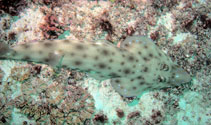 Acroteriobatus leucospilus
Photo de Henlé, C.
Images | Images Google
Photo de Henlé, C.
Classification / Noms Noms communs | Synonymes | Catalog of Fishes(Genre, Espèce) | ITIS | CoL | WoRMS | Cloffa
Élasmobranches (requins et raies) (sharks and rays) > Rhinopristiformes (Shovelnose rays) > Rhinobatidae (Guitarfishes)
More on author: Norman.
More on author: Norman.
Environnement : milieu / zone climatique / profondeur / gamme de distribution Écologie
marin démersal; profondeur 0 - 100 m (Ref. 124452), usually ? - 37 m (Ref. 124452). Subtropical; - 32°S
Distribution Territoires | Zones FAO | Écosystèmes | Occurrences | Carte par point | Introductions | Faunafri
Western Indian Ocean: South Africa, Mozambique, and Tanzania.
Taille / Poids / Âge
Maturité: Lm ? range ? - ? cm
Max length : 56.5 cm TL mâle / non sexé; (Ref. 124452); 96.0 cm TL (female)
Max length : 56.5 cm TL mâle / non sexé; (Ref. 124452); 96.0 cm TL (female)
Description synthétique Clés d'identification | Morphologie | Morphométrie
Vertèbres: 200 - 205. This medium-sized species is distinguished by the following set of characters: dorsal surface smooth, no prominent thorns or tubercles, except for slightly enlarged granular denticles partially around orbital rims, and rather regularly distributed along midline from nape to near first dorsal-fin origin, none between dorsal fins and upper caudal fin; snout semi-translucent with elongated bluish spots giving stripe-nosed appearance, numerous small bluish spots covering the snout, pectoral, pelvic, dorsal, and caudal fins but not the central disc, on a sandy brown background with darker brown spots of varying sizes covering the disc, tail, fin bases, and fins, and sometimes giving the caudal peduncle a striped appearance, the outer edges of pectoral- and pelvic-fin margins blue, while lateral tail folds white or striped blue and brown and ventral surface white; nasal lamellae 37-41; upper jaw tooth row count ca. 60-75; post-synarcual centra 187-192; total vertebral segments 200-205; total pectoral skeleton radials 63-70 (Ref. 124452).
Cross section: flattened.
Cross section: flattened.
Found inshore from the surf line to a depth of 100 m (Ref. 5578, 11228). Feeds on bivalves, gastropods, shrimps, crabs and small bony fishes (Ref. 5578). Common length 92-96 cm TL; males and females mature at about 56 cm TL and birth size ca. 25 cm TL (Ref. 114953). Ovoviviparous (Ref. 50449). Flesh esteemed (Ref. 3919).
Cycle de vie et comportement reproducteur Maturité | Reproduction | Frai | Œufs | Fécondité | Larves
Exhibit ovoviparity (aplacental viviparity), with embryos feeding initially on yolk, then receiving additional nourishment from the mother by indirect absorption of uterine fluid enriched with mucus, fat or protein through specialised structures (Ref. 50449). Bears 2 to 4 young (Ref. 5578).
Référence principale
Téléchargez vos références | Références | Coordinateur : McEachran, John | Collaborateurs
Weigmann, S., D.A. Ebert, B. Séret, 2021. Resolution of the Acroteriobatus leucospilus species complex, with a redescription of A. leucospilus (Norman, 1926) and descriptions of two new western Indian Ocean species of Acroteriobatus (Rhinopristiformes, Rhinobatidae). Marine Biodiversity (2021):51:58. (Ref. 124452)
Statut dans la liste rouge de l'IUCN (Ref. 130435: Version 2025-2 (Global))
Menacé (EN) (A2d); Date assessed: 25 April 2018
Menace pour l'homme
Harmless
Utilisations par l'homme
Pêcheries: pêcheries vivrières; pêche sportive: oui
FAO - Publication: search | FishSource |
Plus d'informations
Écologie trophique
Aliments (proies)
Composition du régime alimentaire
Consommation alimentaire
Rations alimentaires
Prédateurs
Aliments (proies)
Composition du régime alimentaire
Consommation alimentaire
Rations alimentaires
Prédateurs
Dynamique des populations
Paramètres de croissance
Âges / tailles maximales
Longueur-poids rel.
Rel. longueur-longueur.
Fréquences de longueurs
Conversion de masse
Recrutement
Abondance
Paramètres de croissance
Âges / tailles maximales
Longueur-poids rel.
Rel. longueur-longueur.
Fréquences de longueurs
Conversion de masse
Recrutement
Abondance
Cycle de vie
Reproduction
Maturité
Maturité/épines rel.
Fécondité
Frai
Agrégats de frai
Œufs
Développement de l'œuf
Larves
Dynamique des populations larvaires
Reproduction
Maturité
Maturité/épines rel.
Fécondité
Frai
Agrégats de frai
Œufs
Développement de l'œuf
Larves
Dynamique des populations larvaires
Anatomie
Surface branchiale
Cerveau
Otolithe
Surface branchiale
Cerveau
Otolithe
Physiologie
Composition corporelle
Nutriments
Consommation d'oxygène
Type de natation
Vitesse de nage
Pigments visuels
Son de poisson
Maladies et parasites
Toxicité (CL50)
Composition corporelle
Nutriments
Consommation d'oxygène
Type de natation
Vitesse de nage
Pigments visuels
Son de poisson
Maladies et parasites
Toxicité (CL50)
Liées à l'homme
Systèmes d'aquaculture
Profils d'aquaculture
Souches
Cas de ciguatera
Timbres, pièces de monnaie, divers
Systèmes d'aquaculture
Profils d'aquaculture
Souches
Cas de ciguatera
Timbres, pièces de monnaie, divers
Outils
Quiz bio | E-book | Guide de terrain | Générateur de fréquences de longueur | Outil de dynamique de population | Carte par point |
Capture-MSY |
Articles particuliers
Télécharger en XML
Sources Internet
AFORO (otoliths) | Aquatic Commons | BHL | Cloffa | Websites from users | FishWatcher | CISTI | Catalog of Fishes: Genre, Espèce | DiscoverLife | ECOTOX | FAO - Publication: search | Faunafri | Fishipedia | Fishtrace | GloBI | Google Books | Google Scholar | Google | IGFA World Record | OneZoom | Open Tree of Life | Otolith Atlas of Taiwan Fishes | PubMed | Reef Life Survey | Socotra Atlas | TreeBase | Arbre de Vie | Wikipedia: aller à, chercher | World Records Freshwater Fishing | Zoological Record
Estimations basées sur des modèles
Indice de diversité phylogénétique (Réf. 82804): PD50 = 0.5010 [Uniqueness, from 0.5 = low to 2.0 = high].
Bayesian length-weight: a=0.00309 (0.00169 - 0.00566), b=3.10 (2.94 - 3.26), in cm total length, based on LWR estimates for this species & (Sub)family-body (Ref. 93245).
Niveau trophique (Réf. 69278): 3.7 ±0.60 se; based on food items.
Résilience (Réf. 120179): Très faible, temps minimum de doublement de population supérieur à 14 ans (Fec=2).