>
Centrarchiformes (Basses) >
Oplegnathidae (Knifejaws)
Etymology: Oplegnathus: Greek, hoplon = weapon + Greek, gnathos = jaw (Ref. 45335).
Eponymy: David Barry Conway (d: 1832) was a Royal navy surgeon who was medical superintendant on two different convict ships to Australia. [...] (Ref. 128868), visit book page.
More on author: Richardson.
Environment: milieu / climate zone / Tiefenbereich / distribution range
Ökologie
seewasser riff-verbunden; tiefenbereich ? - 150 m. Subtropical; 28°S -
Western Indian Ocean: South Africa.
Size / Gewicht / Alter
Geschlechtsreife: Lm ? range ? - ? cm
Max length : 90.0 cm TL Männchen/unbestimmt; (Ref. 4387)
Rückenflossenstacheln (insgesamt) : 12; Rückenflossenweichstrahlen (insgesamt) : 11 - 14; Afterflossenstacheln: 3; Afterflossenweichstrahlen: 11 - 13.
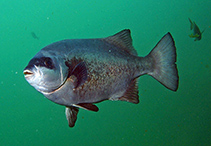
Body shape (shape guide): short and / or deep.
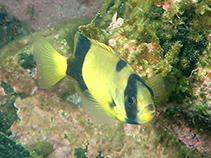
Found in coastal waters down at a depth of about 150 m. Adults found near reefs, juveniles found near floating objects. Feed on benthic invertebrates and algae (Ref. 5213). May live longer than 10 years. Spawning occurs throughout the year (Ref. 57746). Rarely hooked but easily speared (Ref. 4387).
Life cycle and mating behavior
Geschlechtsreife | Fortpflanzung | Ablaichen | Eier | Fecundity | Larven
van der Elst, R., 1981. A guide to the common sea fishes of southern Africa. C. Struik, Cape Town. 367 p. (Ref. 3670)
IUCN Rote Liste Status (Ref. 130435: Version 2025-1)
Bedrohung für Menschen
Harmless
Nutzung durch Menschen
Fischereien: kommerziell; Sportfisch: ja
Tools
Zusatzinformationen
Download XML
Internet Quellen
Estimates based on models
Phylogenetic diversity index (Ref.
82804): PD
50 = 0.5156 [Uniqueness, from 0.5 = low to 2.0 = high].
Bayesian length-weight: a=0.01995 (0.00906 - 0.04395), b=3.01 (2.83 - 3.19), in cm total length, based on all LWR estimates for this body shape (Ref.
93245).
Trophic level (Ref.
69278): 2.7 ±0.24 se; based on food items.
Widerstandsfähigkeit (Ref.
120179): niedrig, Verdopplung der Population dauert 4,5 - 14 Jahre. (tmax > 10).
Fishing Vulnerability (Ref.
59153): High vulnerability (56 of 100).
🛈
Nutrients (Ref.
124155): Calcium = 19.4 [8.6, 35.0] mg/100g; Iron = 0.515 [0.294, 0.877] mg/100g; Protein = 19.3 [18.1, 20.5] %; Omega3 = 0.148 [0.083, 0.264] g/100g; Selenium = 26.6 [12.9, 56.1] μg/100g; VitaminA = 14.8 [3.5, 62.2] μg/100g; Zinc = 0.602 [0.387, 0.917] mg/100g (wet weight);