>
Gobiesociformes (Clingfishes) >
Gobiesocidae (Clingfishes and singleslits) > Diademichthyinae
Etymology: Lepadichthys: Greek, lepas, -ados = limpet + Greek, ichtys = fish (Ref. 45335); erythraeus: From the Greek for red, in reference to the Mare Erythraeum, an ancient name for Red Sea (Ref. 42101).
More on authors: Briggs & Link.
Environment: milieu / climate zone / εύρος βάθους / distribution range
Οικολογία
Θαλασσινό(ά) βενθικό(ς); εύρος βάθους 1 - 3 m (Ref. 103877). Tropical
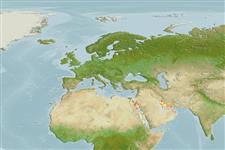
Western Indian Ocean: Red Sea, from the Gulf of Aqaba and Gulf of Suez, south to Al Wajh (northeastern Saudi Arabia).
Μέγεθος / Βάρος / Age
Γεννητική Ωρίμανση: Lm ? range ? - ? cm
Max length : 3.7 cm SL αρσενικό/απροσδιόριστο; (Ref. 42101)
Short description
Κλείδες προσδιορισμού | Μορφολογία | Μορφομετρία
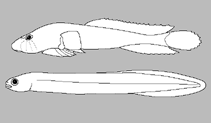
Ραχιαίες άκανθες (συνολικά) : 0; Μαλακές ραχιαίες ακτίνες (συνολικά) : 15 - 16; Εδρικές άκανθες: 0; Μαλακές εδρικές ακτίνες: 13; Σπόνδυλοι: 34. This species is distinguished by the following characters: a membrane joining dorsal and anal fins with the caudal fin; the anus is closer to anal fin than to disc, about two-thirds the distance from the rear margin of the disc to the origin of anal fin; upper attachment of gill membrane opposite ninth pectoral-fin ray; second gill arch with 8 rakers; postdorsal-caudal distance 6.4-7.3 in dorsal-fin length; D 15-16; A 13; pectoral-fin rays 26-28 (rarely 28); principle caudal-fin rays 12; total caudal-fin rays 20 (Ref. 103877).
Cross section: compressed.
Specimens were collected from the base of a coral block on a reef flat with mixed sand and flat rock with patches of dead corals, from within live coral head in a sheltered bay, from a fringing reef at a depth of 1-3 m and from an isolated coral block. All were collected in close association with sea urchins of the genus Diadema, utilizing the long spines for shelter (Ref. 103877).
Life cycle and mating behavior
Γεννητική Ωρίμανση | Αναπαραγωγή | Γεννοβολία | Αβγά | Γονιμότητα | Προνύμφες
Oviparous, distinct pairing during breeding (Ref. 205).
McAllister, D.E., 1990. A working list of fishes of the world. Copies available from D.E. McAllister, Canadian Museum of Nature, P.O. Box 3443, Ottawa, Ontario K1P 6P4, Canada. 2661 p. plus 1270 p. Index. (Ref. 27116)
IUCN Red List Status (Ref. 130435: Version 2025-1)
Threat to humans
Harmless
Human uses
Εργαλεία
Special reports
Download XML
Διαδικτυακές πηγές
Estimates based on models
Preferred temperature (Αναφ.
123201): 23.5 - 27.7, mean 26.1 °C (based on 72 cells).
Phylogenetic diversity index (Αναφ.
82804): PD
50 = 0.5010 [Uniqueness, from 0.5 = low to 2.0 = high].
Bayesian length-weight: a=0.00389 (0.00180 - 0.00842), b=3.12 (2.94 - 3.30), in cm total length, based on all LWR estimates for this body shape (Ref.
93245).
Τροφικό Επίπεδο (Αναφ.
69278): 3.5 ±0.2 se; based on size and trophs of closest relatives
Ελαστικότητα (Αναφ.
120179): Υψηλό, ελάχιστος χρόνος για διπλασιασμό πληθυσμού < 15 μήνες (Preliminary K or Fecundity.).
Fishing Vulnerability (Ref.
59153): Low vulnerability (10 of 100).
🛈