Teleostei (teleosts) >
Eupercaria/misc (Various families in series Eupercaria) >
Labridae (Wrasses) > Julidinae
Etymology: Thalassoma: Greek, thalassa = the sea + Greek, soma = body; the colour of the sea (Ref. 45335); heiseri: Named in honor of John B. Heiser who wrote his PhD theis (1981) on the classification of the genus Thalassoma (Ref. 10372).
Eponymy: Dr John B ‘J B’ Heiser is an American ichthyologist and marine biologist. [...] (Ref. 128868), visit book page.
More on authors: Randall & Edwards.
Environment: milieu / climate zone / depth range / distribution range
Ecology
Marine; reef-associated. Subtropical
Eastern Central Pacific: Pitcairn Group and the Tuamoto Archipelago.
Size / Weight / Age
Maturity: Lm ? range ? - ? cm
Max length : 11.6 cm SL male/unsexed; (Ref. 10372)
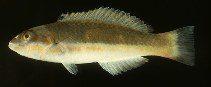
Dorsal spines (total): 8; Dorsal soft rays (total): 13; Anal spines: 3; Anal soft rays: 10; Vertebrae: 25. Caudal fin varying from slightly rounded in juveniles to emarginate to deeply emarginate in adults. Outer half of caudal fin dusky to blackish in adults (Ref. 10372). Head greenish with a single blue-green stripe running from mouth under eye, then turning ventrally to end on posterior margin of opercle (Ref 9823).
Body shape (shape guide): fusiform / normal.
Life cycle and mating behavior
Maturity | Reproduction | Spawning | Eggs | Fecundity | Larvae
Oviparous, distinct pairing during breeding (Ref. 205).
Randall, J.E. and A. Edwards, 1984. A new labrid fish of the genus Thalassoma from the Pitcairn group, with a review of related Indo-Pacific species. J. Aquaricult. Aquat. Sci. 4(2):13-32. (Ref. 10372)
IUCN Red List Status (Ref. 130435: Version 2025-2)
Threat to humans
Harmless
Human uses
Tools
Special reports
Download XML
Internet sources