>
Ovalentaria/misc (Various families in series Ovalentaria) >
Pomacentridae (Damselfishes) > Pomacentrinae
Etymology: Chrysiptera: Greek, chrysos = golden + Greek, pteron = fin, wing (Ref. 45335).
Eponymy: Sir Robert Brownrigg (1759–1833) was an army officer and colonial administrator. [...] (Ref. 128868), visit book page.
Environment: milieu / climate zone / εύρος βάθους / distribution range
Οικολογία
Θαλασσινό(ά) Υφαλόφιλο(α); μη μεταναστευτικό(ά); εύρος βάθους 0 - 12 m (Ref. 9710). Tropical; 32°N - 30°S
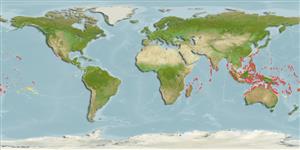
Indo-Pacific: East Africa to Marquesan and Society islands, north to Japan, south to Australia.
Μέγεθος / Βάρος / Age
Γεννητική Ωρίμανση: Lm ? range ? - ? cm
Max length : 8.0 cm TL αρσενικό/απροσδιόριστο; (Ref. 9710)
Short description
Κλείδες προσδιορισμού | Μορφολογία | Μορφομετρία
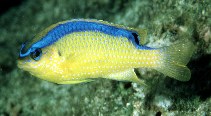
Ραχιαίες άκανθες (συνολικά) : 13; Μαλακές ραχιαίες ακτίνες (συνολικά) : 12 - 13; Εδρικές άκανθες: 2; Μαλακές εδρικές ακτίνες: 11 - 13. This species occurs in 2 basic color phases: a blue-backed (leucopoma) phase and a gray to black (amabilis) phase usually with 2 light bars (Ref. 37816). Large blue-edged black spot at end of dorsal fin base, and yellow form with black spots at end of dorsal fin and its base (Ref. 48636). Body depth 2.3-2.5 in SL (Ref. 90102).
Body shape (shape guide): fusiform / normal; Cross section: oval.
Adults occur in rubble-strewn surge channels, the outermost reaches of exposed reef flats, and the upper submarine terrace at 12 meters. Territorial but they generally occur in groups, and remains close to shelter. Feed mainly on benthic algae and small crustaceans (Ref. 1602, 37816 ). Oviparous, distinct pairing during breeding (Ref. 205). Eggs are demersal and adhere to the substrate (Ref. 205). Males guard and aerate the eggs (Ref. 205). Diurnal species (Ref. 54980; 113699).
Life cycle and mating behavior
Γεννητική Ωρίμανση | Αναπαραγωγή | Γεννοβολία | Αβγά | Γονιμότητα | Προνύμφες
Oviparous, distinct pairing during breeding (Ref. 205). Eggs are demersal and adhere to the substrate (Ref. 205). Males guard and aerate the eggs (Ref. 205).
Allen, G.R., 1991. Damselfishes of the world. Mergus Publishers, Melle, Germany. 271 p. (Ref. 7247)
IUCN Red List Status (Ref. 130435: Version 2025-1)
Threat to humans
Harmless
Human uses
αλιεία: περιορισμένης εμπορικότητας; Ενυδρείο: Εμπορικό(ά)
Εργαλεία
Special reports
Download XML
Διαδικτυακές πηγές
Estimates based on models
Preferred temperature (Αναφ.
123201): 25.4 - 29.3, mean 28.4 °C (based on 2701 cells).
Phylogenetic diversity index (Αναφ.
82804): PD
50 = 0.5000 [Uniqueness, from 0.5 = low to 2.0 = high].
Bayesian length-weight: a=0.01479 (0.00651 - 0.03363), b=3.00 (2.81 - 3.19), in cm total length, based on LWR estimates for this (Sub)family-body shape (Ref.
93245).
Τροφικό Επίπεδο (Αναφ.
69278): 2.7 ±0.3 se; based on diet studies.
Ελαστικότητα (Αναφ.
120179): Υψηλό, ελάχιστος χρόνος για διπλασιασμό πληθυσμού < 15 μήνες (Preliminary K or Fecundity.).
Fishing Vulnerability (Ref.
59153): Low vulnerability (10 of 100).
🛈
Nutrients (Ref.
124155): Calcium = 152 [84, 266] mg/100g; Iron = 0.934 [0.573, 1.490] mg/100g; Protein = 18.6 [17.5, 19.6] %; Omega3 = 0.143 [0.086, 0.231] g/100g; Selenium = 19.1 [10.8, 35.1] μg/100g; VitaminA = 142 [48, 433] μg/100g; Zinc = 2.41 [1.65, 3.39] mg/100g (wet weight);