>
Ovalentaria/misc (Various families in series Ovalentaria) >
Pomacentridae (Damselfishes) > Microspathodontinae
Etymology: Plectroglyphidodon: Greek,plektron = anything to strike with, spur + Greek, glyphis = carved + Greek, odous = teeth (Ref. 45335).
More on author: Bleeker.
Environment: milieu / climate zone / Tiefenbereich / distribution range
Ökologie
seewasser riff-verbunden; standorttreu; tiefenbereich 0 - 6 m (Ref. 9002). Tropical; 30°N - 30°S
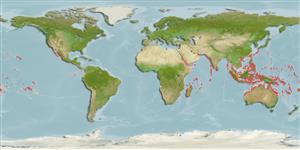
Indo-Pacific: Red Sea and East Africa to the Marshall and Pitcairn island groups, north to Japan, south to Australia.
Size / Gewicht / Alter
Geschlechtsreife: Lm ? range ? - ? cm
Max length : 12.0 cm TL Männchen/unbestimmt; (Ref. 4391)
Rückenflossenstacheln (insgesamt) : 12; Rückenflossenweichstrahlen (insgesamt) : 15 - 17; Afterflossenstacheln: 2; Afterflossenweichstrahlen: 12 - 13.
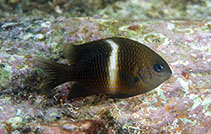
Body shape (shape guide): short and / or deep; Cross section: compressed.
Adults inhabit surge-swept shorelines and seaward reef margins. Juveniles often occur in pockets of the intertidal reef crest, while adults are found in ridges between surge channels (Ref. 1602). Feed on benthic algae. Juveniles found in sheltered ocean bays, shallow low boulder-reefs above sand level. Known in clear-water reefs in gutters and upper edge of drop-offs (Ref. 9002). Oviparous, distinct pairing during breeding (Ref. 205). Eggs are demersal and adhere to the substrate (Ref. 205). Males guard and aerate the eggs (Ref. 205). Diurnal species (Ref. 54980; 113699).
Life cycle and mating behavior
Geschlechtsreife | Fortpflanzung | Ablaichen | Eier | Fecundity | Larven
Oviparous, distinct pairing during breeding (Ref. 205). Eggs are demersal and adhere to the substrate (Ref. 205). Males guard and aerate the eggs (Ref. 205).
Randall, J.E., 1995. Coastal fishes of Oman. University of Hawaii Press, Honolulu, Hawaii. 439 p. (Ref. 11441)
IUCN Rote Liste Status (Ref. 130435: Version 2025-1)
Bedrohung für Menschen
Harmless
Nutzung durch Menschen
Fischereien: nicht kommerziell; Aquarium: Kommerziell
Tools
Zusatzinformationen
Download XML
Internet Quellen
Estimates based on models
Preferred temperature (Ref.
123201): 24.7 - 29.3, mean 28.3 °C (based on 3089 cells).
Phylogenetic diversity index (Ref.
82804): PD
50 = 0.5000 [Uniqueness, from 0.5 = low to 2.0 = high].
Bayesian length-weight: a=0.01995 (0.00910 - 0.04376), b=2.99 (2.80 - 3.18), in cm total length, based on LWR estimates for this (Sub)family-body shape (Ref.
93245).
Trophic level (Ref.
69278): 2.0 ±0.00 se; based on food items.
Widerstandsfähigkeit (Ref.
120179): hoch, Verdopplung der Population dauert weniger als 15 Monate. (Preliminary K or Fecundity.).
Fishing Vulnerability (Ref.
59153): Low vulnerability (10 of 100).
🛈
Nutrients (Ref.
124155): Calcium = 121 [60, 203] mg/100g; Iron = 0.799 [0.471, 1.390] mg/100g; Protein = 18 [17, 19] %; Omega3 = 0.0886 [, ] g/100g; Selenium = 18.7 [9.7, 39.3] μg/100g; VitaminA = 76.6 [17.9, 304.5] μg/100g; Zinc = 2.08 [1.36, 3.21] mg/100g (wet weight);