>
Eupercaria/misc (Various families in series Eupercaria) >
Nemipteridae (Threadfin breams, Whiptail breams)
Etymology: Nemipterus: Greek, nema, -atos = filament + Greek, pteron = wing, fin (Ref. 45335).
More on author: Bleeker.
Environment: milieu / climate zone / distribuzione batimetrica / distribution range
Ecologia
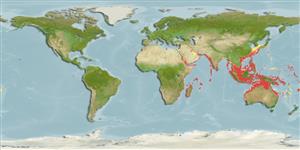
marino demersale; non migratori; distribuzione batimetrica 10 - 125 m (Ref. 9785). Tropical; 37°N - 30°S, 31°E - 176°W (Ref. 3810)
Indo-West Pacific: Red Sea and East Africa to the Indo-Malay Archipelago, north to Japan, south to northwestern Australia. This species has generally been treated under the name Nemipterus metopias by most previous authors.
Size / Peso / Age
Maturità: Lm ? range ? - ? cm
Max length : 34.0 cm TL maschio/sesso non determinato; (Ref. 124816); common length : 21.0 cm TL maschio/sesso non determinato; (Ref. 5450); peso massimo pubblicato: 395.00 g (Ref. 124816)
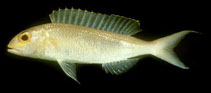
Spine dorsali (totale) : 10; Raggi dorsali molli (totale) : 9; Spine anali: 3; Raggi anali molli: 7. Suborbital spine absent. Preopercle with 3 transverse scale rows. Pectoral and pelvic fins short, reaching to just short of level of anus. A line drawn up from posterior edge of suborbital reaching the dorsal profile about 2 to 6 scale rows before origin of dorsal fin. Upper lobe of caudal fin produced into a long yellow trailing filament. Axillary scale present. Color: Upper body reddish, silvery below. Yellow stripes in front of eye through nostrils, and from upper lip to beneath eye. Less distinct golden stripe from behind eye to origin of lateral line.
Body shape (shape guide): fusiform / normal; Cross section: oval.
Benthic on sand bottoms near rocks (Ref. 30573). Swims in groups and feeds on benthic organisms.
Life cycle and mating behavior
Maturità | Riproduzione | Deposizione | Uova | Fecundity | Larve
Russell, B.C., 1990. FAO Species Catalogue. Vol. 12. Nemipterid fishes of the world. (Threadfin breams, whiptail breams, monocle breams, dwarf monocle breams, and coral breams). Family Nemipteridae. An annotated and illustrated catalogue of nemipterid species known to date. FAO Fish. Synop. 125(12):149p. Rome: FAO. (Ref. 3810)
IUCN Red List Status (Ref. 130435: Version 2025-1)
Threat to humans
Harmless
Human uses
Pesca: scarso interesse commerciale
Strumenti
Special reports
Download XML
Fonti Internet
Estimates based on models
Preferred temperature (Fonte Biblio.
123201): 23.7 - 28.5, mean 27.4 °C (based on 928 cells).
Phylogenetic diversity index (Fonte Biblio.
82804): PD
50 = 0.5000 [Uniqueness, from 0.5 = low to 2.0 = high].
Bayesian length-weight: a=0.01349 (0.01131 - 0.01609), b=2.96 (2.92 - 3.00), in cm total length, based on LWR estimates for this species (Ref.
93245).
Trophic level (Fonte Biblio.
69278): 3.5 ±0.44 se; based on food items.
Resilienza (Fonte Biblio.
120179): Alto, tempo minimo di raddoppiamento della popolazione meno di 15 mesi (Preliminary K or Fecundity.).
Fishing Vulnerability (Ref.
59153): Low vulnerability (25 of 100).
🛈
Nutrients (Ref.
124155): Calcium = 456 [105, 859] mg/100g; Iron = 1.3 [0.4, 3.5] mg/100g; Protein = 17.9 [16.2, 19.5] %; Omega3 = 0.28 [0.14, 0.61] g/100g; Selenium = 46 [19, 130] μg/100g; VitaminA = 8.35 [2.03, 44.31] μg/100g; Zinc = 0.826 [0.485, 2.737] mg/100g (wet weight);