This website uses cookies to enhance your browsing experience and ensure the functionality of our site. For more detailed information about the types of cookies we use and how we protect your privacy, please visit our Privacy Information page.
×
Cookie Settings
This website uses different types of cookies to enhance your experience. Please select your preferences below:
> Eupercaria/misc (Various families in series Eupercaria) > Nemipteridae (Threadfin breams, Whiptail breams)
Etymology: Scolopsis:Name from the Greek masculine noun 'skolos' meaning 'thorn' and suffix '-opsis' (from Greek feminine n. 'opsis' meaning 'aspect', 'appearance') meaning ‘thorny appearance’ presumably referring to 'les dentelures de la préopercule, en ont aussi, et même d'épineuses, aux sous-orbitaires' mentioned by Cuvier (1814) in his designation of the genus. Name ending in -'opsis' are treated as feminine according to ICZN 1999: Article 30.1.2 (Ref. 130620). More on author: Cuvier.
Umwelt: Milieu / Klimazone / Tiefenbereich / Verbreitungsgebiet Ökologie
Western Pacific: Eastern Indonesia, Solomon Islands, Santa Cruz Islands and Fiji. This species closely resembles Scolopsis monogramma, and the two species have been previously confused.
Größe / Gewicht / Alter
Geschlechtsreife: Lm? range ? - ? cm Max length : 35.0 cm SL Männchen/unbestimmt; (Ref. 48635); common length : 20.0 cm SL Männchen/unbestimmt; (Ref. 3810)
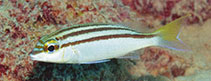
Rückenflossenstacheln (insgesamt) : 10; Rückenflossenweichstrahlen (insgesamt) : 9; Afterflossenstacheln: 3; Afterflossenweichstrahlen: 7. Head scales reaching forward to or just behind level of anterior margin of eye. A small naked area on temporal region behind eye. Lower limb of preopercle scaly. Antrorse (forward-directed) suborbital spine absent. Pelvic fins long, reaching to or beyond level of anus. Upper lobe of caudal fin a little longer then lower lobe. Lobes produced to form filamentous extensions in larger specimens. Color: Upper body bluish, white below. Sides are also bluish. Scales on body with yellow centers forming horizontal lines above lateral line and diagonal lines below. A pinkish-brown stripe from behind eye, arching on back beneath lateral line and terminating behind tip of pectoral fin. Four blue stripes on head. Body shape (shape guide): fusiform / normal; Cross section: oval.
Inhabits coastal and lagoon waters, on sand rubble bottoms close to reefs. Usually seen solitary in 20+ m depth. May also be seen in groups. (Ref. 48635, 90102)
Russell, B.C., 1990. FAO Species Catalogue. Vol. 12. Nemipterid fishes of the world. (Threadfin breams, whiptail breams, monocle breams, dwarf monocle breams, and coral breams). Family Nemipteridae. An annotated and illustrated catalogue of nemipterid species known to date. FAO Fish. Synop. 125(12):149p. Rome: FAO. (Ref. 3810)
IUCN Rote Liste Status (Ref. 130435: Version 2025-2 (Global))
Bevorzugte Temperatur (Ref. 123201): 27.3 - 29.3, mean 28.8 °C (based on 1018 cells).
Phylogenetischer Diversitätsindex (Ref. 82804): PD50 = 0.5000 [Uniqueness, from 0.5 = low to 2.0 = high].
Bayesian length-weight: a=0.01479 (0.00797 - 0.02745), b=2.96 (2.81 - 3.11), in cm total length, based on LWR estimates for this species & Genus-body shape (Ref. 93245).
Trophische Ebene (Ref. 69278): 3.5 ±0.37 se; based on food items.
Widerstandsfähigkeit (Ref. 120179): mittel, Verdopplung der Population dauert 1,4 - 4,4 Jahre. (Preliminary K or Fecundity.).
Anfälligkeit der Fischerei (Ref. 59153): Low to moderate vulnerability (33 of 100). 🛈