This website uses cookies to enhance your browsing experience and ensure the functionality of our site. For more detailed information about the types of cookies we use and how we protect your privacy, please visit our Privacy Information page.
×
Cookie Settings
This website uses different types of cookies to enhance your experience. Please select your preferences below:
> Eupercaria/misc (Various families in series Eupercaria) > Nemipteridae (Threadfin breams, Whiptail breams)
Etymology: Scolopsis:Name from the Greek masculine noun 'skolos' meaning 'thorn' and suffix '-opsis' (from Greek feminine n. 'opsis' meaning 'aspect', 'appearance') meaning ‘thorny appearance’ presumably referring to 'les dentelures de la préopercule, en ont aussi, et même d'épineuses, aux sous-orbitaires' mentioned by Cuvier (1814) in his designation of the genus. Name ending in -'opsis' are treated as feminine according to ICZN 1999: Article 30.1.2 (Ref. 130620). Eponymy: Arnout Vosmaer (1720–1799) was a Dutch naturalist and the Curator of the Menagerie and the Museum of the Stadtholder (Dutch Head of State). [...] (Ref. 128868), visit book page. More on author: Bloch.
Entorno: milieu / zona climática / rango de profundidad / gama de distribución Ecología
marino asociado a arrecife; rango de profundidad 2 - 30 m (Ref. 130620). Tropical
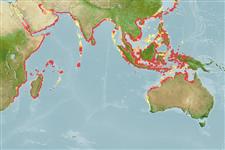
Indo-Pacific: northern Indian Ocean (except Red Sea, Arabian Gulf, east African coast, or islands of the Western Indian Ocean); from Pakistan, western India, Sri Lanka; Bay of Bengal and Andaman to western Indonesia, East Malaysia and Brunei.
Tamaño / Peso / Edad
Madurez: Lm? range ? - ? cm Max length : 17.3 cm SL macho / no sexado; (Ref. 130620); common length : 15.0 cm SL macho / no sexado; (Ref. 3810)
Espinas dorsales (total) : 10; Radios blandos dorsales (total) : 9; Espinas anales: 3; Radios blandos anales: 7. This species is distinguished by the following set of characters: head is scaly except for subopercle which is naked with numerous small pores; scales on top of the head reaching forward to or just in front of anterior nostrils; lower margin of eye tangent to or just above a line from snout tip to upper pectoral-fin base; suborbital (second infraorbital) with a large retrorse spine, a small antrorse spine on third infraorbital immediately above suborbital spine; posterior margin of preopercle serrate or denticulate, the lower edge smooth; second anal-fin spine longer and more robust than first or third anal-fin spines. Colouration: most body scales, except for caudal peduncle, with a black spot; caudal peduncle white; a white band is usually present beneath the lateral line, from origin of lateral line to below posterior part of dorsal fin; a broad white bar from the nape onto operculum, and suborbital with distinctive white patch; upper limb of the opercular margin edged brown, and lower limb edged reddish orange; no wedge-shaped dark spot on the upper base of pectoral fin (sometimes small dark spot is present); dorsal, anal and pelvic fins are crimson or orangered; juveniles and smaller subadults without white bar on nape and with dark-edged white band from behind eye to upper part of caudal peduncle (Ref. 130620). Body shape (shape guide): fusiform / normal; Cross section: compressed.
Benthic in inshore turbid or weedy waters, usually on sand or mud or rubble bottoms close to reefs, in depths to about 30 m (Ref. 92980), as well as offshore areas (Ref. 9785). Seen solitary, but may school deep (Ref. 48635).
Ciclo vital y comportamiento de apareamiento Madurez | Reproducción | Puesta | Huevos | Fecundidad | Larva
Russell, B.C., S.V. Bogorodsky, A.O. Mal, K.K. Bineesh and T.J. Alpermann, 2022. The taxonomic identity of the monocle bream Scolopsis vosmeri species complex (Perciformes: Nemipteridae), with comments on molecular phylogenetic relationships within the genus Scolopsis. Zootaxa 5105(4):501-538. (Ref. 130620)
Situación en la Lista Roja de la UICN (Ref. 130435: Version 2025-2 (Global))
Fisiología Composición corporal Nutrientes Consumo del oxígeno Tipo de natación Velocidad de natación Pigmentos visuales Sonido de peces Enfermedades y parásitos Toxicidad (CL50)
Temperatura preferida (Referencia 123201): 25.4 - 29.3, mean 28.6 °C (based on 2454 cells).
Índice de diversidad filogenética (Referencia 82804): PD50 = 0.5000 [Uniqueness, from 0.5 = low to 2.0 = high].
Bayesian length-weight: a=0.01445 (0.00782 - 0.02670), b=3.02 (2.87 - 3.17), in cm total length, based on LWR estimates for this species & Genus-body shape (Ref. 93245).
Nivel trófico (Referencia 69278): 4.6 ±0.09 se; based on food items.
Resiliencia (Referencia 120179): Alto, población duplicada en un tiempo mínimo inferior a 15 meses (Preliminary K or Fecundity.).
Vulnerabilidad pesquera (Ref. 59153): Low vulnerability (11 of 100). 🛈