Classification / Names
Noms communs | Synonymes | Catalog of Fishes(Genre, Espèce) | ITIS | CoL | WoRMS | Cloffa
>
Gadiformes (Cods) >
Macrouridae (Grenadiers or rattails)
Etymology: Ventrifossa: Latin, venter, ventris = belly + Latin, fosa = pit (Ref. 45335); vinolenta: From the Latin vinolentus, drunk on wine, but also meaning wine-colored, in reference to the overall tint of the trunk and tail of the fish and of the nose of the second author.
More on authors: Iwamoto & Merrett.
Environment: milieu / climate zone / profondeur / distribution range
Écologie
marin bathydémersal; profondeur 745 - 825 m (Ref. 35908). Deep-water
Western Central Pacific: known only from the Chesterfield and Bellona Plateau west of New Caledonia.
Taille / Poids / Âge
Maturité: Lm ? range ? - ? cm
Max length : 23.0 cm TL mâle / non sexé; (Ref. 35908)
Description synthétique
Clés d'identification | Morphologie | Morphométrie
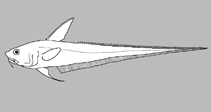
Épines dorsales (Total) : 2. Pelvic rays rarely 9; snout relatively long and pointed, 27-32 % HL; preoral 19-25% HL, orbit diameter 32-36%; length upper jaw 37-38%; inner gill rakers first arch 12-14; dorsolateral dark streak extending from parietal region to end of tail; dorsum above dark streak distinctly pale; leading edge of snout with black margin, extending posteriorly over supranarial ridges and dorsal rim of orbits; no median snout streak; base of first dorsal pale, but rays proximally black, distally fading to pale; lips blackish, ascending process of premaxillary black; mouth mostly black but with pale areas; small species, probably less than 30 cm TL.
Body shape (shape guide): elongated.
Life cycle and mating behavior
Maturité | Reproduction | Frai | Œufs | Fécondité | Larves
Iwamoto, T. and N.R. Merrett, 1997. Pisces Gadiformes: Taxonomy of grenadiers of the New Caledonian region, southwest Pacific. Mem. Mus. Natl. Hist. Nat. (176):473-570. (Ref. 35908)
Statut dans la liste rouge de l'IUCN (Ref. 130435: Version 2025-1)
Menace pour l'homme
Harmless
Utilisations par l'homme
Outils
Articles particuliers
Télécharger en XML
Sources Internet
Estimates based on models
Preferred temperature (Réf.
123201): 5 - 6.7, mean 5.5 °C (based on 7 cells).
Phylogenetic diversity index (Réf.
82804): PD
50 = 0.5000 [Uniqueness, from 0.5 = low to 2.0 = high].
Bayesian length-weight: a=0.00214 (0.00109 - 0.00421), b=3.20 (3.03 - 3.37), in cm total length, based on LWR estimates for this (Sub)family-body shape (Ref.
93245).
Niveau trophique (Réf.
69278): 3.6 ±0.5 se; based on size and trophs of closest relatives
Résilience (Réf.
120179): Milieu, temps minimum de doublement de population : 1,4 à 4,4 années (Preliminary K or Fecundity.).
Fishing Vulnerability (Ref.
59153): Low vulnerability (13 of 100).
🛈