sub class Elasmobranchii (ฉลามและกระเบน) (sharks and rays) >
Orectolobiformes (Carpet sharks) >
Ginglymostomatidae (Nurse sharks)
Etymology: Nebrius: Nebrius ferrugineus (Lesson 1831) (See ETYFish); ferrugineus: Latin for rust-colored, referring to brown coloration (See ETYFish).
สิ่งแวดล้อม : สิ่งแวดล้อม / เขตภูมิอากาศ / ระดับความลึก / ระยะการกระจายสินค้า
นิเวศวิทยา
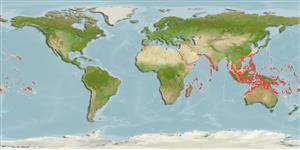
เกี่ยวกับทะเล,น้ำเค็ม เกี่ยวกับหินโสโครก; ระดับความลึก 0 - 70 m (Ref. 106604), usually 5 - 30 m (Ref. 43278). Tropical; 36°N - 27°S, 32°E - 136°W
Indo-Pacific: Persian Gulf (Ref.80050), Red Sea and East Africa to the Tuamoto Islands, north to southern Japan, south to Australia.
ความยาวเมื่อครบกำหนดครั้งแรก / ขนาด / น้ำหนัก / อายุ
วัยเจริญพันธุ์: Lm ?, range 230 - ? cm
Max length : 320 cm TL เพศผู้/กระเทย; (Ref. 247); common length : 250 cm TL เพศผู้/กระเทย; (Ref. )
คำอธิบายสั้นๆ
เครื่องมือที่ใช้ในการแยกชนิดสัตว์,สิ่งมีชีวิตออกจากกัน | สัณฐานวิทยา | ความยาวต่างๆ
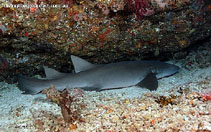
เงี่ยงครีบหลัง (รวม) : 0; เงี่ยงครีบก้น: 0. This large, bulky nurse shark is distinguished by the following features: side of body without lateral ridges; precaudal tail shorter than trunk; spiracles much smaller than eyes; nostrils close to front of snout, with short barbels and nasoral grooves connecting them with the mouth but without circumnarial grooves and folds; snout wedge-shaped in lateral view; two dorsal fins, both with angular apices, the origin of the first about over the pelvic-fin origins and its insertion slightly behind the pelvic-fin insertions; second dorsal fin slightly smaller than first; caudal fin about 1/3 of total length, strongly asymmetrical. Colour tan dorsally, paler ventrally and fins slightly dusky (Ref. 9999, 90102).
Body shape (shape guide): elongated; Cross section: angular.
Found on continental and insular shelves, from the intertidal down to at least 70 m (Ref. 247). Occurs on or near the bottom in lagoons or along the outer edges of coral and rocky reefs, sandy areas near reefs and off sandy beaches (Ref. 247, 43278). Primarily nocturnal, but may be active during the day (Ref. 247). Prefers crevices and caves on reefs but may be found hiding in more exposed areas (Ref. 247). Forms resting aggregations, and often seen piled across or on top of one another (Ref. 247). Feeds on a wide variety of bottom invertebrates, small fishes (Ref. 247), including cephalopods, crustaceans and sea urchins (Ref. 37816), corals (Ref. 68964). Docile and known to allow itself to be touched, but a few non-fatal attacks have been recorded (Ref. 247). Ovoviviparous (Ref. 43278). 4 or more young are born per litter (Ref. 37816). Survives in captivity (Ref. 247). Marketed fresh and dried-salted; fins dried for the oriental sharkfin trade; liver processed for vitamins and oil; offal processed for fishmeal; hide potentially valuable for leather (Ref. 247).
Ovoviviparous, with number of young at least four per uterus (Ref. 247); gives birth to litters of at about 8 pups (Ref.58048). Described as an oviparous or post-oviparous shark that retains the egg-cases until they hatch and the young are born. Size at birth 40 cm (TL, Ref.58048) to 60 cm (Ref. 9999). Also Ref. 205.
Compagno, L.J.V., 1984. FAO Species Catalogue. Vol. 4. Sharks of the world. An annotated and illustrated catalogue of shark species known to date. Part 1 - Hexanchiformes to Lamniformes. FAO Fish. Synop. 125(4/1):1-249. Rome, FAO. (Ref. 247)
สถานะบัญชีแดงของ IUCN (Ref. 130435: Version 2025-2)
การใช้ของมนุษย์
การประมง: การค้า; การตกปลาเป็นกีฬา: ใช่
เครื่องมือ
รายงานพิเศษ
ดาวน์โหลด XML
แหล่งที่มาจากอินเตอร์เน็ต
การประมาณค่าตามแบบจำลอง
อุณหภูมิที่ต้องการ (อ้างอิง
123201): 24.7 - 29, mean 28 °C (based on 1466 cells).
ดัชนีความหลากหลายทางวิวัฒนาการ (อ้างอิง
82804): PD
50 = 1.0625 [Uniqueness, from 0.5 = low to 2.0 = high].
Bayesian length-weight: a=0.00417 (0.00157 - 0.01105), b=3.08 (2.85 - 3.31), in cm total length, based on LWR estimates for this (Sub)family-body shape (Ref.
93245).
ระดับชั้นอาหาร (อ้างอิง
69278): 4.1 ±0.4 se; based on diet studies.
ความสามารถในการกลับคืนสู่ปกติ (อ้างอิง
120179): ต่ำมาก, เวลาต่ำสุดที่จะทำให้ประชากรเพิ่มขึ้นเป็น 2 เท่าใช้เวลามากกว่า 14 ปี (Fec=4).
ความเสี่ยงต่อการตกปลา (Ref.
59153): Very high vulnerability (90 of 100).
🛈
สารอาหาร (Ref.
124155): Calcium = 7.35 [1.66, 30.19] mg/100g; Iron = 0.365 [0.085, 1.034] mg/100g; Protein = 19.7 [17.5, 21.8] %; Omega3 = 0.0735 [, ] g/100g; Selenium = 43 [12, 125] μg/100g; VitaminA = 34.8 [12.7, 93.7] μg/100g; Zinc = 0.538 [0.259, 1.091] mg/100g (wet weight);