


Hemigaleus microstoma Bleeker, 1852
Sicklefin weasel shark
Ajouter votre observation dans Fish Watcher
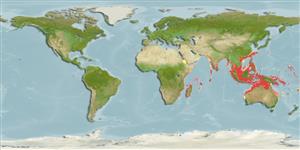
| Native range | All suitable habitat | Point map | Year 2050 |
|
| This map was computer-generated and has not yet been reviewed. |
| Hemigaleus microstoma AquaMaps Data sources: GBIF OBIS |
Envoyez vos Photos et vidéos
Images | Images Google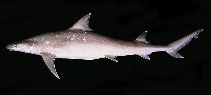 Hemigaleus microstoma
Photo de Randall, J.E.
Images | Images Google
Photo de Randall, J.E.
Classification / Noms Noms communs | Synonymes | Catalog of Fishes(Genre, Espèce) | ITIS | CoL | WoRMS | Cloffa
Élasmobranches (requins et raies) (sharks and rays) > Carcharhiniformes (Ground sharks) > Hemigaleidae (Weasel sharks)
Etymology: Hemigaleus: hemi-, from hemisys (Gr.), half, referring to similarity to and/or close affinity with Galeus (now in Pentanchidae) (See ETYFish); microstoma: micro-, from mikros (Gr.), small; stoma (Gr.), mouth, referring to very short arched mouth compared with Chaenogaleus macrostoma, its presumed congener at the time (See ETYFish).
More on author: Bleeker.
Etymology: Hemigaleus: hemi-, from hemisys (Gr.), half, referring to similarity to and/or close affinity with Galeus (now in Pentanchidae) (See ETYFish); microstoma: micro-, from mikros (Gr.), small; stoma (Gr.), mouth, referring to very short arched mouth compared with Chaenogaleus macrostoma, its presumed congener at the time (See ETYFish).
More on author: Bleeker.
Taxonomic Remarks
Specimens from Australia (and probably Papua New Guinea) are placed in Hemigaleus australiensis White, Last & Compagno, 2005 (Ref. 56150).
Environnement : milieu / zone climatique / profondeur / gamme de distribution Écologie
marin démersal. Tropical; 22°C - 28°C (Ref. 244); 28°N - 30°S
Distribution Territoires | Zones FAO | Écosystèmes | Occurrences | Carte par point | Introductions | Faunafri
Indo-West Pacific: southern India and Sri Lanka; China to Indonesia (Ref. 56150). Also from Red Sea (Ref. 93009).
Specimens found in Australia (and probably Papua New Guinea) belong to a separate species, Hemigaleus australiensis (Ref. 56150).
Longueur à la première maturité / Taille / Poids / Âge
Maturité: Lm ?, range 78 - ? cm
Max length : 135 cm TL mâle / non sexé; (Ref. 130455); poids max. publié: 14.0 kg (Ref. 130455)
Max length : 135 cm TL mâle / non sexé; (Ref. 130455); poids max. publié: 14.0 kg (Ref. 130455)
Description synthétique Clés d'identification | Morphologie | Morphométrie
Épines dorsales (Total) : 0; Épines anales: 0. Australian specimens with dark-tipped fins; tooth counts 28-34/43-54; total vertebral counts 111 to 118 (Ref. 13567). Indonesian, Singapore and Thailand specimens with light-tipped fins; tooth counts 25-32/37-43; total vertebral counts 137 to 150 (Ref. 13567). Grey-brown above, lighter below, dorsal fins with white tips and posterior margins, sometimes with spots on sides of body (Ref. 13567).
Body shape (shape guide): elongated.
Body shape (shape guide): elongated.
A small, relatively common inshore and offshore shark of tropical continental seas (Ref. 13567). Feeds mainly on cephalopods, particularly octopi (Ref. 13567) but also takes crustaceans and cephalopods (Ref. 244). Viviparous (Ref. 50449). Taken regularly in inshore artisanal fisheries (Ref.244), commonly caught by inshore gillnet, bottom trawl and, to a lesser extent, longline fisheries. Utilized for human consumption (Ref. 244). Offal used for fishmeal (Ref. 244).
Cycle de vie et comportement reproducteur Maturité | Reproduction | Frai | Œufs | Fécondité | Larves
Viviparous, with a yolk-sac placenta; 4 to 14 fetuses in a litter (Ref. 13567); 2-4 pups after a gestation period of about 6 months; born at about 45-47 cm TL (Ref. 58048). Size of full-term fetuses (detached umbilical cords and placentae) ranges from 23.7 to 25.6 cm (Ref. 244). Distinct pairing with embrace (Ref. 205).
Référence principale
Téléchargez vos références | Références | Coordinateur | Collaborateurs
Compagno, L.J.V., 1984. FAO Species Catalogue. Vol. 4. Sharks of the world. An annotated and illustrated catalogue of shark species known to date. Part 2 - Carcharhiniformes. FAO Fish. Synop. 125(4/2):251-655. Rome: FAO. (Ref. 244)
Statut dans la liste rouge de l'IUCN (Ref. 130435: Version 2025-2 (Global))
Vulnérable (VU) (A2d); Date assessed: 06 November 2020
CITES
Not Evaluated
Menace pour l'homme
Harmless (Ref. 13567)
Utilisations par l'homme
Pêcheries: intérêt commercial mineur
FAO - Publication: search | FishSource |
Plus d'informations
Écologie trophique
Aliments (proies)
Composition du régime alimentaire
Consommation alimentaire
Rations alimentaires
Prédateurs
Aliments (proies)
Composition du régime alimentaire
Consommation alimentaire
Rations alimentaires
Prédateurs
Dynamique des populations
Paramètres de croissance
Âges / tailles maximales
Longueur-poids rel.
Rel. longueur-longueur.
Fréquences de longueurs
Conversion de masse
Recrutement
Abondance
Paramètres de croissance
Âges / tailles maximales
Longueur-poids rel.
Rel. longueur-longueur.
Fréquences de longueurs
Conversion de masse
Recrutement
Abondance
Cycle de vie
Reproduction
Maturité
Maturité/épines rel.
Fécondité
Frai
Agrégats de frai
Œufs
Développement de l'œuf
Larves
Dynamique des populations larvaires
Reproduction
Maturité
Maturité/épines rel.
Fécondité
Frai
Agrégats de frai
Œufs
Développement de l'œuf
Larves
Dynamique des populations larvaires
Physiologie
Composition corporelle
Nutriments
Consommation d'oxygène
Type de natation
Vitesse de nage
Pigments visuels
Son de poisson
Maladies et parasites
Toxicité (CL50)
Composition corporelle
Nutriments
Consommation d'oxygène
Type de natation
Vitesse de nage
Pigments visuels
Son de poisson
Maladies et parasites
Toxicité (CL50)
Liées à l'homme
Systèmes d'aquaculture
Profils d'aquaculture
Souches
Cas de ciguatera
Timbres, pièces de monnaie, divers
Systèmes d'aquaculture
Profils d'aquaculture
Souches
Cas de ciguatera
Timbres, pièces de monnaie, divers
Outils
E-book | Guide de terrain | Clés d'identification | Générateur de fréquences de longueur | Outil de dynamique de population | Carte par point |
Capture-MSY |
Articles particuliers
Télécharger en XML
Sources Internet
AFORO (otoliths) | Aquatic Commons | BHL | Cloffa | Websites from users | FishWatcher | CISTI | Catalog of Fishes: Genre, Espèce | DiscoverLife | ECOTOX | FAO - Publication: search | Faunafri | Fishipedia | Fishtrace | GloBI | Google Books | Google Scholar | Google | IGFA World Record | Bases de données nationales | OneZoom | Open Tree of Life | Otolith Atlas of Taiwan Fishes | PubMed | Reef Life Survey | Socotra Atlas | TreeBase | Arbre de Vie | Wikipedia: aller à, chercher | World Records Freshwater Fishing | Zoobank | Zoological Record
Estimations basées sur des modèles
Température préférée (Réf. 123201): 22.2 - 28.3, mean 27 °C (based on 816 cells).
Indice de diversité phylogénétique (Réf. 82804): PD50 = 0.7539 [Uniqueness, from 0.5 = low to 2.0 = high].
Bayesian length-weight: a=0.00214 (0.00107 - 0.00426), b=3.10 (2.92 - 3.28), in cm total length, based on LWR estimates for this species & (Sub)family-body (Ref. 93245).
Niveau trophique (Réf. 69278): 4.2 ±0.4 se; based on diet studies.
Résilience (Réf. 120179): Très faible, temps minimum de doublement de population supérieur à 14 ans (Fec=4).
Nutriments (Ref. 124155): Calcium = 27.9 [4.5, 154.3] mg/100g; Iron = 0.693 [0.182, 2.119] mg/100g; Protein = 19 [17, 21] %; Omega3 = 0.114 [0.048, 0.271] g/100g; Selenium = 54.1 [16.0, 167.0] μg/100g; VitaminA = 22.3 [7.2, 70.4] μg/100g; Zinc = 0.769 [0.374, 1.395] mg/100g (wet weight);