


Masukkan pemerhatian anda di Fish Watcher
| Native range | All suitable habitat | Point map | Year 2050 |

|
| This map was computer-generated and has not yet been reviewed. |
| Iago garricki AquaMaps Data sources: GBIF OBIS |
muatnaik fotos/gambar dan video
Gambar | imej Google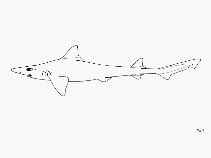 Iago garricki
foto/gambar oleh FAO
Gambar | imej Google
foto/gambar oleh FAO
klasifikasi / Nama Nama-nama umum | Sinonim (persamaan) | Catalog of Fishes(Marga, Jenis) | ITIS | CoL | WoRMS | Cloffa
Ikan bertulang rawan (sharks and rays) > Carcharhiniformes (Ground sharks) > Triakidae (Houndsharks) > Galeorhininae
Etymology: Iago: Name of villain in Shakespeare’s Othello, because members of this genus have been a “troublemaker for systematists and hence a kind of villain” (See ETYFish); garricki: Patronym not identified but clearly in honor of J.A.F. (Jack) Garrick (1928-2018), New Zealand shark taxonomist and biologist (See ETYFish).
Eponymy: The name of this genus derives from Iago, the villain in Shakespeare’s play Othello. The authors say that this genus is “a troublemaker for systematists and hence a kind of villain”. Dr John Andrew Frank (Jack) Garrick (1928–2018) was a New Zealand ichthyologist with a specialization in elasmobranchs. [...] (Ref. 128868), visit book page.
Etymology: Iago: Name of villain in Shakespeare’s Othello, because members of this genus have been a “troublemaker for systematists and hence a kind of villain” (See ETYFish); garricki: Patronym not identified but clearly in honor of J.A.F. (Jack) Garrick (1928-2018), New Zealand shark taxonomist and biologist (See ETYFish).
Eponymy: The name of this genus derives from Iago, the villain in Shakespeare’s play Othello. The authors say that this genus is “a troublemaker for systematists and hence a kind of villain”. Dr John Andrew Frank (Jack) Garrick (1928–2018) was a New Zealand ichthyologist with a specialization in elasmobranchs. [...] (Ref. 128868), visit book page.
Lingkungan: lingkungan / zona iklim / kisaran kedalaman / jangkauan distribusi Ekologi
laut batidemersal; kisaran kedalaman 250 - 475 m (Ref. 6871). Deep-water; 9°S - 26°S
Penyebaran Wilayah | Daerah-daerah FAO | Ekosistem | Kemunculan | peta titik | Introduksi | Faunafri
Indo-Pacific: from the South China Sea (off Dongsha Atolll) to nw and ne Australia, including Indonesia, the Philippines, Papua New Guinea and Vanuatu.
Panjang pada saat jatuh tempo pertama / Ukuran / Berat / umur
deskripsi pendek Kunci identifiaksi (pengenalan) | Morfologi | Morfometrik
Duri punggung (Keseluruhan (total)) : 0; Duri dubur: 0. This species is distinguished by the following characters: snout long and narrow; preoral length 35.1% (34.9-38.7%) head length; eye large, its length 18.5% (17.0-24.1%) HL; gill slit rather short, first gill slit height 47.8% (31.4-51.6%) eye length; anterolateral teeth straight to slightly oblique, blade-like, with 1-3 broad, smooth distal cusplets; first dorsal-fin origin does not reach to the vertical line through the pectoral-fin base; caudal-fin ventral lobe is moderately developed in adults. Colouration: body generally grey, with faint dark edges on dorsal-fin apexes, more prominent in juveniles (Ref. 127459).
Body shape (shape guide): elongated; Cross section: angular.
Body shape (shape guide): elongated; Cross section: angular.
A little-known tropical shark found on the uppermost insular slopes (Ref. 13563) at depths of 250-475 m (Ref.58048). Stomach contents of a specimen included small Macrouridae (Hymenocephalus sp., Nezumia sp., Ventrifossa spp.), crustaceans (Penaeoidea, Munidae) (Ref. 127459) and cephalopods (Ref. 244). Viviparous, placental (Ref. 50449). Caught irregularly by the small-scale demersal longline fisheries operating in deepwater. Utilized for its meat and fins, but of limited value due to its small size (Ref.58048).
Siklus hidup dan perilaku kawin Kematangan | Reproduksi, perkembang biakan | Pemijahan | telur-telur | Fekunditas | Larva
Viviparous, placental (Ref. 50449). With 4 or 5 young per litter (Ref. 244). Size at birth near 23 cm (full-term fetuses) (Ref. 244). Distinct pairing with embrace (Ref. 205).
rujukan utama
Unggah referensi Anda | Acuan | Koordinator : Compagno, Leonard J.V. | mitra
Ng, S.-L., H.-C. Ho, K.-M. Liu and S.-J. Joung, 2022. Redescription of the longnose houndshark Iago garricki (Carcharhiniformes: Triakidae), based on specimens recently collected from the South China Sea. Zootaxa 5189(1):67-77. (Ref. 127459)
Status IUCN Red List (Ref. 130435: Version 2025-2 (Global))
kurang bimbang (LC) ; Date assessed: 14 May 2015
CITES
Not Evaluated
ancaman kepada manusia
Harmless (Ref. 13563)
penggunaan manusia
Perikanan: nilai komersial kecil
FAO - Publication: search | FishSource |
informasi lanjut
Dinamika populasi
Parameter pertumbuhan
Maks. usia / ukuran
Panjang-berat rel.
Panjang-panjang rel.
ukuran frekuensi
Konversi massa
pemulihan
Kelimpahan
Parameter pertumbuhan
Maks. usia / ukuran
Panjang-berat rel.
Panjang-panjang rel.
ukuran frekuensi
Konversi massa
pemulihan
Kelimpahan
Siklus hidup
Reproduksi, perkembang biakan
Kematangan
Kedewasaan / insang rel.
Fekunditas
Pemijahan
Agregasi pemijahan
telur-telur
pekembangan telor
Larva
Dinamika larva
Reproduksi, perkembang biakan
Kematangan
Kedewasaan / insang rel.
Fekunditas
Pemijahan
Agregasi pemijahan
telur-telur
pekembangan telor
Larva
Dinamika larva
Anatomi
Area insang
Otak
Otolith
Area insang
Otak
Otolith
Fisiologi
Komposisi tubuh
Nutrisi
Konsumsi oksigen
Jenis renang
Kecepatan berenang
Pigmen visual
Suara ikan
Penyakit & Parasit
Toksisitas (LC50)
Komposisi tubuh
Nutrisi
Konsumsi oksigen
Jenis renang
Kecepatan berenang
Pigmen visual
Suara ikan
Penyakit & Parasit
Toksisitas (LC50)
Genetika
genom
Genetika
Heterozigositas
Diturunkan
Keanekaragaman Genetik
genom
Genetika
Heterozigositas
Diturunkan
Keanekaragaman Genetik
Yang berhubungan dengan manusia
Sistem akuakultur
profil budidaya air
Strain
Kasus Ciguatera
Perangko, koin, dll.
Sistem akuakultur
profil budidaya air
Strain
Kasus Ciguatera
Perangko, koin, dll.
Alat, peralatan
E-book | Penuntun lapangan | Kunci identifiaksi (pengenalan) | tanda freqkuenci panjang | peringkat sejarah hidup | peta titik |
Tangkap-MSY |
laporan khas
muat turun XML
Sumber internet
AFORO (otoliths) | Aquatic Commons | BHL | Cloffa | Websites from users | semak peneliti ikan | CISTI | Catalog of Fishes: Marga, Jenis | DiscoverLife | ECOTOX | FAO - Publication: search | Faunafri | Fishipedia | Fishtrace | GloBI | Google Books | Google Scholar | Google | IGFA World Record | OneZoom | Open Tree of Life | Otolith Atlas of Taiwan Fishes | PubMed | Reef Life Survey | Socotra Atlas | TreeBase | Tree of Life | Wikipedia: pergi, Cari | World Records Freshwater Fishing | Zoobank | Catatan Zoologi
Estimasi berdasarkan model
Suhu yang disukai (Acuan 123201): 11 - 17.2, mean 12.4 °C (based on 26 cells).
Indeks keanekaragaman filogenetik (Acuan 82804): PD50 = 0.5625 [Uniqueness, from 0.5 = low to 2.0 = high].
Bayesian length-weight: a=0.00427 (0.00183 - 0.00997), b=3.04 (2.84 - 3.24), in cm total length, based on LWR estimates for this (Sub)family-body shape (Ref. 93245).
Tingkat Trofik (Acuan 69278): 4.5 ±0.37 se; based on food items.
Daya lenting (Acuan 120179): sangat rendah, Waktu penggandaan populasi minimum lebih dari 14 tahun (Fec=4).