This website uses cookies to enhance your browsing experience and ensure the functionality of our site. For more detailed information about the types of cookies we use and how we protect your privacy, please visit our Privacy Information page.
×
Cookie Settings
This website uses different types of cookies to enhance your experience. Please select your preferences below:
> Centrarchiformes (Basses) > Cirrhitidae (Hawkfishes)
Etymology: Paracirrhites:Greek, para = the side of + Latin, cirrus = curl (Ref. 45335). Eponymy: Johann Reinhold Forster (1729–1798) was a German clergyman in Danzig (now Gdansk, Poland). [...] (Ref. 128868), visit book page. More on author: Schneider.
Milieu: milieu / Klimaatzone / Diepte / verspreidingsgebied Ecologie
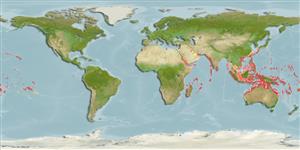
marien rifbewoner; diepte 0 - 35 m (Ref. 37816), usually 5 - 35 m (Ref. 27115). Tropical; 24°C - 27°C (Ref. 27115); 35°N - 36°S, 28°E - 124°W
Indo-Pacific: Red Sea and East Africa (Ref. 5469) to the Hawaiian, Line, Marquesan and Ducie islands, north to southern Japan, south to New Caledonia and the Austral Islands. Unknown from the Persian and Oman gulfs (Ref. 11441).
Grootte / Gewicht / Leeftijd
Maturiteit: Lm? range ? - ? cm Max length : 22.0 cm TL mannelijk / geslacht onbekend; (Ref. 30573); common length : 18.0 cm TL mannelijk / geslacht onbekend; (Ref. 30573)
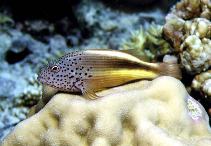
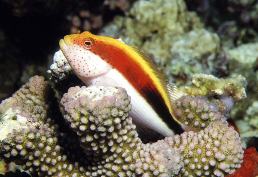
Dorsale stekels (totaal) : 10; Dorsale zachte stralen (totaal) : 11; Anale stekels: 3; Anale zachte stralen: 6. Body yellowish with broad blackish stripe on upper side; head and anterior part of body with small dark reddish spots (Ref. 5469).Color changes with growth as well as varies among adults (Ref. 37816). In Oceania, juveniles are a golden green dorsally and white ventrally; in continental areas juveniles may be red dorsally (Ref. 37816). The maroon and yellow phase was originally described as a distinct species, P. typee (Ref. 37816).
Body shape (shape guide): fusiform / normal; Cross section: compressed.
Inhabits clear lagoon or seaward reefs to at least 33 m depth (Ref. 9710), but may venture very deep. Occurs openly on coral and soft-bottom habitats, occasionally in pairs (Ref. 48636). Benthic (Ref. 58302). Tends to perch on outermost branches of Stylophora, Pocillopora, and Acropora corals (Ref. 9710). Feeds mainly on small fishes and crustaceans, sometimes on shrimps and is territorial and haremic (Ref. 37816). Solitary on corals (Ref 90102). Marketed mostly fresh. Minimum depth reported taken from Ref. 128797.
Randall, J.E., G.R. Allen and R.C. Steene, 1990. Fishes of the Great Barrier Reef and Coral Sea. University of Hawaii Press, Honolulu, Hawaii. 506 p. (Ref. 2334)
Status op de Rode Lijst van het IUCN (Ref. 130435: Version 2025-2 (Global))
Gewenste temperatuur (Ref. 123201): 24.5 - 28.8, mean 27.5 °C (based on 856 cells).
Fylogenetische diversiteitsindex (Ref. 82804): PD50 = 0.5156 [Uniqueness, from 0.5 = low to 2.0 = high].
Bayesian length-weight: a=0.00871 (0.00429 - 0.01769), b=3.09 (2.91 - 3.27), in cm total length, based on LWR estimates for this species & (Sub)family-body (Ref. 93245).
Trofisch niveau (Ref. 69278): 4.3 ±0.76 se; based on food items.
Kwetsbaarheid van de visserij (Ref. 59153): Low vulnerability (12 of 100). 🛈