


Copadichromis atripinnis Stauffer & Sato, 2002
Hochladen Photos und videos
Google Bild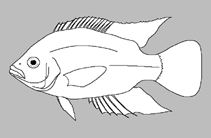 No image available for this species;
drawing shows typical species in Cichlidae.
Google Bild
drawing shows typical species in Cichlidae.
Klassifizierung / Names Namen | Synonyme | Catalog of Fishes(Gattung, Arten) | ITIS | CoL | WoRMS | Cloffa
> Cichliformes (Cichlids, convict blennies) > Cichlidae (Cichlids) > Pseudocrenilabrinae
Etymology: Copadichromis: Greek, kopas, -ados = carved + Chromis, see; atripinnis: Named for the solid black pigmentation of the pelvic fin.
Etymology: Copadichromis: Greek, kopas, -ados = carved + Chromis, see; atripinnis: Named for the solid black pigmentation of the pelvic fin.
Umwelt: Milieu / Klimazone / Tiefenbereich / Verbreitungsgebiet Ökologie
; süßwasser pelagisch; tiefenbereich 12 - 25 m (Ref. 42940). Tropical
Verbreitung Territorien | FAO Gebiete | Ökosysteme | Vorkommen | Punkt Karte | Einführungen | Faunafri
Africa: Endemic to Lake Malawi, occurring along the rocky shores of Nankumba Peninsula and along those shores between the Masinje River and Gome Village.
Größe / Gewicht / Alter
Kurzbeschreibung Bestimmungsschlüssel | Morphologie | Morphometrie
Rückenflossenstacheln (insgesamt) : 14 - 17; Rückenflossenweichstrahlen (insgesamt) : 10 - 12; Afterflossenstacheln: 0; Afterflossenweichstrahlen: 8 - 10. Diagnosis: 3 lateral spots on the body (Ref. 57549). Supra-pectoral spot about 1-1.5 times the supra-anal spot (Ref. 57549) and overlapping upper lateral line (Ref. 42940). Supra-anal spot present (Ref. 42940, 57549). Spots in the rayed portion of dorsal fin yellow; anal fin black (Ref. 42940). Breeding males with wide yellow marginal band in anal fin (Ref. 42940, 57549), blue breast and a narrow black submarginal band in the dorsal fin (Ref. 57549). Caudal fin membrane yellow, in breeding males with broad bands; pectoral fin completely black; dorsal fin base length 56.3-62.45% SL; 14-20 gill rakers on the ceratobranchial (Ref. 42940).
Body shape (shape guide): fusiform / normal.
Body shape (shape guide): fusiform / normal.
Inhabits the sand/rock interface; territorial males construct bowers on sand slopes near rocky areas with distances between bowers approximately 2-7m; females gather in large schools, sometimes numbering more than a hundred individuals; foraging schools are about 2-3m off the bottom and feed on plankton in the water column and on benthic invertebrates; mouthbrooding females are found close to the bottom (Ref. 57549).
Lebenszyklus und Paarungsverhalten Geschlechtsreife | Fortpflanzung | Ablaichen | Eier | Fruchtbarkeit | Larven
Builds bowers on a sand slope near rocky area at depth of 16-25 m. Bowers are circular or oval in shape with slight depression on the center and a surrounding sand mound. These contain a stone usually at the deeper margin of the sand mound. The depression is usually deepest near the stone and spawning takes place at this deepest part.
Hauptreferenz
Laden Sie Ihre Referenzen hoch | Referenzen | Koordinator : Kullander, Sven O. | Partner
Stauffer, J.R. Jr. and T. Sato, 2002. A new species of Copadichromis (Cichlidae) from Thumbi West Island, Lake Malawi. Ichthyol. Explor. Freshwat. 13(1):91-95. (Ref. 42940)
IUCN Rote Liste Status (Ref. 130435: Version 2025-2 (Global))
nicht bedroht (LC) ; Date assessed: 22 June 2018
CITES
Not Evaluated
Bedrohung für Menschen
Harmless
Nutzung durch Menschen
FAO - Publication: search | FishSource |
Mehr Information
Trophische Ökologie
Lebensmittel (Beutetiere)
Nahrungszusammensetzung
Nahrungsaufnahme
Lebensmittelrationen
Räuber
Lebensmittel (Beutetiere)
Nahrungszusammensetzung
Nahrungsaufnahme
Lebensmittelrationen
Räuber
Ökologie
Ökologie
Ökologie
Populationsdynamik
Wachstumsparameter
Max. Alter/Größen
Länge-Gewicht-Rel.
Länge-Länge-Verhältnis.
Längenhäufigkeiten
Massenkonvertierung
Rekrutierung
Dichte
Wachstumsparameter
Max. Alter/Größen
Länge-Gewicht-Rel.
Länge-Länge-Verhältnis.
Längenhäufigkeiten
Massenkonvertierung
Rekrutierung
Dichte
Lebenszyklus
Fortpflanzung
Geschlechtsreife
Reifung/Kiemen rel.
Fruchtbarkeit
Ablaichen
Laichaggregationen
Eier
Eientwicklung
Larven
Larven Pop.Dyn.
Fortpflanzung
Geschlechtsreife
Reifung/Kiemen rel.
Fruchtbarkeit
Ablaichen
Laichaggregationen
Eier
Eientwicklung
Larven
Larven Pop.Dyn.
Anatomie
Kiemenoberfläche
Gehirn
Otolith
Kiemenoberfläche
Gehirn
Otolith
Physiologie
Körperliche Zusammensetzung
Nährstoffe
Sauerstoffverbrauch
Schwimmart
Schwimmgeschwindigkeit
Visuelle Pigmente
Fischgeräusche
Krankheiten und Parasiten
Toxizität (LC50s)
Körperliche Zusammensetzung
Nährstoffe
Sauerstoffverbrauch
Schwimmart
Schwimmgeschwindigkeit
Visuelle Pigmente
Fischgeräusche
Krankheiten und Parasiten
Toxizität (LC50s)
Genetik
Genom
Genetik
Heterozygotie
Vererbbarkeit
Genetische Vielfalt
Genom
Genetik
Heterozygotie
Vererbbarkeit
Genetische Vielfalt
Menschenbezogen
Aquakultur-Systeme
Aquakultur Profile
Zuchtlinien
Ciguatera-Fälle
Briefmarken, Münzen, Verschiedenes.
Aquakultur-Systeme
Aquakultur Profile
Zuchtlinien
Ciguatera-Fälle
Briefmarken, Münzen, Verschiedenes.
Tools
E-Book | Feldführer | Bestimmungsschlüssel | Längenhäufigkeits Tool | Lebensdaten Tool | Punkt Karte |
Catch-MSY |
Zusatzinformationen
Download XML
Zusammenfassung | Punktdaten | Namen | Photos
Internet Quellen
AFORO (otoliths) | Aquatic Commons | BHL | Cloffa | Websites from users | FishWatcher Einträge suchen | CISTI | Catalog of Fishes: Gattung, Arten | DiscoverLife | ECOTOX | FAO - Publication: search | Faunafri | Fishipedia | Fishtrace | GloBI | Google Books | Google Scholar | Google | IGFA World Record | OneZoom | Open Tree of Life | Otolith Atlas of Taiwan Fishes | PubMed | Reef Life Survey | Socotra Atlas | TreeBase | Tree of Life | Wikipedia: Gehe zu, Suchen | World Records Freshwater Fishing | Zoobank | Zoologischer Rekord
Schätzungen auf der Grundlage von Modellen
Phylogenetischer Diversitätsindex (Ref. 82804): PD50 = 0.5000 [Uniqueness, from 0.5 = low to 2.0 = high].
Bayesian length-weight: a=0.01445 (0.00671 - 0.03113), b=2.99 (2.82 - 3.16), in cm total length, based on LWR estimates for this (Sub)family-body shape (Ref. 93245).
Trophische Ebene (Ref. 69278): 3.3 ±0.4 se; based on size and trophs of closest relatives
Widerstandsfähigkeit (Ref. 120179): hoch, Verdopplung der Population dauert weniger als 15 Monate. (Preliminary K or Fecundity.).