>
Atheriniformes (Silversides) >
Atherinidae (Silversides) > Atherinomorinae
Etymology: Doboatherina: Name from 'Dobo', the local name of atherinid fishes in Mie Prefecture, Japan, and 'Atherina', the name of type genus of Atherinidae; aetholepis: Named for its scales with long spatular outgrowth posteriorly along the dorsal midline anterior to the second dorsal fin.
Environment: milieu / Zona climática / intervalo de profundidade / distribution range
Ecologia
marinhas; estuarina pelagic-neritic. Tropical; 13°N - 6°S, 100°E - 155°E (Ref. 121273)
Western Pacific: Thailand, the Philippines, Malaysia, Indonesia and Papua New Guinea.
Tamanho / Peso / Idade
Maturidade: Lm ? range ? - ? cm
Max length : 7.2 cm SL macho/indeterminado; (Ref. 44256)
Descrição suscinta
Chaves de identificação | Morfologia | Morfometria
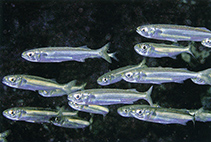
Espinhos dorsais (total) : 5 - 8; Raios dorsais (total) : 9 - 11; Espinhos anais: 12 - 14; Vértebras: 38 - 42. This species is distinguished by the following combination of characters: a long spatular outgrowth on the posterior margin of most predorsal and interdorsal scales; ascending process of premaxilla is short and blunt, its height about two times maximum width, and shorter than horizontal length of premaxilla, its height about 2/5 to 1/2 of the horizontal length; premaxilla with a single lateral process; palatine with teeth; head rather large, HL 25-31% SL; upper jaw length 8.4-11% SL and 32-41% HL; midlateral band rather wide, width about 3/5-4/5 of width of midlateral scale, and its lower margin reaching to lower margin of midlateral scale row at the level of anal-fin origin (width of midlateral band 17-30% of body depth and 47-75% of caudal peduncle depth at the level of anal-fin origin. Colour of head and body faintly greenish-
tan dorsally, brilliant silver laterally; the midlateral band glossy indigo blue, upper edge with a greenish-white line; with small black dots ventrolaterally on body; snout dusky; a narrow black band along the anal-fin base; rays of second dorsal, caudal, and pectoral fins are fringed with dark dots; fin membranes hyaline (Ref. 121273).
Cross section: oval.
Adults occur usually along the open coast; rarely seen in lagoons or inner parts of bays and inlets (Ref. 44256).
Ciclo de vida ou comportamento de acasalamento
Maturidade | Reprodução | Desova | Ovos | Fecundidade | Larvas
Kimura, S., Y. Iwatsuki and T. Yoshino, 2002. A new silverside, Atherinosomus aetholepis sp. nov., from the West Pacific (Atheriniformes: Atherinidae). Ichthyol. Res. 49(3):240-244. (Ref. 44256)
Status na Lista Vermelha da UICN (Ref. 130435: Version 2025-1)
Ameaça para os humanos
Harmless
Uso pelos humanos
Ferramentas
Relatórios especiais
Baixar XML
Fontes da internet
Estimates based on models
Preferred temperature (Ref.
123201): 28 - 29.1, mean 28.5 °C (based on 74 cells).
Índice de diversidade filogenética (Ref.
82804): PD
50 = 0.6250 [Uniqueness, from 0.5 = low to 2.0 = high].
Bayesian length-weight: a=0.00562 (0.00240 - 0.01320), b=3.15 (2.95 - 3.35), in cm total length, based on LWR estimates for this (Sub)family-body shape (Ref.
93245).
Nível Trófico (Ref.
69278): 3.2 ±0.4 se; based on size and trophs of closest relatives
Resiliência (Ref.
120179): Elevada, tempo mínimo de duplicação da população menor que 15 meses (Preliminary K or Fecundity.).
Fishing Vulnerability (Ref.
59153): Low vulnerability (10 of 100).
🛈