


muatnaik fotos/gambar dan video
imej Google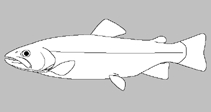 No image available for this species;
drawing shows typical species in Salmonidae.
imej Google
drawing shows typical species in Salmonidae.
klasifikasi / Nama Nama-nama umum | Sinonim (persamaan) | Catalog of Fishes(Marga, Jenis) | ITIS | CoL | WoRMS | Cloffa
> Salmoniformes (Salmons) > Salmonidae (Salmonids) > Salmoninae
Etymology: Salmo: Latin, salmo, Plinius = salmon (Ref. 45335).
Eponymy: This is a toponym; referring to Lake Ezenam, Daghestan, Caucasus, Russia which is the type locality. (Ref. 128868), visit book page.
More on author: Berg.
Etymology: Salmo: Latin, salmo, Plinius = salmon (Ref. 45335).
Eponymy: This is a toponym; referring to Lake Ezenam, Daghestan, Caucasus, Russia which is the type locality. (Ref. 128868), visit book page.
More on author: Berg.
Lingkungan: lingkungan / zona iklim / kisaran kedalaman / jangkauan distribusi Ekologi
; air tawar bentopelagis. Temperate
Penyebaran Wilayah | Daerah-daerah FAO | Ekosistem | Kemunculan | peta titik | Introduksi | Faunafri
Europe: Lake Kezenoi-am (formerly Eizenam) (Daghestan) in northern Caucasus, Russia. Introduced in 1963 in Lake Mochokh (Daghestan), probably established.
Ukuran / Berat / umur
Kematangan: Lm ? range ? - ? cm
Max length : 113 cm SL jantan/; (Ref. 59043); Berat maksimum terpublikasi: 17.0 kg (Ref. 59043)
Max length : 113 cm SL jantan/; (Ref. 59043); Berat maksimum terpublikasi: 17.0 kg (Ref. 59043)
deskripsi pendek Kunci identifiaksi (pengenalan) | Morfologi | Morfometrik
Distinguished from congeners in Caspian Sea basin by having the following unique characters: 16-21 short and broad gill rakers, without denticles, in large individuals sometimes slightly expanded at tip; maxilla not reaching posterior margin of eye; and bright coloration comprising of 10-30 relatively large (6-7 mm in diameter) carmine red spots above lateral line, small black spots on back, red spots on dorsal, upper caudal lobe, and adipose fins (Ref. 59043).
Body shape (shape guide): fusiform / normal.
Body shape (shape guide): fusiform / normal.
Inhabits mountain lake (Lake Kezenoi-am) with altitude of 1870 m above sea level, with a maximum depth of 74 m, temperature about 5° C below 20 m and 5-18° C in upper layers in summer, covered by ice in winter, high oxygen concentrations down to bottom throughout the year and low plankton density. This was the only fish inhabiting the lake prior to the introduction of Gobio holurus and Squalius cephalus. Young juveniles feed predominantly on gammarids, chironomid larvae; larger juveniles and adults prey on molluscs, benthic invertebrates and fry; largest individuals are mostly piscivorous, especially since the introduction of Gobio holurus. Spawns in lake, close to underwater springs. Large-sized individuals probably undertake migration to tributaries. Spawning extends over almost entire year. Threatened due to the introduction of Squalius cephalus, which feeds on its fry (Ref. 59043).
Siklus hidup dan perilaku kawin Kematangan | Reproduksi, perkembang biakan | Pemijahan | telur-telur | Fekunditas | Larva
rujukan utama
Unggah referensi Anda | Acuan | Koordinator | mitra
Bogutskaya, N.G. and A.M. Naseka, 2002. An overview of nonindigenous fishes in inland waters of Russia. Proc. Zool. Inst. Russ. Acad. Sci. 296:21-30. (Ref. 45022)
Status IUCN Red List (Ref. 130435: Version 2025-2 (Global))
sangat terancam (CR) (B1ab(iii,v)+2ab(iii,v)); Date assessed: 01 January 2008
CITES
Not Evaluated
ancaman kepada manusia
Harmless
penggunaan manusia
Perikanan: memiliki potensi kepentingan
FAO - Publication: search | FishSource |
informasi lanjut
Ekologi trofik
Item makanan (mangsa)
Komposisi makanan
Konsumsi makanan
Ransum makanan
Pemangsa
Item makanan (mangsa)
Komposisi makanan
Konsumsi makanan
Ransum makanan
Pemangsa
Ekologi
Ekologi
Ekologi
Dinamika populasi
Parameter pertumbuhan
Maks. usia / ukuran
Panjang-berat rel.
Panjang-panjang rel.
ukuran frekuensi
Konversi massa
pemulihan
Kelimpahan
Parameter pertumbuhan
Maks. usia / ukuran
Panjang-berat rel.
Panjang-panjang rel.
ukuran frekuensi
Konversi massa
pemulihan
Kelimpahan
Siklus hidup
Reproduksi, perkembang biakan
Kematangan
Kedewasaan / insang rel.
Fekunditas
Pemijahan
Agregasi pemijahan
telur-telur
pekembangan telor
Larva
Dinamika larva
Reproduksi, perkembang biakan
Kematangan
Kedewasaan / insang rel.
Fekunditas
Pemijahan
Agregasi pemijahan
telur-telur
pekembangan telor
Larva
Dinamika larva
Anatomi
Area insang
Otak
Otolith
Area insang
Otak
Otolith
Fisiologi
Komposisi tubuh
Nutrisi
Konsumsi oksigen
Jenis renang
Kecepatan berenang
Pigmen visual
Suara ikan
Penyakit & Parasit
Toksisitas (LC50)
Komposisi tubuh
Nutrisi
Konsumsi oksigen
Jenis renang
Kecepatan berenang
Pigmen visual
Suara ikan
Penyakit & Parasit
Toksisitas (LC50)
Genetika
genom
Genetika
Heterozigositas
Diturunkan
Keanekaragaman Genetik
genom
Genetika
Heterozigositas
Diturunkan
Keanekaragaman Genetik
Yang berhubungan dengan manusia
Sistem akuakultur
profil budidaya air
Strain
Kasus Ciguatera
Perangko, koin, dll.
Sistem akuakultur
profil budidaya air
Strain
Kasus Ciguatera
Perangko, koin, dll.
Alat, peralatan
E-book | Penuntun lapangan | tanda freqkuenci panjang | peringkat sejarah hidup | peta titik |
Tangkap-MSY |
laporan khas
muat turun XML
Sumber internet
AFORO (otoliths) | Aquatic Commons | BHL | Cloffa | Websites from users | semak peneliti ikan | CISTI | Catalog of Fishes: Marga, Jenis | DiscoverLife | ECOTOX | FAO - Publication: search | Faunafri | Fishipedia | Fishtrace | GloBI | Google Books | Google Scholar | Google | IGFA World Record | OneZoom | Open Tree of Life | Otolith Atlas of Taiwan Fishes | PubMed | Reef Life Survey | Socotra Atlas | TreeBase | Tree of Life | Wikipedia: pergi, Cari | World Records Freshwater Fishing | Catatan Zoologi
Estimasi berdasarkan model
Indeks keanekaragaman filogenetik (Acuan 82804): PD50 = 0.5000 [Uniqueness, from 0.5 = low to 2.0 = high].
Bayesian length-weight: a=0.01047 (0.00486 - 0.02255), b=3.03 (2.86 - 3.20), in cm total length, based on LWR estimates for this Genus-body shape (Ref. 93245).
Tingkat Trofik (Acuan 69278): 3.8 ±0.5 se; based on size and trophs of closest relatives
Daya lenting (Acuan 120179): sangat rendah, Waktu penggandaan populasi minimum lebih dari 14 tahun (Preliminary K or Fecundity.).