Environment: milieu / climate zone / rango de profundidad / distribution range
Ecología
marino; salobre pelagic-neritic; rango de profundidad 0 - 50 m (Ref. 189). Tropical; 2°S - 40°S, 20°E - 51°E
Western Indian Ocean: from the east coast of Africa, Kenya to Natal, South Africa, and Madagascar.
Tamaño / Peso / Age
Madurez: Lm ? range ? - ? cm
Max length : 22.0 cm TL macho / no sexado; (Ref. 5430)
Short description
Claves de identificación | Morfología | Morfometría
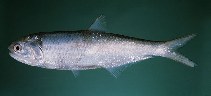
Espinas dorsales (total) : 0; Radios blandos dorsales (total) : 13 - 14; Espinas anales: 0; Radios blandos anales: 34 - 44; Vértebra: 43 - 45. Diagnosis: Body compressed, belly with 16-19 pre-pelvic and 8-12 post-pelvic scutes, a total of 24-30 keeled scutes from isthmus to anus; maxilla long, reaching beyond base of first pectoral finray; first supra-maxilla a minute oval; lower gillrakers 18-24, the serrae on the inner edge in distinct clumps in larger fishes; anal fin with 3-4 unbranched rays and 31-40 branched rays; a dark blotch behind upper part of gill opening; inside of gill cavity bright orange (Ref. 189). This species overlaps the range of different other species of Thryssa, of which five have a similar maxilla, very small first supra-maxilla and overlapping gillraker counts; however of these five species, T. gautamiensis, T. malabarica, T. purava and T. whiteheadi all have the tip of the snout at or above the level of the centre of the eye, and the last two, plus T. stenosoma, have at least 38 branched anal finrays (Ref. 189).
Body shape (shape guide): elongated; Cross section: compressed.
A coastal, pelagic species (Ref. 28), apparently common along shore and in estuaries (Ref. 5430). Presumably schooling, occurring inshore and entering estuaries and lagoons, perhaps used as nursery areas, but moving further out in rainy seasons when coastal waters are freshened up by rivers (Ref. 189). It feeds on plankton organisms (Ref. 28). May be caught using ringnets (Ref. 5213). Generally marketed fresh, may be salted or dried (Ref. 5284).
Life cycle and mating behavior
Madurez | Reproducción | Puesta | Huevos | Fecundidad | Larva
Hata, H. and H. Motomura, 2019. Two new species of Thrissina (Clupeiformes: Engraulidae) from the northern Indian Ocean and redescription of Thrissina vitrirostris (Gilchrist and Thompson 1908). Ichthyol. Res. 67(1):155-166 (Ref. 128122)
IUCN Red List Status (Ref. 130435: Version 2025-1)
Threat to humans
Harmless
Human uses
Pesquerías: escaso valor comercial; carnada: usually
Herramientas
Special reports
Download XML
Fuentes de Internet
Estimates based on models
Preferred temperature (Referencia
123201): 24.6 - 29.3, mean 27.4 °C (based on 294 cells).
Phylogenetic diversity index (Referencia
82804): PD
50 = 0.5039 [Uniqueness, from 0.5 = low to 2.0 = high].
Bayesian length-weight: a=0.00513 (0.00309 - 0.00850), b=3.15 (3.01 - 3.29), in cm total length, based on LWR estimates for this species & (Sub)family-body (Ref.
93245).
Nivel trófico (Referencia
69278): 3.4 ±0.5 se; based on size and trophs of closest relatives
Resiliencia (Referencia
120179): Alto, población duplicada en un tiempo mínimo inferior a 15 meses (K=0.5).
Fishing Vulnerability (Ref.
59153): Low vulnerability (24 of 100).
🛈