>
Perciformes/Percoidei (Perchs) >
Percidae (Perches) > Etheostomatinae
Etymology: Etheostoma: Greek, etheo = to strain + Greek, stoma = mouth; Rafinesque said "various mouths", but Jordan and Evermann suggest the name might have been intended as "Heterostoma (Ref. 45335); lawrencei: Named after Lawrence M. Page.
Eponymy: Professor Dr Lawrence ‘Larry’ Merle Page (d: 1944) (see Page) (Ref. 128868), visit book page.
Environment: milieu / climate zone / rango de profundidad / distribution range
Ecología
; agua dulce demersal. Temperate
North America: 3 disjunct river systems in Kentucky and Tennessee: headwaters of Salt River system; upper Green River system including the Nolin and Mud River systems; and Cumberland River system from Wilburn Creek on the north and Dillard Creek on the south side of the Cumberland River, Smith County, Tennessee, upstream to near Cumberland Falls.
Length at first maturity / Tamaño / Peso / Age
Madurez: Lm ? range ? - ? cm
Max length : 6.2 cm SL macho / no sexado; (Ref. 47261); 5.7 cm SL (female)
Short description
Claves de identificación | Morfología | Morfometría
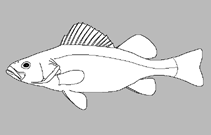
Espinas dorsales (total) : 8 - 11; Radios blandos dorsales (total) : 11 - 15; Espinas anales: 0; Radios blandos anales: 6 - 9. Differs from all members of the Etheostoma spectabile complex except E. tecumsehi in having orange belly color confluent with the anterior orange interspaces in breeding males and in having the alternating orange and blue transverse bars prominent along the entire length of the body (versus limited to posterior half) (Ref. 47261).
Body shape (shape guide): elongated.
Attains its greatest abundance in small (1-2 m wide) to medium (3-5 m wide) upland gravel and cobble streams where it is found mainly in moderately-flowing to swift shallow riffles and runs (Ref. 47261). Adults and juveniles are encountered in pools over gravel and bedrock but not as common there unless the pool is in or near a spring (Ref. 47261).
Life cycle and mating behavior
Madurez | Reproducción | Puesta | Huevos | Fecundidad | Larva
Ceas, P.A. and B.M. Burr, 2002. Etheostoma lawrencei, a new species of darter in the E. spectabile species complex (Percidae: subgenus Oligocephalus), from Kentucky and Tennessee. Ichthyol. Explor. Freshwat. 13(3):203-216. (Ref. 47261)
IUCN Red List Status (Ref. 130435: Version 2025-1)
Threat to humans
Harmless
Human uses
Herramientas
Special reports
Download XML
Fuentes de Internet
Estimates based on models
Phylogenetic diversity index (Referencia
82804): PD
50 = 0.5000 [Uniqueness, from 0.5 = low to 2.0 = high].
Bayesian length-weight: a=0.00676 (0.00301 - 0.01516), b=3.12 (2.94 - 3.30), in cm total length, based on LWR estimates for this Genus-body shape (Ref.
93245).
Nivel trófico (Referencia
69278): 3.3 ±0.5 se; based on size and trophs of closest relatives
Resiliencia (Referencia
120179): Medio, población duplicada en un tiempo mínimo de 1.4-4.4 años (tm=2).
Fishing Vulnerability (Ref.
59153): Low vulnerability (10 of 100).
🛈