Elasmobranquios (tiburones y rayas) (sharks and rays) >
Torpediniformes (Electric rays) >
Narcinidae (Numbfishes)
Etymology: lasti: Named for Dr. Peter R. Last, in recognition of his studies in the taxonomy and distribution of Australian elasmobranchs.
Eponymy: Dr Peter Robert Last is an eminent Australian ichthyologist who is the senior taxonomist and Senior Principal Research Scientist at CSIRO Marine and Atmospheric Research Hobart. [...] (Ref. 128868), visit book page.
Environment: milieu / climate zone / rango de profundidad / distribution range
Ecología
marino demersal; rango de profundidad 178 - 350 m (Ref. 75154). Tropical; 8°S - 32°S, 111°E - 132°E (Ref. 114953)
Eastern Indian Ocean: Australia (Western Australia to off the Northern Territory) and Arafura Sea (SE Indonesia, south of Tanimbar I.).
Tamaño / Peso / Age
Madurez: Lm ? range ? - 24 cm
Max length : 36.5 cm TL macho / no sexado; (Ref. 93928)
Short description
Claves de identificación | Morfología | Morfometría
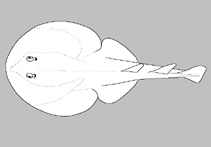
This species is distinguished by the following characters: tail length as measured from cloaca much longer than disc width or length (means: tail length 53.7% of TL, vs. disc width 40.3% of TL and disc length 42.1% TL); nasal curtain much wider than long; colour pattern dorsally uniform light yellowish-brown, which is also present over preorbital snout region, no distinctive spotting or markings over disc and tail; low and inconspicuous lateral tail ridge, not resembling a distinct fold; mean preorbital snout length just over 10% of TL (Ref. 93928).
Body shape (shape guide): other.
Usually found over sandy and muddy bottoms (Ref. 93928). Maturity size reaches at ca. 24 cm TL; born at ca. 7-8 cm TL. Biology little known (Ref. 114953).
Life cycle and mating behavior
Madurez | Reproducción | Puesta | Huevos | Fecundidad | Larva
de Carvalho, M.R. and B. Séret, 2002. Narcine lasti: a new species of numbfish from Western Australia and Indonesia (Chondrichthyes: Torpediniformes: Narcinidae). Rec. Western Australia Mus. 20:393-408. (Ref. 93928)
IUCN Red List Status (Ref. 130435: Version 2025-1)
Threat to humans
Harmless
Human uses
Herramientas
Special reports
Download XML
Fuentes de Internet
Estimates based on models
Preferred temperature (Referencia
123201): 13.2 - 17.5, mean 15.6 °C (based on 19 cells).
Phylogenetic diversity index (Referencia
82804): PD
50 = 0.5312 [Uniqueness, from 0.5 = low to 2.0 = high].
Bayesian length-weight: a=0.01175 (0.00470 - 0.02937), b=2.88 (2.66 - 3.10), in cm total length, based on LWR estimates for this (Sub)family-body shape (Ref.
93245).
Nivel trófico (Referencia
69278): 3.3 ±0.4 se; based on size and trophs of closest relatives
Resiliencia (Referencia
120179): Bajo, población duplicada en un tiempo mínimo de 4.5-14 años (Assuming fecundity<100).
Fishing Vulnerability (Ref.
59153): Low to moderate vulnerability (27 of 100).
🛈