This website uses cookies to enhance your browsing experience and ensure the functionality of our site. For more detailed information about the types of cookies we use and how we protect your privacy, please visit our Privacy Information page.
×
Cookie Settings
This website uses different types of cookies to enhance your experience. Please select your preferences below:
> Gobiiformes (Gobies) > Gobiidae (Gobies) > Gobiinae
Etymology: Trimma:Greek, trimma, -atos = something crushed (Ref. 45335); anaima:Name from the Greek 'anaimos', meaning bloodless, pallid, pale or anaemic, referring to the pale, almost washed-out colouration of the species; noun in apposition (Ref. 100726). More on author: Winterbottom.
Lingkungan: lingkungan / zona iklim / kisaran kedalaman / jangkauan distribusi Ekologi
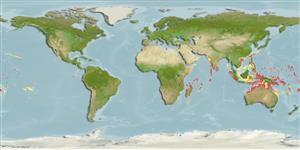
laut dasar (demersal); kisaran kedalaman 3 - 35 m (Ref. 90102). Tropical
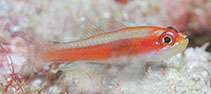
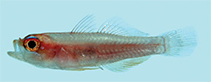
Duri punggung (Keseluruhan (total)) : 6 - 7; duri punggung lunak (Keseluruhan (total)) : 8; Duri dubur: 1; Sirip dubur lunak: 8. Distinguished by the following characters: a bony interorbital about 2/3 pupil diameter in width and only slightly concave; absence of troughs or trenches in the interorbital or posterodorsal orbital regions; unbranched fifth pelvic-fin ray, 50-60% fourth ray; epaxialis extending anteriorly to a vertical in line with the posterior margin of the orbit (Ref. 100726); no elongated spines; all pectoral rays unbranched; longitudinal scale series 23; absence of predorsal scales on midline; 1-2 deciduous scales on upper opercle; depth of body 4.0-4.1 in SL; semi-translucent pink on upper half of body (straw-yellow, translucent above midlateral septum, Ref. 100726); midlateral stripe is broad and reddish orange in color; breast and belly, white; narrow light blue lines below eye, dorsal midline of snout and behind upper rear corner of eye (Ref. 90102). Body shape (shape guide): fusiform / normal; Cross section: compressed.
Inhabits coastal reef slopes and lagoons. Found along reef margins with rubble (Ref. 48637). Also found in caves and crevices, often on drop-offs in 3-35 m (Ref. 90102). A relatively rare species in collections, usually been taken in lots of one or two specimens (Ref. 100726)..
Siklus hidup dan perilaku kawin Kematangan | Reproduksi, perkembang biakan | Pemijahan | telur-telur | Fekunditas | Larva
Winterbottom, R. and D.F. Hoese, 2015. A revision of the Australian species of Trimma (Actinopterygii, Gobiidae), with descriptions of six new species and redescriptions of twenty-three valid species. Zootaxa 3934(1):001-102. (Ref. 100726)
Status IUCN Red List (Ref. 130435: Version 2025-2 (Global))
Dinamika populasi Parameter pertumbuhan Maks. usia / ukuran Panjang-berat rel. Panjang-panjang rel. ukuran frekuensi Konversi massa pemulihan Kelimpahan
Suhu yang disukai (Acuan 123201): 26.3 - 28.9, mean 27.8 °C (based on 302 cells).
Indeks keanekaragaman filogenetik (Acuan 82804): PD50 = 0.5000 [Uniqueness, from 0.5 = low to 2.0 = high].
Bayesian length-weight: a=0.01023 (0.00477 - 0.02194), b=3.01 (2.83 - 3.19), in cm total length, based on LWR estimates for this (Sub)family-body shape (Ref. 93245).
Daya lenting (Acuan 120179): Tinggi, Waktu penggandaan populasi minimum kurang dari 15 bulan (Preliminary K or Fecundity.).
Kerentanan Penangkapan Ikan (Ref. 59153): Low vulnerability (10 of 100). 🛈