Classificatie / Namen
Lokale namen | Synoniemen | Catalog of Fishes(Genus, Soort(en)) | ITIS | CoL | WoRMS | Cloffa
>
Stomiiformes (Lightfishes and dragonfishes) >
Stomiidae (Barbeled dragonfishes) > Melanostomiinae
Etymology: Eustomias: Greek, eu = good + Greek, stoma = mouth (Ref. 45335); jimcraddocki: Named for Dr. James E. Craddock of the Woods Hole Oceanographic Institution in recognition of his many contributions to our knowledge of deep-sea fishes (Ref. 51076).
Eponymy: Dr James Edward ‘Jim’ Craddock (1937–2009) was a naturalist and ichthyologist who was Oceanographer Emeritus when he retired. [...] (Ref. 128868), visit book page.
Environment: milieu / Klimaatzone / Diepte / distribution range
Ecologie
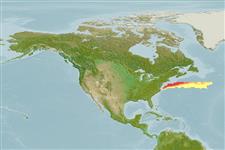
marien bathypelagisch; diepte 0 - 809 m (Ref. 51076). Deep-water; 41°N - 26°N
Northwest Atlantic: known only from slope water south of Georges Bank to the northern Sargasso Sea.
Grootte / Gewicht / Leeftijd
Maturiteit: Lm ? range ? - ? cm
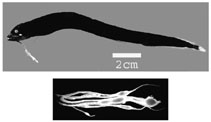
Max length : 14.3 cm SL mannelijk / geslacht onbekend; (Ref. 51076)
Korte beschrijving
Determinatiesleutels | Morfologie | Morfometrie
Dorsale zachte stralen (totaal) : 24 - 25; Anale zachte stralen: 40 - 41. Two pectoral rays (one as tiny rudiment), and a barbel with three branches arising proximal to midlength of the stem, followed by two ovoid swellings (bulbs), either contiguous or separated, and a large terminal bulb. The tear-shaped terminal bulb larger in diameter than the stem or proximal bulbs, with the acuminate end posteriad and upturned dorsally, and bears multiple filaments and bulblets in two groups, one at its anterodorsal surface and one at its terminus. Barbels relatively short (<= 20% standard length) (Ref. 51076).
Body shape (shape guide): elongated.
Probably undergoes some form of vertical migration from below 500 m during the day and within the upper 100 m at night (Ref. 51076).
Levenscyclus en paargedrag
Maturiteit | Voortplanting | Paaien | Eieren | Fecunditeit | Larven
Sutton, T.T. and K.E. Hartel, 2004. New species of Eustomias (Teleostei: Stomiidae) from the western north Atlantic, with a review of the subgenus Neostomias. Copeia 2004(1):116-121. (Ref. 51076)
Status op de Rode Lijst van het IUCN (Ref. 130435: Version 2025-1)
Gevaar voor de mens
Harmless
Gebruik door de mens
Visserij: van geen belang
Tools
Speciale rapporten
Download XML
Internetbronnen
Estimates based on models
Preferred temperature (Ref.
123201): 2.9 - 8.8, mean 3.6 °C (based on 14 cells).
Fylogenetische diversiteitsindex (Ref.
82804): PD
50 = 0.5000 [Uniqueness, from 0.5 = low to 2.0 = high].
Bayesian length-weight: a=0.00302 (0.00116 - 0.00786), b=3.12 (2.89 - 3.35), in cm total length, based on LWR estimates for this (Sub)family-body shape (Ref.
93245).
Trofisch niveau (Ref.
69278): 4.2 ±0.8 se; based on size and trophs of closest relatives
Weerstandsvermogen (Ref.
120179): Gemiddeld, minimale populatieverdubbelingstijd 1,4-4,4 jaar (Assuming tmax>3).
Fishing Vulnerability (Ref.
59153): Low vulnerability (10 of 100).
🛈