


Haplochromis paradoxus (Lippitsch & Kaufman, 2003)
Uploaden van uw Foto's en video's
Google afbeelding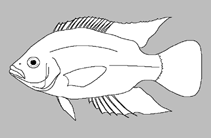 No image available for this species;
drawing shows typical species in Cichlidae.
Google afbeelding
drawing shows typical species in Cichlidae.
Classificatie / Namen Lokale namen | Synoniemen | Catalog of Fishes(Genus, Soort(en)) | ITIS | CoL | WoRMS | Cloffa
> Cichliformes (Cichlids, convict blennies) > Cichlidae (Cichlids) > Pseudocrenilabrinae
Etymology: Haplochromis: Greek, Haploos = single + Greek, chromis = a fish, perhaps a perch (Ref. 45335); paradoxus: From the Greek 'paradoxos', meaning 'contrary to expectation, incredible'; the species name is a double entendre, in reference to the strange appearance of the fishes, especially their strongly oblique gape and lower jaw, and to their seemingly paradoxical zoogeographical situation (Ref. 51927).
Etymology: Haplochromis: Greek, Haploos = single + Greek, chromis = a fish, perhaps a perch (Ref. 45335); paradoxus: From the Greek 'paradoxos', meaning 'contrary to expectation, incredible'; the species name is a double entendre, in reference to the strange appearance of the fishes, especially their strongly oblique gape and lower jaw, and to their seemingly paradoxical zoogeographical situation (Ref. 51927).
Milieu: milieu / Klimaatzone / Diepte / verspreidingsgebied Ecologie
; zoet water benthopelagisch. Tropical
Verspreiding Gebieden | FAO regio's | Ecosystemen | Voorkomen | Verspreidingskaart | Introducties | Faunafri
Grootte / Gewicht / Leeftijd
Korte beschrijving Determinatiesleutels | Morfologie | Morfometrie
Dorsale stekels (totaal) : 14 - 16; Dorsale zachte stralen (totaal) : 9 - 11; Anale stekels: 3; Anale zachte stralen: 8 - 9; Wervels: 29 - 30. Diagnosis: Haplochromis paradoxus differs from all known paedophagous species of Haplochromis of the Lake Edward system by its more numerous outer teeth, 36-65 vs. 16-35, that are strongly recurved and closely set in long tooth bands (Ref. 127594). It is further distinct from H. gracilifur and H. molossus by a longer snout, 28.7-36.0% of head length vs. 24.0-26.7% and 25.1-30.7%, respectively, and longer head, 32.2-36.2% of standard length vs. 29.8-30.7% and 29.5-32.0%, respectively (Ref. 127594). It differs from H. taurinus by its smaller eyes, 25.3-32.1% of head length vs. 32.9-40.2%, and from H. relictidens by its more slender head, 41.7-51.2% of head length vs. 47.7-54.7% (Ref. 127594). Mature males dorsally grey to bluish and ventrally intense yellow vs. different colour patterns in other paedophages (Ref. 127594). Haplochromis paradoxus can be distinguished from piscivorous sensu stricto species from Lake Edward system by its small teeth with very strongly recurved necks and short, bluntly pointed, and usually weakly tricuspid crowns vs. larger, straight to recurved, and acutely pointed teeth in piscivores; its lips are slightly thickened, and its maxillae reach posteriorly before vertical through anterior edge of eyes vs. lips are not thickened and maxilla generally exceed this point in piscivorous species (Ref. 127594). It's a haplochromine species with a strongly oblique gape and lower jaw, in connection with a pronounced concavity in the outline of the head in front of the eye (Ref. 51927). It is distinguished from members of the genus Pyxichromis by a lower body depth, 31.5-33.5% of standard length vs. 35-42%; a lower cheek, 20-24% of head length vs. 24-32%; and the dentition of the oral jaws consisting of bicuspid and tricuspid teeth in both jaws (Ref. 51927).
Body shape (shape guide): fusiform / normal.
Body shape (shape guide): fusiform / normal.
Levenscyclus en paargedrag Maturiteit | Voortplanting | Paaien | Eieren | Fecunditeit | Larven
Hoofdreferentie
Upload uw referenties | Referenties | Coördinator : Kullander, Sven O. | Medewerkers
Vranken, N., M. Van Steenberge and J. Snoeks, 2019. Grasping ecological opportunities: not one but five paedophagous species of Haplochromis (Teleostei: Cichlidae) in the Lake Edward system. Hydrobiologia 832(1):105-134. (Ref. 127594)
Status op de Rode Lijst van het IUCN (Ref. 130435: Version 2025-2 (Global))
Onvoldoende gegevens (DD) ; Date assessed: 03 March 2007
CITES
Not Evaluated
Gevaar voor de mens
Harmless
Gebruik door de mens
FAO - Publication: search | FishSource |
Meer informatie
Trofische ecologie
Voedsel (prooien)
Dieetsamenstelling
Voedselconsumptie
Voedselrantsoenen
Predatoren
Voedsel (prooien)
Dieetsamenstelling
Voedselconsumptie
Voedselrantsoenen
Predatoren
Ecologie
Ecologie
Ecologie
Populatiedynamica
Groeiparameters
Max. leeftijden / maten
Lengte-gewicht rel.
Lengte-lengte rel.
Lengtefrequenties
Massaconversie
Rekrutering
Abundantie
Groeiparameters
Max. leeftijden / maten
Lengte-gewicht rel.
Lengte-lengte rel.
Lengtefrequenties
Massaconversie
Rekrutering
Abundantie
Levenscyclus
Voortplanting
Maturiteit
Rijpheid/kieuwen rel.
Fecunditeit
Paaien
Paaibestanden
Eieren
Ontwikkeling van de eieren
Larven
Larvale populatiedynamiek
Voortplanting
Maturiteit
Rijpheid/kieuwen rel.
Fecunditeit
Paaien
Paaibestanden
Eieren
Ontwikkeling van de eieren
Larven
Larvale populatiedynamiek
Anatomie
Kieuwoppervlak
Hersenen
Otoliet
Kieuwoppervlak
Hersenen
Otoliet
Fysiologie
Lichaamssamenstelling
Voedingsstoffen
Zuurstofverbruik
Type zwemmen
Zwemsnelheid
Visuele pigmenten
Vis geluid
Ziekten en parasieten
Toxiciteit (LC50)
Lichaamssamenstelling
Voedingsstoffen
Zuurstofverbruik
Type zwemmen
Zwemsnelheid
Visuele pigmenten
Vis geluid
Ziekten en parasieten
Toxiciteit (LC50)
Genetica
genoom
Genetica
Heterozygositeit
Erfelijkheid
Genetische diversiteit
genoom
Genetica
Heterozygositeit
Erfelijkheid
Genetische diversiteit
Menselijk gerelateerd
Aquacultuursystemen
Aquacultuurprofielen
Kweeklijnen
Ciguatera gevallen
Postzegels, munten, diversen.
Aquacultuursystemen
Aquacultuurprofielen
Kweeklijnen
Ciguatera gevallen
Postzegels, munten, diversen.
Tools
Speciale rapporten
Bekijk gegevens voor het houden in een aquarium | Bekijk Fact Sheets voor de soort | Bekijk Aquacultuur Fact Sheets
Download XML
Internetbronnen
AFORO (otoliths) | Aquatic Commons | BHL | Cloffa | Websites from users | Bekijk FishWatcher | CISTI | Catalog of Fishes: Genus, Soort(en) | DiscoverLife | ECOTOX | FAO - Publication: search | Faunafri | Fishipedia | Fishtrace | GloBI | Google Books | Google Scholar | Google | IGFA World Record | OneZoom | Open Tree of Life | Otolith Atlas of Taiwan Fishes | PubMed | Reef Life Survey | Socotra Atlas | TreeBase | Tree of Life | Wikipedia: ga naar, zoek | World Records Freshwater Fishing | Zoological Record
Schattingen op basis van modellen
Fylogenetische diversiteitsindex (Ref. 82804): PD50 = 0.5000 [Uniqueness, from 0.5 = low to 2.0 = high].
Bayesian length-weight: a=0.01445 (0.00671 - 0.03113), b=2.99 (2.82 - 3.16), in cm total length, based on LWR estimates for this (Sub)family-body shape (Ref. 93245).
Trofisch niveau (Ref. 69278): 3.3 ±0.4 se; based on size and trophs of closest relatives
Weerstandsvermogen (Ref. 120179): Hoog, minimale populatieverdubbelingstijd minder dan 15 maanden (Preliminary K or Fecundity.).