Klassifizierung / Names
Namen | Synonyme | Catalog of Fishes(Gattung, Arten) | ITIS | CoL | WoRMS | Cloffa
>
Siluriformes (Catfishes) >
Pimelodidae (Long-whiskered catfishes)
Etymology: Brachyplatystoma: Greek, brachys, eia = short + Greek, platys = flat + Greek, stoma = mouth (Ref. 45335); capapretum: The name capapretum is from Portuguese. While seeking information about this undescribed species in Belém, the authors encountered only one person who distinguished the species from the similar "filhote" or "piraiba", B. filamentosum. This o.
Umwelt: Milieu / Klimazone / Tiefenbereich / Verbreitungsgebiet
Ökologie
; süßwasser benthopelagisch; tiefenbereich 5 - 10 m (Ref. 55106). Tropical
South America: Amazon River from Belém, Brazil upriver to at least Iquitos, Peru, and several large tributary rivers and lakes including Trombetas, Madeira, Negro, Manacapuru, Purus, Tefé, Juruá, Jutaí, and Içá.
Größe / Gewicht / Alter
Geschlechtsreife: Lm ? range ? - ? cm
Max length : 58.1 cm SL Männchen/unbestimmt; (Ref. 55106); max. veröff. Gewicht: 32.7 kg (Ref. 72380)
Kurzbeschreibung
Bestimmungsschlüssel | Morphologie | Morphometrie
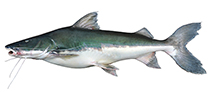
This species is distinguished by the following characters of which the first three are unique among the Pimelodidae and the last is unique among the Brachyplatystomatini: jaw teeth dimorphic with mostly fine, densely spaced outer teeth and relatively few (3-6) inner rows of slender, straight, inwardly depressible teeth; juveniles (< 200 mm SL, but some as large as 300 mm SL) marked by bold, large (twice or more times eye diameter) dark brown or gray spots centered above lateral line; ground color in preservative tan to medium brown; adults and juveniles (> ca. 200 mm SL) black to very dark gray or brown dorsally and abruptly countershaded along a horizontal from snout tip to caudal-fin base, especially along posterior half of body just above or at lateral line; ventrally it is plain white to dusky cream; most specimens with light patch anterior to upper lobe of caudal fin; caudal fin of adults is moderately to shallowly forked, lobes broad and nearly equal (Ref. 55106).
Body shape (shape guide): elongated.
Collected below 200 m asl in the Amazon mainstream and largest white and black water triburtaries; trawled 10s to 100s m off shore, on mud and sand substrates (Ref. 55106).
Lebenszyklus und Paarungsverhalten
Geschlechtsreife | Fortpflanzung | Ablaichen | Eier | Fruchtbarkeit | Larven
Lundberg, J.G. and A. Akama, 2005. Brachyplatystoma capapretum: a new species of Goliath catfish from the Amazon basin, with a reclassification of allied catfishes (Siluriformes: Pimelodidae). Copeia 2005(3):492-516. (Ref. 55106)
IUCN Rote Liste Status (Ref. 130435: Version 2025-2)
Bedrohung für Menschen
Harmless
Nutzung durch Menschen
Tools
Zusatzinformationen
Download XML
Internet Quellen
Schätzungen auf der Grundlage von Modellen
Phylogenetischer Diversitätsindex (Ref.
82804): PD
50 = 0.5078 [Uniqueness, from 0.5 = low to 2.0 = high].
Bayesian length-weight: a=0.00871 (0.00504 - 0.01504), b=3.09 (2.94 - 3.24), in cm total length, based on LWR estimates for this species & (Sub)family-body (Ref.
93245).
Trophische Ebene (Ref.
69278): 4.2 ±0.8 se; based on size and trophs of closest relatives
Widerstandsfähigkeit (Ref.
120179): mittel, Verdopplung der Population dauert 1,4 - 4,4 Jahre. (Preliminary K or Fecundity.).
Anfälligkeit der Fischerei (Ref.
59153): Moderate to high vulnerability (48 of 100).
🛈