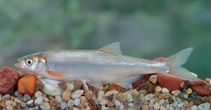
Classification / Names
Noms communs | Synonymes | Catalog of Fishes(Genre, Espèce) | ITIS | CoL | WoRMS | Cloffa
Environment: milieu / climate zone / profondeur / distribution range
Écologie
; eau douce benthopélagique. Temperate
Europe: Subalpine lakes in Danube drainage in Germany and Austria.
Taille / Poids / Âge
Maturité: Lm ? range ? - ? cm
Max length : 40.0 cm SL mâle / non sexé; (Ref. 59043)
Description synthétique
Clés d'identification | Morphologie | Morphométrie
Diagnosed from other species of the Alburnus mento species group by having 15-17½ branched anal-fin rays and 21-25 gill rakers; and the ventral keel exposed for 8-12 scales in front of the anus; up to almost 90% of the distance between the anus and the pelvic-fin base (Ref. 75106). Differs also from its congeners in Black Sea basin by the following characters: origin of anal fin about 1½ -2½ scales behind last dorsal ray; lateral line with 52-65 + 4 scales; anal fin with 15-17½ branched rays; 21-25 gill rakers; ventral keel exposed for 8-12 scales in front of anus (up to almost 90% of distance between anus and pelvic fin base); caudal peduncle depth 1.8-2.4 times in its length; and nuptial males with numerous small tubercles (Ref. 59043).
Body shape (shape guide): fusiform / normal.
Inhabit lakes. Feed on zooplankton. Undertake migration for short distances to lower reaches of tributary streams. Spawn in streams with strong current on gravel bottom, rarely along lake shores. Adults move back to lakes soon after spawning to forage. Larvae migrate downriver soon after hatching (Ref. 59043).
Life cycle and mating behavior
Maturité | Reproduction | Frai | Œufs | Fécondité | Larves
Deposits sticky eggs which adhere on pebbles or stones (Ref. 59043).
Freyhof, J. and M. Kottelat, 2007. Review of the Alburnus mento species group with description of two new species (Teleostei: Cyprinidae). Ichthyol. Explor. Freshwat. 18(3):213-225. (Ref. 75106)
Statut dans la liste rouge de l'IUCN (Ref. 130435: Version 2025-1)
Menace pour l'homme
Harmless
Utilisations par l'homme
Outils
Articles particuliers
Télécharger en XML
Sources Internet
Estimates based on models
Phylogenetic diversity index (Réf.
82804): PD
50 = 0.5000 [Uniqueness, from 0.5 = low to 2.0 = high].
Bayesian length-weight: a=0.00661 (0.00311 - 0.01404), b=3.12 (2.95 - 3.29), in cm total length, based on LWR estimates for this Genus-body shape (Ref.
93245).
Niveau trophique (Réf.
69278): 2.7 ±0.3 se; based on size and trophs of closest relatives
Résilience (Réf.
120179): Milieu, temps minimum de doublement de population : 1,4 à 4,4 années (Assuming Fec < 10,000).
Fishing Vulnerability (Ref.
59153): Moderate vulnerability (39 of 100).
🛈