>
Cypriniformes (Carps) >
Gobionidae (Gudgeons)
Eponymy: Dr Demeter (Dimitry) Beling was a German ichthyologist and hydrobiologist who was Professor of Zoology, University of Kiev and Director of the Dnieper Biological Station in the 1920s. [...] (Ref. 128868), visit book page.
Issue
Previously treated as a subspecies of Romanogobio albipinnatus (Ref. 59043).
Environment: milieu / climate zone / rango de profundidad / distribution range
Ecología
; agua dulce demersal. Temperate
Europe: Northern Black Sea basin (Dniestr, South Bug and Dniepr drainages), southern Baltic basin (Odra, Vistula), southern North Sea basin (Elbe, Rhine). Reports from Lake Ilmen and Ladoga basins are questionable.
Tamaño / Peso / Age
Madurez: Lm ? range ? - ? cm
Max length : 11.5 cm SL macho / no sexado; (Ref. 59043); edad máxima reportada: 5 años (Ref. 59043)
Short description
Claves de identificación | Morfología | Morfometría
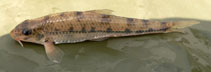
Diagnosed from its congeners in Baltic and Black Sea basins by the following characters: longitudinal epithelial crests on predorsal scales; scales on lateral line 39-42 + 2; scale rows around caudal peduncle 14-16, rarely 12; dorsal fin with 7½ branched rays; anal fin with 6½ branched rays; dorsal behind middle of body, predorsal length greater than postdorsal length; anus closer to pelvic origin than to anal origin; snout longer than or equal to postorbital distance (Ref. 59043).
Body shape (shape guide): elongated.
Inhabits bottom of moderately flowing lowland rivers and prefers sand bottom. A nocturnal species feeding on insect larvae and other larger benthic invertebrates (Ref. 59043).
Life cycle and mating behavior
Madurez | Reproducción | Puesta | Huevos | Fecundidad | Larva
Both sexes move to surface or open water to spawn (Ref. 59043). Females spawn up to 4 times during a season at about two-week intervals (Ref. 59043).
Naseka, A.M. and J. Freyhof, 2004. Romanogobio parvus, a new gudgeon from River Kuban, southern Russia (Cyprinidae, Gobioninae). Ichthyol. Explor. Freshwat. 15(1):17-23. (Ref. 52363)
IUCN Red List Status (Ref. 130435: Version 2025-1)
Threat to humans
Harmless
Human uses
Herramientas
Special reports
Download XML
Fuentes de Internet
Estimates based on models
Phylogenetic diversity index (Referencia
82804): PD
50 = 0.5000 [Uniqueness, from 0.5 = low to 2.0 = high].
Bayesian length-weight: a=0.00603 (0.00294 - 0.01235), b=3.12 (2.95 - 3.29), in cm total length, based on LWR estimates for this (Sub)family-body shape (Ref.
93245).
Nivel trófico (Referencia
69278): 3.4 ±0.4 se; based on size and trophs of closest relatives
Generation time: 1.8 ( na - na) years. Estimated as median ln(3)/K based on 1
growth studies.
Resiliencia (Referencia
120179): Alto, población duplicada en un tiempo mínimo inferior a 15 meses (Preliminary K or Fecundity.).
Fishing Vulnerability (Ref.
59153): Low vulnerability (10 of 100).
🛈