


Bedotia albomarginata Sparks & Rush, 2005
Envoyez vos Photos et vidéos
Images | Images Google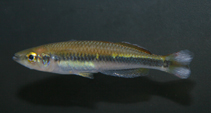 Bedotia albomarginata
Female Photo de Loiselle, P.V.
Images | Images Google
Female Photo de Loiselle, P.V.
Classification / Noms Noms communs | Synonymes | Catalog of Fishes(Genre, Espèce) | ITIS | CoL | WoRMS | Cloffa
> Atheriniformes (Silversides) > Bedotiidae (Madagascar rainbowfishes)
Etymology: Bedotia: After Maurice Bedot, 1859-1927; born in Geneva, systematist on Hydrozoan; albomarginata: The specific name is derived from the Latin 'albo' (white) and 'marginatus' (edged or bordered), in reference to the characteristic white marginal stripes present on the second dorsal and anal fin (Ref. 56501).
Eponymy: Maurice Bedot (1859–1927) was a Swiss expert on Hydrozoans. [...] (Ref. 128868), visit book page.
Etymology: Bedotia: After Maurice Bedot, 1859-1927; born in Geneva, systematist on Hydrozoan; albomarginata: The specific name is derived from the Latin 'albo' (white) and 'marginatus' (edged or bordered), in reference to the characteristic white marginal stripes present on the second dorsal and anal fin (Ref. 56501).
Eponymy: Maurice Bedot (1859–1927) was a Swiss expert on Hydrozoans. [...] (Ref. 128868), visit book page.
Environnement : milieu / zone climatique / profondeur / gamme de distribution Écologie
; eau douce pélagique. Tropical
Distribution Territoires | Zones FAO | Écosystèmes | Occurrences | Carte par point | Introductions | Faunafri
Africa: Mananara and Rienana River drainages, southeastern Madagascar (Ref. 56501).
Taille / Poids / Âge
Description synthétique Clés d'identification | Morphologie | Morphométrie
Épines dorsales (Total) : 0; Rayons mous dorsaux (Total) : 15 - 20; Épines anales: 0; Rayons mous anaux: 16 - 19; Vertèbres: 33 - 36. Body elongate and laterally compressed, particularly posteriorly (Ref. 56501). Snout elongate, dorsoventrally compressed and wide, in lateral view concave posterior to premaxillary pedicels (Ref. 56501). Eye large (Ref. 56501). Mouth large and oblique, caudal margins of maxilla and premaxilla terminate at level of vertical located at about 1/3 distance through orbit from anterior margin (Ref. 56501). First dorsal-fin origin located well posterior to vertical through pelvic-fin insertion, at about 3/4 of distance between pelvic- and anal-fin origins; with 4-6 feeble unbranched rays (Ref. 56501). Second dorsal-fin origin located well posterior to vertical through anal-fin origin, at about 1/3 distance along anal-fin base; with 11-14 rays (Ref. 56501). Flanks covered with large, regularly imbricate cycloid scales; head asquamate from tip of snout through interorbital region to posterior margin of orbit, except for single, enlarged, dorsal interorbital scale that extends anteriorly to approximately mid-orbit; cheek scaled; opercle scaled except along caudal margin, and subopercle scaled except along caudal or caudoventral margin; interopercle scaled; lacrimal and posterior margin of preopercle asquamate; 19-20 predorsal scales, and 37-38 scales in longitudinal series (Ref. 56501).
Base body coloration dark olive to dark grayish-brown dorsal of lateral midline, white or pearlescent ventral to lateral midline; prominent, wide black midlateral stripe present and continuous, some iridescent golden scales present within midlateral stripe centrally on body and dorsal to midlateral stripe posteriorly on flanks; chest and belly white or pearlescent (Ref. 56501). Males have a white margin on the second dorsal fin , and both sexes have a blotchy bright yellow, orange, or orangish-red anal fin (Ref. 56501).
Body shape (shape guide): elongated; Cross section: compressed.
Body shape (shape guide): elongated; Cross section: compressed.
Restricted to inland, generally forested, highland habitats; not collected in deforested lower reaches of Mananara or Rienana Rivers; also found in swamps, small rivers and streams that are quite shallow and that are likely subject to periodic drying or very reduced flow (Ref. 56501).
Cycle de vie et comportement reproducteur Maturité | Reproduction | Frai | Œufs | Fécondité | Larves
Référence principale
Téléchargez vos références | Références | Coordinateur | Collaborateurs
Sparks, J.S. and L.M.R. Rush, 2005. A new rainbowfish (Teleostei: Melanotaenioidei: Bedotiidae) from the southeastern highlands of Madagascar, with comments on the biogeography of Bedotia. Zootaxa 1051:39-54. (Ref. 56501)
Statut dans la liste rouge de l'IUCN (Ref. 130435: Version 2025-2 (Global))
Menacé (EN) (B1ab(iii)); Date assessed: 21 June 2016
CITES
Not Evaluated
Menace pour l'homme
Harmless
Utilisations par l'homme
FAO - Publication: search | FishSource |
Plus d'informations
Écologie trophique
Aliments (proies)
Composition du régime alimentaire
Consommation alimentaire
Rations alimentaires
Prédateurs
Aliments (proies)
Composition du régime alimentaire
Consommation alimentaire
Rations alimentaires
Prédateurs
Dynamique des populations
Paramètres de croissance
Âges / tailles maximales
Longueur-poids rel.
Rel. longueur-longueur.
Fréquences de longueurs
Conversion de masse
Recrutement
Abondance
Paramètres de croissance
Âges / tailles maximales
Longueur-poids rel.
Rel. longueur-longueur.
Fréquences de longueurs
Conversion de masse
Recrutement
Abondance
Cycle de vie
Reproduction
Maturité
Maturité/épines rel.
Fécondité
Frai
Agrégats de frai
Œufs
Développement de l'œuf
Larves
Dynamique des populations larvaires
Reproduction
Maturité
Maturité/épines rel.
Fécondité
Frai
Agrégats de frai
Œufs
Développement de l'œuf
Larves
Dynamique des populations larvaires
Anatomie
Surface branchiale
Cerveau
Otolithe
Surface branchiale
Cerveau
Otolithe
Physiologie
Composition corporelle
Nutriments
Consommation d'oxygène
Type de natation
Vitesse de nage
Pigments visuels
Son de poisson
Maladies et parasites
Toxicité (CL50)
Composition corporelle
Nutriments
Consommation d'oxygène
Type de natation
Vitesse de nage
Pigments visuels
Son de poisson
Maladies et parasites
Toxicité (CL50)
Génétique
génôme
Génétique
Hétérozygotie
Héritabilité
Diversité génétique
génôme
Génétique
Hétérozygotie
Héritabilité
Diversité génétique
Liées à l'homme
Systèmes d'aquaculture
Profils d'aquaculture
Souches
Cas de ciguatera
Timbres, pièces de monnaie, divers
Systèmes d'aquaculture
Profils d'aquaculture
Souches
Cas de ciguatera
Timbres, pièces de monnaie, divers
Outils
E-book | Guide de terrain | Générateur de fréquences de longueur | Outil de dynamique de population | Carte par point |
Capture-MSY |
Articles particuliers
Télécharger en XML
Sources Internet
AFORO (otoliths) | Aquatic Commons | BHL | Cloffa | Websites from users | FishWatcher | CISTI | Catalog of Fishes: Genre, Espèce | DiscoverLife | ECOTOX | FAO - Publication: search | Faunafri | Fishipedia | Fishtrace | GloBI | Google Books | Google Scholar | Google | IGFA World Record | OneZoom | Open Tree of Life | Otolith Atlas of Taiwan Fishes | PubMed | Reef Life Survey | Socotra Atlas | TreeBase | Arbre de Vie | Wikipedia: aller à, chercher | World Records Freshwater Fishing | Zoobank | Zoological Record
Estimations basées sur des modèles
Indice de diversité phylogénétique (Réf. 82804): PD50 = 0.5020 [Uniqueness, from 0.5 = low to 2.0 = high].
Bayesian length-weight: a=0.00389 (0.00180 - 0.00842), b=3.12 (2.94 - 3.30), in cm total length, based on all LWR estimates for this body shape (Ref. 93245).
Niveau trophique (Réf. 69278): 2.6 ±0.3 se; based on size and trophs of closest relatives