-

- Über diese Seite
- Sprachen
- Rückmeldungen der Nutzer
- Zitat
- Uploads
-
Verwandte Arten
- Arten in
Oryzias - Arten in
Adrianichthyidae - - Klassifizierung -
- Oryziinae
- Adrianichthyidae
- Beloniformes
- Teleostei
- Chordata
- Animalia
- Arten in
-



Oryzias marmoratus (Aurich, 1935)
Marmorated medaka
Hochladen Photos und videos
Bilder | Google Bild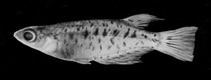 Oryzias marmoratus
Male Photo von Parenti, L.R.
Bilder | Google Bild
Male Photo von Parenti, L.R.
Klassifizierung / Names Namen | Synonyme | Catalog of Fishes(Gattung, Arten) | ITIS | CoL | WoRMS | Cloffa
> Beloniformes (Needle fishes) > Adrianichthyidae (Ricefishes) > Oryziinae
Etymology: Oryzias: Greek, oryza = rice; because of the habitat used by this fish (Ref. 45335).
Etymology: Oryzias: Greek, oryza = rice; because of the habitat used by this fish (Ref. 45335).
Umwelt: Milieu / Klimazone / Tiefenbereich / Verbreitungsgebiet Ökologie
; süßwasser benthopelagisch; pH range: 7.5 - 8.5; standorttreu. Tropical; 22°C - 25°C (Ref. 31267)
Verbreitung Territorien | FAO Gebiete | Ökosysteme | Vorkommen | Punkt Karte | Einführungen | Faunafri
Asia: Indonesia.
Größe / Gewicht / Alter
Kurzbeschreibung Bestimmungsschlüssel | Morphologie | Morphometrie
Rückenflossenweichstrahlen (insgesamt) : 9 - 10; Afterflossenweichstrahlen: 22 - 25. This species is distinguished (from O. profundicola, O. loxolepis) by the following characters: abdominal vertebrae usually 12, total vertebrae 29-31; D 9-10, A 22-25; transverse scales 10-11; body depth at anal-fin origin 24.8-30.1% SL and at dorsal-fin origin 20.2-25.3% SL; caudal peduncle length 12.0-16.3% SL; distinct nuchal concavity; lateral scales are more-or-less aligned parallel to midlateral stripe; male with elongated-shaped dorsal fin without yellow margin (Ref. 133090).
Cross section: compressed.
Cross section: compressed.
Non-annual breeder. Is very difficult to maintain in aquarium (Ref. 27139). In 2013 and 2018, the collected and observed specimens were only during the day and at TanjungTimbala, slightly south of the type locality, and at Lengkona in Lake Towuti. This species is collected with O. loxolepis and O. profundicola that form schools in gently sloping, shallow (< 1.5 m) shore areas with large boulders and submerged wood over sand and gravel. Other taxa occurring in samples included Paratherina spp., Glossogobius flavipinnis, G. intermedius, Glossogobius sp., Mugilogobius rexi, M. latifrons, and Nomorhamphus megarrhamphus. In Lake Lantoa, it inhabits gently sloping, shallow shores (1 m depth) with a large area of plants on a muddy substratum. It swims in schools and was collected in association with Telmatherina celebensis and Glossogobius sp. (an undescribed lake endemic: HK, pers. obsv.). Some individuals were infested with parasitic copepods. In Lake Mahalona, it also inhabits gently sloping, shallow shores (1 m depth) with large boulders over a sand and gravel substratum, covered with aquatic vegetation. Often, it also forms schools and co-occurring with Tominanga aurea, Glossogobius sp. (as for Lake Towuti), Glossogobius mahalonensis, G. intermedius, M. rexi, and Mugilogobius cf. hitam (Ref. 133093).
Lebenszyklus und Paarungsverhalten Geschlechtsreife | Fortpflanzung | Ablaichen | Eier | Fruchtbarkeit | Larven
Egg clusters are carried by females under the ventral fin (Ref. 26687).
Hauptreferenz
Laden Sie Ihre Referenzen hoch | Referenzen | Koordinator : Seegers, Lothar | Partner
Kottelat, M., A.J. Whitten, S.N. Kartikasari and S. Wirjoatmodjo, 1993. Freshwater fishes of Western Indonesia and Sulawesi. Periplus Editions, Hong Kong. 221 p. (Ref. 7050)
IUCN Rote Liste Status (Ref. 130435: Version 2025-2)
Gefährdung zunehmend (NT) (B1b(i,ii,iii,iv)+2b(i,ii,iii,iv)); Date assessed: 13 June 2018
CITES
Not Evaluated
Bedrohung für Menschen
Harmless
Nutzung durch Menschen
Fischereien: kommerziell; Aquarium: Kommerziell
FAO - Publication: search | FishSource |
Mehr Information
Trophische Ökologie
Lebensmittel (Beutetiere)
Nahrungszusammensetzung
Nahrungsaufnahme
Lebensmittelrationen
Räuber
Lebensmittel (Beutetiere)
Nahrungszusammensetzung
Nahrungsaufnahme
Lebensmittelrationen
Räuber
Ökologie
Ökologie
Ökologie
Populationsdynamik
Wachstumsparameter
Max. Alter/Größen
Länge-Gewicht-Rel.
Länge-Länge-Verhältnis.
Längenhäufigkeiten
Massenkonvertierung
Rekrutierung
Dichte
Wachstumsparameter
Max. Alter/Größen
Länge-Gewicht-Rel.
Länge-Länge-Verhältnis.
Längenhäufigkeiten
Massenkonvertierung
Rekrutierung
Dichte
Lebenszyklus
Fortpflanzung
Geschlechtsreife
Reifung/Kiemen rel.
Fruchtbarkeit
Ablaichen
Laichaggregationen
Eier
Eientwicklung
Larven
Larven Pop.Dyn.
Fortpflanzung
Geschlechtsreife
Reifung/Kiemen rel.
Fruchtbarkeit
Ablaichen
Laichaggregationen
Eier
Eientwicklung
Larven
Larven Pop.Dyn.
Physiologie
Körperliche Zusammensetzung
Nährstoffe
Sauerstoffverbrauch
Schwimmart
Schwimmgeschwindigkeit
Visuelle Pigmente
Fischgeräusche
Krankheiten und Parasiten
Toxizität (LC50s)
Körperliche Zusammensetzung
Nährstoffe
Sauerstoffverbrauch
Schwimmart
Schwimmgeschwindigkeit
Visuelle Pigmente
Fischgeräusche
Krankheiten und Parasiten
Toxizität (LC50s)
Genetik
Genom
Genetik
Heterozygotie
Vererbbarkeit
Genetische Vielfalt
Genom
Genetik
Heterozygotie
Vererbbarkeit
Genetische Vielfalt
Menschenbezogen
Aquakultur-Systeme
Aquakultur Profile
Zuchtlinien
Ciguatera-Fälle
Briefmarken, Münzen, Verschiedenes.
Aquakultur-Systeme
Aquakultur Profile
Zuchtlinien
Ciguatera-Fälle
Briefmarken, Münzen, Verschiedenes.
Tools
E-Book | Feldführer | Bestimmungsschlüssel | Längenhäufigkeits Tool | Lebensdaten Tool | Punkt Karte |
Catch-MSY |
Zusatzinformationen
Download XML
Zusammenfassung | Punktdaten | Namen | Photos
Internet Quellen
AFORO (otoliths) | Aquatic Commons | BHL | Cloffa | Websites from users | FishWatcher Einträge suchen | CISTI | Catalog of Fishes: Gattung, Arten | DiscoverLife | ECOTOX | FAO - Publication: search | Faunafri | Fishipedia | Fishtrace | GloBI | Google Books | Google Scholar | Google | IGFA World Record | OneZoom | Open Tree of Life | Otolith Atlas of Taiwan Fishes | PubMed | Reef Life Survey | Socotra Atlas | TreeBase | Tree of Life | Wikipedia: Gehe zu, Suchen | World Records Freshwater Fishing | Zoologischer Rekord
Schätzungen auf der Grundlage von Modellen
Phylogenetischer Diversitätsindex (Ref. 82804): PD50 = 0.5000 [Uniqueness, from 0.5 = low to 2.0 = high].
Bayesian length-weight: a=0.00479 (0.00189 - 0.01213), b=3.13 (2.91 - 3.35), in cm total length, based on LWR estimates for this (Sub)family-body shape (Ref. 93245).
Trophische Ebene (Ref. 69278): 3.4 ±0.4 se; based on size and trophs of closest relatives
Widerstandsfähigkeit (Ref. 120179): niedrig, Verdopplung der Population dauert 4,5 - 14 Jahre. (Assuming fec < 100, egg cluster of 13-15 eggs).