


Salvelinus vasiljevae Safronov & Zvezdov, 2005
Sakhalinian char
Uploaden van uw Foto's en video's
Google afbeelding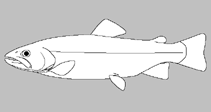 No image available for this species;
drawing shows typical species in Salmonidae.
Google afbeelding
drawing shows typical species in Salmonidae.
Classificatie / Namen Lokale namen | Synoniemen | Catalog of Fishes(Genus, Soort(en)) | ITIS | CoL | WoRMS | Cloffa
> Salmoniformes (Salmons) > Salmonidae (Salmonids) > Salmoninae
Etymology: Salvelinus: Old name for char; it is the same root of german "saibling" = little salmon (Ref. 45335); vasiljevae: Named for Ekaterina Denisovna Vasil'yeva.
Eponymy: Dr Ekaterina Denisovna Vasil’eva née Medvedeva (d: 1952) is an ichthyologist who has both Russian and US nationality. [...] (Ref. 128868), visit book page.
Etymology: Salvelinus: Old name for char; it is the same root of german "saibling" = little salmon (Ref. 45335); vasiljevae: Named for Ekaterina Denisovna Vasil'yeva.
Eponymy: Dr Ekaterina Denisovna Vasil’eva née Medvedeva (d: 1952) is an ichthyologist who has both Russian and US nationality. [...] (Ref. 128868), visit book page.
Milieu: milieu / Klimaatzone / Diepte / verspreidingsgebied Ecologie
; zoet water pelagisch. Temperate
Verspreiding Gebieden | FAO regio's | Ecosystemen | Voorkomen | Verspreidingskaart | Introducties | Faunafri
Asia: endemic to water bodies linked to Amur lagoon and Nevelskii Strait.
Grootte / Gewicht / Leeftijd
Korte beschrijving Determinatiesleutels | Morfologie | Morfometrie
Wervels: 59 - 62. Diagnosis: Lateral line 109-119 scales; gill rakers 18-22; pyloric caeca 19-24; vertebrae 59-62 (trunk 25-26, caudal 34-37); body deep, maximum depth about 30 (27.8-29.7)% fork length, minimum 8.6-11% FL; caudal peduncle short (15.8-17.9% FL); head deep, 62.5-81.3% of head length (HL), forehead wide, 15.8-17.9% HL; jaws long - upper jaw 51.6-61.1% HL and lower jaw 65.9-67.5% HL (Ref. 56657).
Body shape (shape guide): fusiform / normal.
Body shape (shape guide): fusiform / normal.
This species lives in rivers of Sakhalin from the mouth to the middle reaches. The dominant form is semi-anadromous; lagoon-river form and the riverine form are much rarer. The fish is characterized by its feeding migrations in the middle of summer and autumn; in other seasons, it remains in holes and in the lagoon. Fish ready to spawn migrate to the Amur lagoon to rivers. Some of the fish move to the lagoon from rivers of Sakhalin for feeding. In rivers of NW Sakhalin, fish reach a length of 80 cm and weigh more than 5 kilos. Biological characteristics are rarely studied: the fish mature in the rivers of Pyrki and Tengi at the age of 4+; mature individuals noted in August-October in areas with relatively rapid current and sandy or pebbled bottom in holes (up to 1.5-2 meters0, the chars may even winter here; omnivorous, feeding on fish, aerial and aquatic insects and their larvae, amphipods, on insectivorous mammals and mice (Ref. 56657).
Levenscyclus en paargedrag Maturiteit | Voortplanting | Paaien | Eieren | Fecunditeit | Larven
Hoofdreferentie
Upload uw referenties | Referenties | Coördinator | Medewerkers
Safronov, S.N. and T.V. Zvezdov, 2005. Salvelinus vasiljevae sp. nova, a new species of freshwater chars (Salmonidae, Salmoniformes) from northwestern Sakhalin. J. Ichthyol. 45(9):700-711. (Ref. 56657)
CITES
Not Evaluated
Gevaar voor de mens
Harmless
Gebruik door de mens
FAO - Publication: search | FishSource |
Meer informatie
Trofische ecologie
Voedsel (prooien)
Dieetsamenstelling
Voedselconsumptie
Voedselrantsoenen
Predatoren
Voedsel (prooien)
Dieetsamenstelling
Voedselconsumptie
Voedselrantsoenen
Predatoren
Populatiedynamica
Groeiparameters
Max. leeftijden / maten
Lengte-gewicht rel.
Lengte-lengte rel.
Lengtefrequenties
Massaconversie
Rekrutering
Abundantie
Groeiparameters
Max. leeftijden / maten
Lengte-gewicht rel.
Lengte-lengte rel.
Lengtefrequenties
Massaconversie
Rekrutering
Abundantie
Levenscyclus
Voortplanting
Maturiteit
Rijpheid/kieuwen rel.
Fecunditeit
Paaien
Paaibestanden
Eieren
Ontwikkeling van de eieren
Larven
Larvale populatiedynamiek
Voortplanting
Maturiteit
Rijpheid/kieuwen rel.
Fecunditeit
Paaien
Paaibestanden
Eieren
Ontwikkeling van de eieren
Larven
Larvale populatiedynamiek
Anatomie
Kieuwoppervlak
Hersenen
Otoliet
Kieuwoppervlak
Hersenen
Otoliet
Fysiologie
Lichaamssamenstelling
Voedingsstoffen
Zuurstofverbruik
Type zwemmen
Zwemsnelheid
Visuele pigmenten
Vis geluid
Ziekten en parasieten
Toxiciteit (LC50)
Lichaamssamenstelling
Voedingsstoffen
Zuurstofverbruik
Type zwemmen
Zwemsnelheid
Visuele pigmenten
Vis geluid
Ziekten en parasieten
Toxiciteit (LC50)
Genetica
genoom
Genetica
Heterozygositeit
Erfelijkheid
Genetische diversiteit
genoom
Genetica
Heterozygositeit
Erfelijkheid
Genetische diversiteit
Menselijk gerelateerd
Aquacultuursystemen
Aquacultuurprofielen
Kweeklijnen
Ciguatera gevallen
Postzegels, munten, diversen.
Aquacultuursystemen
Aquacultuurprofielen
Kweeklijnen
Ciguatera gevallen
Postzegels, munten, diversen.
Tools
Speciale rapporten
Bekijk gegevens voor het houden in een aquarium | Bekijk Fact Sheets voor de soort | Bekijk Aquacultuur Fact Sheets
Download XML
Internetbronnen
AFORO (otoliths) | Aquatic Commons | BHL | Cloffa | Websites from users | Bekijk FishWatcher | CISTI | Catalog of Fishes: Genus, Soort(en) | DiscoverLife | ECOTOX | FAO - Publication: search | Faunafri | Fishipedia | Fishtrace | GloBI | Google Books | Google Scholar | Google | IGFA World Record | OneZoom | Open Tree of Life | Otolith Atlas of Taiwan Fishes | PubMed | Reef Life Survey | Socotra Atlas | TreeBase | Tree of Life | Wikipedia: ga naar, zoek | World Records Freshwater Fishing | Zoobank | Zoological Record
Schattingen op basis van modellen
Fylogenetische diversiteitsindex (Ref. 82804): PD50 = 0.5000 [Uniqueness, from 0.5 = low to 2.0 = high].
Bayesian length-weight: a=0.00977 (0.00477 - 0.02003), b=3.04 (2.87 - 3.21), in cm total length, based on LWR estimates for this (Sub)family-body shape (Ref. 93245).
Trofisch niveau (Ref. 69278): 3.6 ±0.49 se; based on food items.
Weerstandsvermogen (Ref. 120179): Gemiddeld, minimale populatieverdubbelingstijd 1,4-4,4 jaar (Preliminary K or Fecundity.).