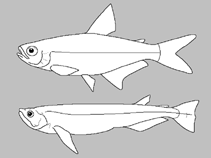
Classification / Names
Nombres comunes | Sinónimos | Catalog of Fishes(Género, Especie) | ITIS | CoL | WoRMS | Cloffa
>
Characiformes (Characins) >
Characidae (Characins; tetras) > Cheirodontinae
Etymology: Odontostilbe: Greek, odous = teeth + Greek, stilbe, es = lamp (Ref. 45335); ecuadorensis: The epithet ecuadorensis refers to the country
where the species was first discovered.
Environment: milieu / climate zone / rango de profundidad / distribution range
Ecología
; agua dulce pelágico. Tropical
South America: Ecuador and Peru on border with Ecuador. Río Napo, río Putumayo, and río Pastaza basins. The species is also recorded on lower río Napo basin in sympatry with O. fugitiva.
Tamaño / Peso / Age
Madurez: Lm ? range ? - ? cm
Max length : 4.6 cm SL macho / no sexado; (Ref. 57085); 5.0 cm SL (female)
Short description
Claves de identificación | Morfología | Morfometría
Characters that diagnose Odontostilbe ecuadorensis are: (1) upper gill rakers 5-6, lower 9-11, mostly 10-11 (vs. upper gill rakers 6-8, mostly 6-7, and lower 11-14, usually 12 in
O. fugitiva; (2) denticulation of gill rakers more numerous in O. ecuadorensis than in O. fugitiva (in specimens
larger than 32.5 mm SL), mainly on posteriormost gill raker of lower arch (5-6 denticles on basal portions of gill raker in O. ecuadorensis vs. 0-2 in O. fugitiva; (3) elongate 2nd unbranched dorsal-fin ray (vs. not elongate in O. euspilura and very short elongate in O. pulchra); (4) no hooks on unbranched pelvic-fin ray (vs. 1-2 unpaired hooks per segment on 1st unbranched pelvic-fin ray occasionally present in O. euspilura and O. pulchra); (5) 1-3 paired or unpaired hooks per segment on last unbranched anal-fin ray, and 1st to 16th anal-fin branched rays (small hooks like knots on anal-fin ray branches, usually on 10th branched fin ray and following rays) (vs. well-developed hooks on 1st to 22nd anal-fin branched rays at distal half length of fin rays in O. pulchra); and (6) usually seven large dentary teeth, with seven cusps (vs. 4 large dentary teeth with 3 large and compressed central cusps and 2, 3 lateral small cusps in O. pequira). Odontostilbe ecuadorensis differs from sympatric O. euspilura by its terminal mouth (vs. subterminal mouth).
Body shape (shape guide): elongated.
Life cycle and mating behavior
Madurez | Reproducción | Puesta | Huevos | Fecundidad | Larva
Bührnheim, C.M. and L.R. Malabarba, 2006. Redescription of the type species of Odontostilbe Cope, 1870 (Teleostei: Characidae: Cheirodontinae), and description of three new species from the Amazon basin. Neotrop. Ichthyol. 4(2):167-196. (Ref. 57085)
IUCN Red List Status (Ref. 130435: Version 2025-1)
Threat to humans
Harmless
Human uses
Herramientas
Special reports
Download XML
Fuentes de Internet
Estimates based on models
Phylogenetic diversity index (Referencia
82804): PD
50 = 0.5000 [Uniqueness, from 0.5 = low to 2.0 = high].
Bayesian length-weight: a=0.00912 (0.00401 - 0.02074), b=3.07 (2.87 - 3.27), in cm total length, based on LWR estimates for this (Sub)family-body shape (Ref.
93245).
Nivel trófico (Referencia
69278): 2.4 ±0.5 se; based on size and trophs of closest relatives
Fishing Vulnerability (Ref.
59153): Low vulnerability (10 of 100).
🛈