>
Gobiiformes (Gobies) >
Gobiidae (Gobies) > Gobiinae
Etymology: Trimma: Greek, trimma, -atos = something crushed (Ref. 45335); anthrenum: From the Greek word 'anthrene', a wild bee, wasp or hornet, referring to its aposematic coloration of yellow with black stripes.
More on author: Winterbottom.
Environment: milieu / Klimaatzone / Diepte / distribution range
Ecologie
marien rifbewoner; diepte 5 - 76 m (Ref. 57544). Tropical
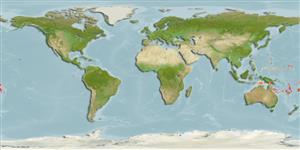
Western Pacific: Fiji and Tonga.
Grootte / Gewicht / Leeftijd
Maturiteit: Lm ? range ? - ? cm
Max length : 2.0 cm SL mannelijk / geslacht onbekend; (Ref. 57544); 2.0 cm SL (female)
Korte beschrijving
Determinatiesleutels | Morfologie | Morfometrie
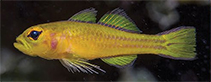
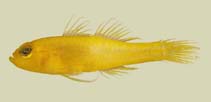
Dorsale stekels (totaal) : 7; Dorsale zachte stralen (totaal) : 8 - 9; Anale stekels: 1; Anale zachte stralen: 7 - 9. Diagnosis: Characterized by the presence of scales in the predorsal midline; second and third dorsal spines either slightly or not elongate; an unbranched fifth pelvic fin ray; both interorbital and postorbital trenches moderately well developed; and the absence of opercular scales. Scale margins of preserved specimens are very finely outlined with melanophores across the top half of the body, which is otherwise almost devoid of visible pigment cells. When alive, it has a yellow body, and the iris has a pair of blue and black triangles with their bases against the anterior and posterior margins of the pupil (giving the pupil a slit-like appearance), the posterior triangle continues anteroventrally around the pupil margin. Both living and preserved specimens have a dark basal stripe in the medial fins and a blaze of brown pigment on the upper part of the pectoral-fin base (Ref. 57544).
Body shape (shape guide): fusiform / normal.
Levenscyclus en paargedrag
Maturiteit | Voortplanting | Paaien | Eieren | Fecunditeit | Larven
Winterbottom, R., 2006. Two new species of the gobiid fish Trimma from the coral reefs of the western Pacific Ocean (Pisces; Perciformes; Gobioidei). Zootaxa 1331:55-68. (Ref. 57544)
Status op de Rode Lijst van het IUCN (Ref. 130435: Version 2025-1)
Gevaar voor de mens
Harmless
Gebruik door de mens
Visserij: van geen belang
Tools
Speciale rapporten
Download XML
Internetbronnen
Estimates based on models
Preferred temperature (Ref.
123201): 25.4 - 28.7, mean 27.3 °C (based on 124 cells).
Fylogenetische diversiteitsindex (Ref.
82804): PD
50 = 0.5000 [Uniqueness, from 0.5 = low to 2.0 = high].
Bayesian length-weight: a=0.01023 (0.00477 - 0.02194), b=3.01 (2.83 - 3.19), in cm total length, based on LWR estimates for this (Sub)family-body shape (Ref.
93245).
Weerstandsvermogen (Ref.
120179): Hoog, minimale populatieverdubbelingstijd minder dan 15 maanden (Preliminary K or Fecundity.).
Fishing Vulnerability (Ref.
59153): Low vulnerability (10 of 100).
🛈