>
Gobiiformes (Gobies) >
Gobiidae (Gobies) > Gobiinae
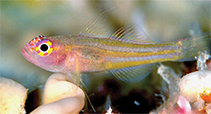
Etymology: Trimma: Greek, trimma, -atos = something crushed (Ref. 45335); preclarum: From the Latin word 'preclarus' meaning splendid ro very beautiful, referring to its color when alive, especially the multi-hued iris.
More on author: Winterbottom.
Environment: milieu / climate zone / profondeur / distribution range
Écologie
marin récifal; profondeur 10 - 60 m (Ref. 90102). Tropical
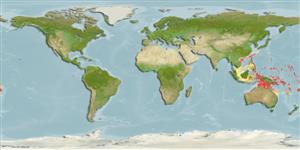
Western Pacific: Fiji, Palau, Papua New Guinea, Solomon Is., and photographed underwater in Saipan.
Taille / Poids / Âge
Maturité: Lm ? range ? - ? cm
Max length : 2.0 cm SL mâle / non sexé; (Ref. 57544)
Description synthétique
Clés d'identification | Morphologie | Morphométrie
Épines dorsales (Total) : 7; Rayons mous dorsaux (Total) : 9; Épines anales: 1; Rayons mous anaux: 8 - 9. Diagnosis: This species is characterized by the presence of predorsal scales; second and third dorsal-fin spines elongate; moderate interorbital and postorbital trenches; no opercular scales; and, scales across the top half of the body outlined with pigment. The fifth pelvic fin ray is branched sequentially once or unbranched depending on the capture location and living specimens has three yellow stripes extending along the body, two stripes in the dorsal and anal fins (one dark and one yellow) and a red or cerise iris with four large, irregularly-spaced yellow spot (Ref. 57544); characterized further by having longitudinal scale series 22-24; predorsal scales 6-9; depth of body about 4.2-4.4 in SL (Ref. 90102).
Body shape (shape guide): fusiform / normal.
Collected from a drop-off wall with a few small caves, coralline algae, antipatherians and numerous hard corals (Ref. 57544). Inhabits reef walls and rubble in 10-60 m (Ref. 90102).
Life cycle and mating behavior
Maturité | Reproduction | Frai | Œufs | Fécondité | Larves
Winterbottom, R., 2006. Two new species of the gobiid fish Trimma from the coral reefs of the western Pacific Ocean (Pisces; Perciformes; Gobioidei). Zootaxa 1331:55-68. (Ref. 57544)
Statut dans la liste rouge de l'IUCN (Ref. 130435: Version 2025-1)
Menace pour l'homme
Harmless
Utilisations par l'homme
Pêcheries: sans intérêt
Outils
Articles particuliers
Télécharger en XML
Sources Internet
Estimates based on models
Preferred temperature (Réf.
123201): 26.1 - 28.9, mean 27.9 °C (based on 170 cells).
Phylogenetic diversity index (Réf.
82804): PD
50 = 0.5000 [Uniqueness, from 0.5 = low to 2.0 = high].
Bayesian length-weight: a=0.01023 (0.00477 - 0.02194), b=3.01 (2.83 - 3.19), in cm total length, based on LWR estimates for this (Sub)family-body shape (Ref.
93245).
Résilience (Réf.
120179): Haut, temps minimum de doublement de population inférieur à 15 mois (Preliminary K or Fecundity.).
Fishing Vulnerability (Ref.
59153): Low vulnerability (10 of 100).
🛈
Nutrients (Ref.
124155): Calcium = 422 [175, 1,489] mg/100g; Iron = 1.96 [0.82, 4.41] mg/100g; Protein = 18 [16, 20] %; Omega3 = 0.183 [0.056, 0.600] g/100g; Selenium = 39.2 [11.2, 113.7] μg/100g; VitaminA = 107 [20, 547] μg/100g; Zinc = 4.93 [2.58, 8.37] mg/100g (wet weight);