Classification / Names
Populärnamn | synonymer | Catalog of Fishes(Släkte, Arter) | ITIS | CoL | WoRMS | Cloffa
>
Siluriformes (Catfishes) >
Sisoridae (Sisorid catfishes) > Glyptosterninae
Etymology: Pseudecheneis: Greek, pseudes = false + Greek, echein = to hold + Greek, nays = ship; remora, suckling fish; 1774 (Ref. 45335).
Environment: milieu / climate zone / djupintervall / distribution range
Ekologi
; sötvatten bottenlevande. Tropical
Asia: Song Thuy Loan drainage in central Viet Nam.
Size / Vikt / Age
Könsmognad: Lm ? range ? - ? cm
Max length : 5.5 cm SL hane/ej könsbestämd; (Ref. 57940)
Short description
Bestämningsnycklar | Morfologi | Morfometri
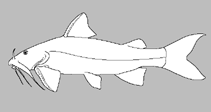
Ryggkotor: 38. Pseudecheneis maurus is distinguished from all congeners in having a shorter adipose-fin base (1.2 times length of anal-fin base vs. 1.5–2.0 times; 15.7% SL vs. 17.6–30.6), (except for P. sympelvica) thoracic adhesive apparatus with sulcae not meeting (vs. meeting) at midline and (except for P. immaculata) in lacking (vs. having) distinct pale spots on the body It further differs from P. immaculata in having a shorter pectoral fin (24.3% SL vs. 32.0) and shorter and deeper caudal peduncle (length 21.2% SL vs. 28.8; depth 6.0% SL vs. 4.0). from. It differs from P. paviei and P. sympelvica in having an elongate body with 38 vertebrae (vs. short body with 33–35 vertebrae) and from P. sympelvica in having separate (vs. fused) pelvic fins. Barbels flattened, and in four pairs. Maxillary barbel with ventral surface densely covered with papillae, and pointed tip; barbel extending about two-thirds of distance between its base and base of first pectoral-fin element. Distal half of barbel attached to snout via large, thin flap of skin. Nasal barbel with small flap of thin skin fringing posterior margin and extending midway to distance between posterior nares and anterior orbital margin. Inner mandibular-barbel densely covered with papillae; origin close to midline, extending to collar on distal margin of branchiostegal membrane. Outer mandibular barbel originating posterolateral of inner mandibular barbel, extending to level of anterior orbital margin. Eye small and almost rounded, subcutaneous and located on dorsal surface of head.Thoracic adhesive apparatus consisting of 13 transverse ridges (laminae) separated by grooves (sulcae); sulcae not meeting at midline of adhesive apparatus. Adhesive apparatus extending from immediately posterior to collar on distal margin of branchiostegal membrane to immediately posterior to level of last pectoralfin ray (Ref. 57940).
Body shape (shape guide): elongated.
Life cycle and mating behavior
Könsmognad | Reproduktion | Lek | Ägg | Fecundity | Larver
Ng, H.H. and H.H. Tan, 2007. Pseudecheneis maurus, a new species of glyptosternine catfish (Teleostei: Sisoridae) from Central Vietnam. Zootaxa 1406(1):25-32. (Ref. 57940)
IUCN Red List Status (Ref. 130435: Version 2025-1)
Threat to humans
Harmless
Human uses
Verktyg
Special reports
Download XML
Internet-källor
Estimates based on models
Phylogenetic diversity index (Ref.
82804): PD
50 = 0.5000 [Uniqueness, from 0.5 = low to 2.0 = high].
Bayesian length-weight: a=0.00589 (0.00264 - 0.01315), b=3.08 (2.88 - 3.28), in cm total length, based on LWR estimates for this (Sub)family-body shape (Ref.
93245).
Trofisk nivå (Ref.
69278): 3.1 ±0.4 se; based on size and trophs of closest relatives
Fishing Vulnerability (Ref.
59153): Low vulnerability (10 of 100).
🛈