


अपना अपलोड करें तस्वीरें और वीडियो
तस्वीरे | Google image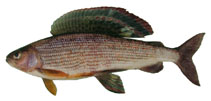 Thymallus tugarinae
चित्र स्रोत: AP Knizhin, I.
तस्वीरे | Google image
चित्र स्रोत: AP Knizhin, I.
वर्गीकरण / नाम आम नाम | उपशब्द | Catalog of Fishes(वर्ग, प्रजाति) | ITIS | CoL | WoRMS | Cloffa
> Salmoniformes (Salmons) > Salmonidae (Salmonids) > Thymallinae
Etymology: Thymallus: Greek, thymallos, -ou = a kind of fish similar to salmon (Ref. 45335); tugarinae: Named for Professor Polina Yakovlevna Tugarina, Irkutsk State University.
Eponymy: Praskov’ya (Polina) Yakovlevna Tugarina (1928–2004) was a Russian ichthyologist as well as being a ‘renowned’ researcher of the graylings of Siberia and Russia’s Far East, especially in the Lake Baikal Region. [...] (Ref. 128868), visit book page.
Etymology: Thymallus: Greek, thymallos, -ou = a kind of fish similar to salmon (Ref. 45335); tugarinae: Named for Professor Polina Yakovlevna Tugarina, Irkutsk State University.
Eponymy: Praskov’ya (Polina) Yakovlevna Tugarina (1928–2004) was a Russian ichthyologist as well as being a ‘renowned’ researcher of the graylings of Siberia and Russia’s Far East, especially in the Lake Baikal Region. [...] (Ref. 128868), visit book page.
पर्यावरण: पर्यावरण / जलवायु क्षेत्र / गहराई सीमा / वितरण सीमा पारिस्थितिकी
; स्वच्छ जल, अलवण जल पिलाजिक. Temperate
वितरण प्रदेशों | ऐफ ऐ ओ क्षेत्र | पारिस्थितिकी प्रणालियों | संयोग | बिन्दु नक्शा | भूमिका | Faunafri
Asia: Lower Amur River Basin in Russia.
आकार / वज़न / आयु
परिपक्व अवधि: Lm ? range ? - ? cm
Max length : 25.5 cm SL पुल्लिंग / अलिंग; (Ref. 57969); अधिकतम सूचित उम्र: 6 वर्षो (Ref. 92308)
Max length : 25.5 cm SL पुल्लिंग / अलिंग; (Ref. 57969); अधिकतम सूचित उम्र: 6 वर्षो (Ref. 92308)
संक्षिप्त वर्णन पहचान कुंजी | आकृति विज्ञान | मौरफोमैटरिक्स
जानवरों की रीड़ का जोड़: 49 - 55. The species is characterized by the following: Pored lateral line scales 75-91; unbranched rays in first dorsal fin 8-12, in second dorsal fin 13-17, total dorsal fin rays 23-26; number of vertebrae excluding urostyle 49-55; pyloric caeca 11-20; a wide red to maroon edging with the width 5-6 mm is seen along the upper margin of the dorsal fin, broadening towards the posterior end of the fin (in large males it may be 10 mm in width or more); below it , parallel with the edging, there are 4-5 rows (bands) of same-color spots; the upper row is slightly separated
from the edging and the bands below, and consists of the largest, slightly horizontally elongated oval spots; the lowest row of the spots, adjoined to the fin base, is weakly pronounced; bright orange sinuous stripes between the scale rows going along the body.; upper jaw overlaps with the anterior margin of the eye; length of dorsal fin base is from 25.3 to 33.3% SL; body significantly compressed laterally, its average depth is 22.9% SL; no teeth on vomer (Ref. 57969).
Body shape (shape guide): fusiform / normal.
Body shape (shape guide): fusiform / normal.
The species spawns in rivers of the Amur Basin from the middle to the end of May, 7-10 days
before the T. grubei flavomaculatus. The autumn downstream migration in tributaries of
the lower Amur takes place from September to October. The range of the food components of the Lower Amur grayling in the Anyui River in July is represented by various zoobenthos organisms. The most weight part in the food boluses of fish older than the age 3+ is
represented by mayfly and stonefly larvae, imago caddis and bugs. The composition and the frequency of occurrence of different organisms in the food boluses of the Lower Amur grayling. Comparison of the feeding spectra in the Lower Amur and yellow-spotted graylings caught in the same stations did not reveal any significant differences in the diversity of the food components (Ref. 57969).
जीवन चक्र और संभोग व्यवहार परिपक्व अवधि | पुनरुत्पत्ति | मछलीऔ का अंडे देना | अंडे | उपजाऊपन | लार्वा
मुख्य संदर्भ
अपने संदर्भ अपलोड करें | संदर्भ | संयोजक | सहयोगीयो
Knizhin, I.B., A.L. Antonov, S.N. Safronov and S.J. Weiss, 2007. New species of Grayling Thymallus tugarinae sp. nova (Thymallidae) from the Amur River Basin. J. Ichthyol. 47(2):123-139. (Ref. 57969)
CITES
Not Evaluated
मनुष्यों के लिए ख़तरा
Harmless
मानव उपयोग
FAO - Publication: search | FishSource |
अधिक जानकारी
ट्रॉफिक पारिस्थितिकी
खाद्य पदार्थ (शिकार)
संघटक आहार
आहार खपत
खाद्यान्न राशन
परभक्षी
खाद्य पदार्थ (शिकार)
संघटक आहार
आहार खपत
खाद्यान्न राशन
परभक्षी
जनसंख्या गतिशीलता
विकास मापदंड
अधिकतम आयु/आकार
लंबाई-वजन संबंध
लंबाई-लंबाई संबंध
लंबाई-आवृत्तियाँ
सामूहिक रूपांतरण
भर्ती
बहुतायत
विकास मापदंड
अधिकतम आयु/आकार
लंबाई-वजन संबंध
लंबाई-लंबाई संबंध
लंबाई-आवृत्तियाँ
सामूहिक रूपांतरण
भर्ती
बहुतायत
जीवन चक्र
पुनरुत्पत्ति
परिपक्व अवधि
परिपक्वता/गिल्स संबंध
उपजाऊपन
मछलीऔ का अंडे देना
स्पॉनिंग एकत्रीकरण
अंडे
अंडे का विकास
लार्वा
लारवल गतिकी
पुनरुत्पत्ति
परिपक्व अवधि
परिपक्वता/गिल्स संबंध
उपजाऊपन
मछलीऔ का अंडे देना
स्पॉनिंग एकत्रीकरण
अंडे
अंडे का विकास
लार्वा
लारवल गतिकी
शरीर रचना
गिल क्षेत्र
दिमाग
ओटोलिथ
गिल क्षेत्र
दिमाग
ओटोलिथ
फिजियोलॉजी
शारीरिक संरचना
पोषक तत्व
प्राणवायु की खपत
तैराकी का प्रकार
तैराकी की गति
दृश्य वर्णक
मछली की आवाज
रोग एवं परजीवी
विषाक्तता (LC50s)
शारीरिक संरचना
पोषक तत्व
प्राणवायु की खपत
तैराकी का प्रकार
तैराकी की गति
दृश्य वर्णक
मछली की आवाज
रोग एवं परजीवी
विषाक्तता (LC50s)
आनुवंशिकी
जीनोम
आनुवंशिकी
विषमयुग्मजी
हैरेटिबिलटी
आनुवंशिक विविधता
जीनोम
आनुवंशिकी
विषमयुग्मजी
हैरेटिबिलटी
आनुवंशिक विविधता
मानव संबंधी
जलकृषि प्रणालियाँ
जलीयकृषि रूपरेखाऐ
खींच
सिगुएटेरा के मामले
टिकट, सिक्के, विविध.
जलकृषि प्रणालियाँ
जलीयकृषि रूपरेखाऐ
खींच
सिगुएटेरा के मामले
टिकट, सिक्के, विविध.
साधन
ई-पुस्तक | कार्यक्षेत्र पथप्रदर्शक | लंबाई आवृति इंद्रजालिक | जीवन-इतिहास उपकरण | बिन्दु नक्शा |
कैच-एमएसवाई |
विशेष रिपोर्ट
एक्वेरियम के रखरखाव की जांच करें | प्रजातियों के तथ्य पत्रक की जाँच करें | जलीय कृषि तथ्य पत्रक की जाँच करें
XML डाउनलोड करें
सारांश पृष्ठ | बिंदु डेटा | आम नाम | तस्वीरें
इंटरनेट स्रोत
AFORO (otoliths) | Aquatic Commons | BHL | Cloffa | Websites from users | Check FishWatcher | CISTI | Catalog of Fishes: वर्ग, प्रजाति | DiscoverLife | ECOTOX | FAO - Publication: search | Faunafri | Fishipedia | Fishtrace | GloBI | Google Books | Google Scholar | Google | IGFA World Record | OneZoom | Open Tree of Life | Otolith Atlas of Taiwan Fishes | PubMed | Reef Life Survey | Socotra Atlas | TreeBase | Tree of Life | Wikipedia: Go, खोज | World Records Freshwater Fishing | Zoobank | प्राणीशास्त्रीय अभिलेख
मॉडल पर आधारित अनुमान
जातिवृति विविधता सूचकांक (संदर्भ 82804): PD50 = 0.5000 [Uniqueness, from 0.5 = low to 2.0 = high].
Bayesian length-weight: a=0.00646 (0.00351 - 0.01187), b=3.06 (2.89 - 3.23), in cm total length, based on LWR estimates for this species & (Sub)family-body (Ref. 93245).
ट्रॉफिक स्तर (संदर्भ 69278): 3.2 ±0.4 se; based on size and trophs of closest relatives
लौटाव (संदर्भ 120179): माध्यम, न्यूनतम जनसंख्या दुगनी होने का समय 1.4 - 4.4 वर्ष। (Preliminary K or Fecundity.).