>
Cypriniformes (Carps) >
Cobitidae (Spined loaches)
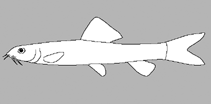
Etymology: lumbriciformis: Deriived from the Latin lumbricus (earthworm) and formis (having the form), in reference to the worm-like body of this species which is round in cross section.
Milieu: milieu / Klimaatzone / Diepte / verspreidingsgebied
Ecologie
; zoet water demersaal. Tropical
Asia: Ayeyarwaddy basin in northern Myanmar.
Grootte / Gewicht / Leeftijd
Maturiteit: Lm ? range ? - ? cm
Max length : 5.2 cm SL mannelijk / geslacht onbekend; (Ref. 57993)
Korte beschrijving
Determinatiesleutels | Morfologie | Morfometrie
Dorsale zachte stralen (totaal) : 10; Anale zachte stralen: 8; Wervels: 54 - 56. Differs from all its congeners except P. signicauda by its unusual color pattern consisting of a number of dark saddle like marks on the dorsum, a dark double spot at the caudal fin base and a horizontal stripe and a transverse subdistal band in the caudal fin, and by its total number of 54-56 vertebrae. Can be differentiated from P. signicauda by a more slender body (body depth 13.6-15.4 times in SL vs. 10.8-13.8 times in SL, ratio body depth-body width 1.2-1.5 vs. 1.6-2.2) and a more slender and less laterally compressed caudal peduncle (ratio caudal peduncle depth/width 1.1-1.3 vs. 1.5-2.0). Among other Myanmar Pangio, it is distinguished further from P. fusca and P. pangia by a narrower (caudal peduncle depth 4.8-5.0 % SL vs. 5.9-9.7) and longer caudal peduncle (caudal peduncle length 15.5-16.6 % SL vs. 9.5-12.5), from P. pangia by shorter pectoral fins (5.2-6.5 % SL vs. 8.2-9.6) and a more slender body (body depth 6.5-7.3 % SL vs. 13.5-16.3), from P. fusca by the presence of the pelvic girdle and fins (vs. absence) and the absence of a nasal barbel (vs. presence), and from P. elongata by the position of the pelvic fins (basipterygia at vertebra 29 vs. 33) (Ref. 57993).
Body shape (shape guide): elongated.
Facultative air-breathing in the genus (Ref. 126274)
Levenscyclus en paargedrag
Maturiteit | Voortplanting | Paaien | Eieren | Fecunditeit | Larven
Britz, R. and J. Maclaine, 2007. A review of the eel-loaches, genus Pangio, from Myanmar (Teleostei: Cypriniformes: Cobitidae). Ichthyol. Explor. Freshwat. 18(1):17-30. (Ref. 57993)
Status op de Rode Lijst van het IUCN (Ref. 130435: Version 2025-2)
Gevaar voor de mens
Harmless
Gebruik door de mens
Visserij: van geen belang
Tools
Speciale rapporten
Download XML
Internetbronnen
Schattingen op basis van modellen
Fylogenetische diversiteitsindex (Ref.
82804): PD
50 = 0.5000 [Uniqueness, from 0.5 = low to 2.0 = high].
Bayesian length-weight: a=0.00501 (0.00233 - 0.01079), b=3.08 (2.90 - 3.26), in cm total length, based on LWR estimates for this (Sub)family-body shape (Ref.
93245).
Trofisch niveau (Ref.
69278): 3.4 ±0.4 se; based on size and trophs of closest relatives
Weerstandsvermogen (Ref.
120179): Hoog, minimale populatieverdubbelingstijd minder dan 15 maanden (Preliminary K or Fecundity.).
Kwetsbaarheid van de visserij (Ref.
59153): Low vulnerability (10 of 100).
🛈