


Pateobatis hortlei (Last, Manjaji-Matsumoto & Kailola, 2006)
Hortle's whipray
Ajouter votre observation dans Fish Watcher
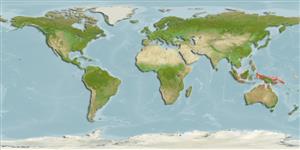
| Native range | All suitable habitat | Point map | Year 2050 |
|
| This map was computer-generated and has not yet been reviewed. |
| Pateobatis hortlei AquaMaps Data sources: GBIF OBIS |
Envoyez vos Photos et vidéos
Images Google No image available for this species;
drawing shows typical species in Dasyatidae.
Images Google
drawing shows typical species in Dasyatidae.
Classification / Noms Noms communs | Synonymes | Catalog of Fishes(Genre, Espèce) | ITIS | CoL | WoRMS | Cloffa
Élasmobranches (requins et raies) (sharks and rays) > Myliobatiformes (Stingrays) > Dasyatidae (Stingrays) > Urogymninae
Etymology: Pateobatis: Combination of Latin 'pateo' for 'lie open, be exposed' and 'batis' for skate, ray or flatfish; referring to the eclectic nature of members of this group; hortlei: Named for Kent Hortle.
Eponymy: Kent Gregory Hortle is an Australian fisheries and environmental consultant whose bachelor’s degree in zoology was awarded by Monash University, Melbourne (1979). [...] (Ref. 128868), visit book page.
More on authors: Last, Manjaji-Matsumoto & Kailola.
Etymology: Pateobatis: Combination of Latin 'pateo' for 'lie open, be exposed' and 'batis' for skate, ray or flatfish; referring to the eclectic nature of members of this group; hortlei: Named for Kent Hortle.
Eponymy: Kent Gregory Hortle is an Australian fisheries and environmental consultant whose bachelor’s degree in zoology was awarded by Monash University, Melbourne (1979). [...] (Ref. 128868), visit book page.
More on authors: Last, Manjaji-Matsumoto & Kailola.
Environnement : milieu / zone climatique / profondeur / gamme de distribution Écologie
marin; saumâtre démersal; profondeur 2 - 7 m (Ref. 58025). Tropical
Distribution Territoires | Zones FAO | Écosystèmes | Occurrences | Carte par point | Introductions | Faunafri
Western Pacific: eastern Indonesia (Irian Jaya), Papua New Guinea and northern Australia.
Taille / Poids / Âge
Maturité: Lm ? range ? - ? cm
Max length : 70.7 cm WD mâle / non sexé; (Ref. 58025); 65.4 cm WD (female)
Max length : 70.7 cm WD mâle / non sexé; (Ref. 58025); 65.4 cm WD (female)
Description synthétique Clés d'identification | Morphologie | Morphométrie
Distinguished by the following combination of characters: subcircular disc, very angular anteriorly, length 1.1 times DW; pectoral-fin apices broadly rounded; snout extremely elongate, 11-18 times orbit diameter, 96-99° angle; snout to maximum disc width 52-58% of DW; orbit very small, diameter 0.4-0.5 of spiracle length, 3.8-6.3 times in interorbital distance; mouth not greatly protrusible; prepelvic process not expanded; 1-3 enlarged, flattened, pearl-shaped mid-scapular denticles; denticles of main band in two main sizes in adults, crowns plate-like to heart-shaped; dorsal disc uniformly yellowish, brownish, or greyish; ventral surface of adults usually canary yellow in fresh material, often black around oronasal region and gill slits; pectoral fin radials 135-143; pelvic-fin radials 22-28; total vertebral centra 99-108 (Ref. 58025).
Body shape (shape guide): other.
Body shape (shape guide): other.
Demersal inshore; commonly found over shallow intertidal mud flats and in estuaries in only several metres depth. Viviparous, with histotrophy. Presumably feeds on crustaceans, molluscs and small fishes. Caught regularly, but usually avoided, by beach seine fisheries operating in intertidal habitats. Possibly adversely affected by mangrove loss. Utilized for its meat, and possibly also for its skin and cartilage. (Ref.58048).
Cycle de vie et comportement reproducteur Maturité | Reproduction | Frai | Œufs | Fécondité | Larves
Référence principale
Téléchargez vos références | Références | Coordinateur : McEachran, John | Collaborateurs
Last, P.R., M. Manjaji-Matsumoto and P.J. Kailola, 2006. Himantura hortlei n. sp., a new species of whipray (Myliobatiformes: Dasyatidae) from Irian Jaya, Indonesia. Zootaxa 1239:19-34. (Ref. 58025)
Statut dans la liste rouge de l'IUCN (Ref. 130435: Version 2025-2 (Global))
Quasi-menacé (NT) (A2cd); Date assessed: 02 February 2021
CITES
Not Evaluated
Menace pour l'homme
Harmless
Utilisations par l'homme
FAO - Publication: search | FishSource |
Plus d'informations
Écologie trophique
Aliments (proies)
Composition du régime alimentaire
Consommation alimentaire
Rations alimentaires
Prédateurs
Aliments (proies)
Composition du régime alimentaire
Consommation alimentaire
Rations alimentaires
Prédateurs
Écologie
Écologie
Écologie
Dynamique des populations
Paramètres de croissance
Âges / tailles maximales
Longueur-poids rel.
Rel. longueur-longueur.
Fréquences de longueurs
Conversion de masse
Recrutement
Abondance
Paramètres de croissance
Âges / tailles maximales
Longueur-poids rel.
Rel. longueur-longueur.
Fréquences de longueurs
Conversion de masse
Recrutement
Abondance
Cycle de vie
Reproduction
Maturité
Maturité/épines rel.
Fécondité
Frai
Agrégats de frai
Œufs
Développement de l'œuf
Larves
Dynamique des populations larvaires
Reproduction
Maturité
Maturité/épines rel.
Fécondité
Frai
Agrégats de frai
Œufs
Développement de l'œuf
Larves
Dynamique des populations larvaires
Anatomie
Surface branchiale
Cerveau
Otolithe
Surface branchiale
Cerveau
Otolithe
Physiologie
Composition corporelle
Nutriments
Consommation d'oxygène
Type de natation
Vitesse de nage
Pigments visuels
Son de poisson
Maladies et parasites
Toxicité (CL50)
Composition corporelle
Nutriments
Consommation d'oxygène
Type de natation
Vitesse de nage
Pigments visuels
Son de poisson
Maladies et parasites
Toxicité (CL50)
Génétique
génôme
Génétique
Hétérozygotie
Héritabilité
Diversité génétique
génôme
Génétique
Hétérozygotie
Héritabilité
Diversité génétique
Liées à l'homme
Systèmes d'aquaculture
Profils d'aquaculture
Souches
Cas de ciguatera
Timbres, pièces de monnaie, divers
Systèmes d'aquaculture
Profils d'aquaculture
Souches
Cas de ciguatera
Timbres, pièces de monnaie, divers
Outils
E-book | Guide de terrain | Générateur de fréquences de longueur | Outil de dynamique de population | Carte par point |
Capture-MSY |
Articles particuliers
Télécharger en XML
Sources Internet
AFORO (otoliths) | Aquatic Commons | BHL | Cloffa | Websites from users | FishWatcher | CISTI | Catalog of Fishes: Genre, Espèce | DiscoverLife | ECOTOX | FAO - Publication: search | Faunafri | Fishipedia | Fishtrace | GloBI | Google Books | Google Scholar | Google | IGFA World Record | OneZoom | Open Tree of Life | Otolith Atlas of Taiwan Fishes | PubMed | Reef Life Survey | Socotra Atlas | TreeBase | Arbre de Vie | Wikipedia: aller à, chercher | World Records Freshwater Fishing | Zoological Record
Estimations basées sur des modèles
Température préférée (Réf. 123201): 27.9 - 29.2, mean 28.8 °C (based on 264 cells).
Indice de diversité phylogénétique (Réf. 82804): PD50 = 0.5312 [Uniqueness, from 0.5 = low to 2.0 = high].
Bayesian length-weight: a=0.01023 (0.00482 - 0.02174), b=3.06 (2.86 - 3.26), in cm total length, based on LWR estimates for this (Sub)family-body shape (Ref. 93245).
Niveau trophique (Réf. 69278): 3.5 ±0.5 se; based on size and trophs of closest relatives